
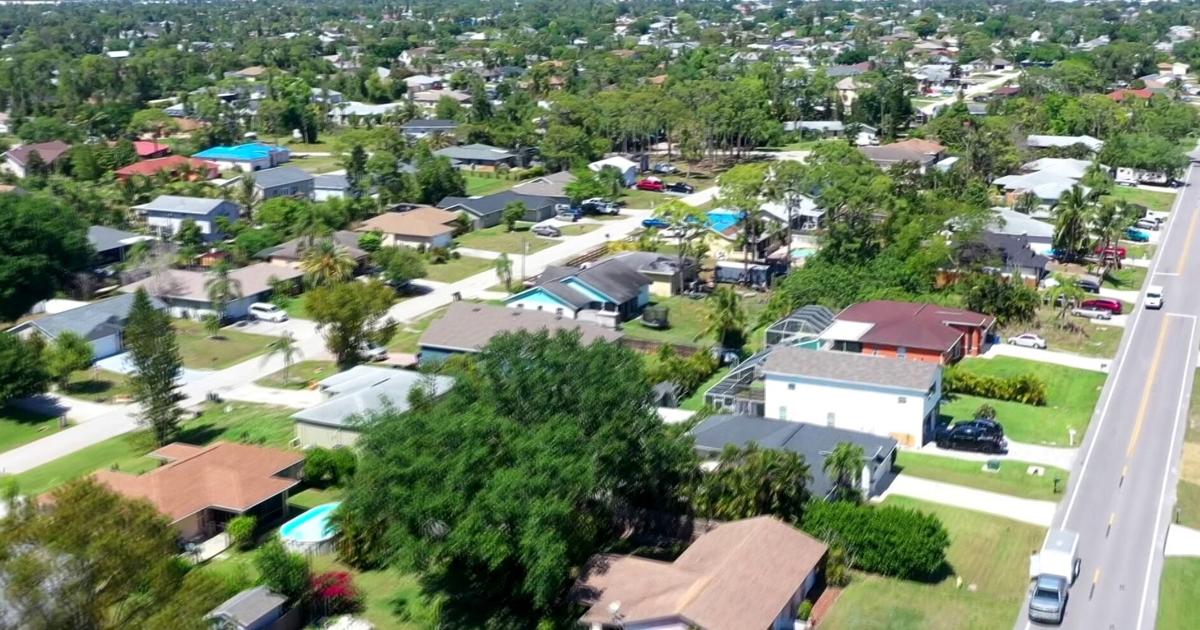

An aerial view shows a residential neighborhood in Fort Myers. Preliminary 2025 property value estimates released by the Lee County Property Appraiser’s Office indicate taxable values were flat or declined across much of Lee County, with growth concentrated in areas still recovering from Hurricane Ian.
WINK News
Lee County and its municipalities and fire districts are unlikely to see significant revenue gains from rising property values when they adopt budgets for the next fiscal year.
Taxable property values were flat or declined across most of Lee County in 2025, with the exception of Fort Myers Beach, where rebuilding efforts following Hurricane Ian continue to drive growth.
“It’s certainly down from the prior years,” Property Appraiser Matt Caldwell said.
“These estimates reflect the mixed bag of outcomes in our current market, with hurricane-damaged properties continuing to be restored and sold, while much of the overall market in 2025 was stable at best,” Caldwell said.
The property appraiser is required to release preliminary estimates by June 1, so local governments can begin preparing budgets for the fiscal year that starts Oct. 1. Final values, typically with only minor adjustments, are due July 1.
Fort Myers Beach posted a 9% increase in taxable value, the largest gain in Lee County. Much of the growth was fueled by new construction, which was 58% higher than in 2024.
Lee County, Cape Coral and Bonita Springs also recorded modest increases in taxable property values. The county’s estimated taxable value rose 2.9%, Cape Coral increased 2.4%, and Bonita Springs gained 0.98%.
Fort Myers’ taxable value was essentially flat, declining 0.15%. Estero’s taxable value fell 0.82%, while Sanibel’s dropped 1.19%.
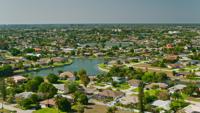
An aerial view shows a residential neighborhood in Cape Coral. Preliminary 2025 property value estimates released by the Lee County Property Appraiser’s Office show taxable property values in Cape Coral increased 2.4% from the previous year as local governments begin preparing budgets for the next fiscal year.
Getty Images
Lee County officials anticipated slower growth because existing home prices declined, County Commissioner Brian Hamman said.
“While there is going to be new construction that is taxable and that’s going to bring in some new money that we could use, we have asked everybody this year to prepare a flat budget, same dollars as they spent last year,” Hamman said.
New construction continues to contribute to the tax base, but the pace has slowed. Unincorporated Lee County added $4.7 billion in new construction to the tax rolls, $454.5 million less than in 2024. New construction also declined in Fort Myers, Cape Coral, Bonita Springs and Estero.
Fort Myers has not yet determined the impact of the newly released values, a city spokesperson said.
City managers from the municipalities were unavailable for comment June 1.
Other than Fort Myers Beach, Sanibel was the only community heavily affected by Hurricane Ian to post an increase in taxable new construction. The island added $25.2 million in new taxable property, a 68% increase from the prior year. Despite that growth, Sanibel’s overall taxable value declined 1.2%.
Sanibel Fire and Rescue District also recorded a 1.2% decline in taxable value. Iona McGregor Fire District was the only other one of Lee County’s 17 fire districts to report a decrease, with taxable values falling just under 1%.
Lehigh Acres Fire Control and Rescue District posted the largest increase at 15.4%. Other notable gains were reported by Fort Myers Beach (9.2%), Bayshore (8.75%), Upper Captiva (8.7%), Tice (7%) and Boca Grande (6.5%).
Caldwell said economic activity has improved this year compared with 2025.
“There were quarters in ’25 that were pretty puny,” he said. “This year activities have picked up a little bit over the last quarter.”
The outlook could change next year depending on the fate of a proposed constitutional amendment that would significantly reduce revenue generated through property taxes, Caldwell said.