
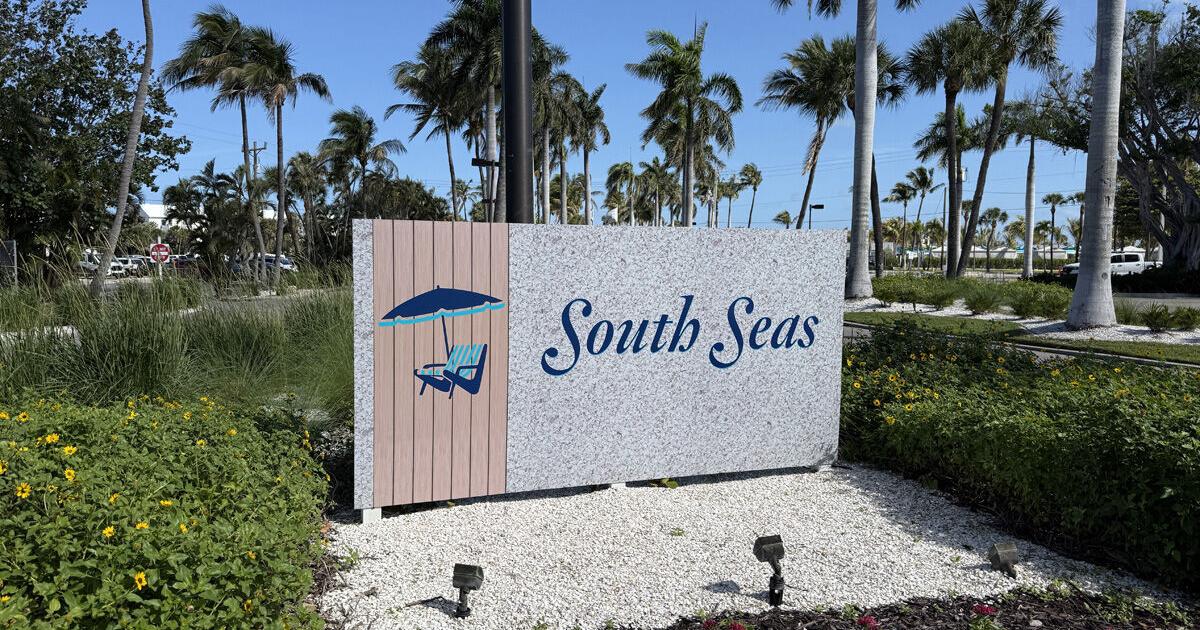

The entrance sign at South Seas Resort on Captiva Island. While a court ruling removed a decades-old density restriction, opponents continue to challenge the redevelopment through pending litigation and possible appeals.
David Dorsey
South Seas resort has cleared a legal hurdle to receive building permits for its first additional units in more than 50 years — but not quite all of the legal hurdles to build them.
A May 22 appellate court ruling in favor of Lee County and a forthcoming Sept. 3 circuit court hearing will be key to South Seas’ expansion efforts. The first ruling unlocked the door to expand; the pending decision following the Sept. 3 hearing could again close the door and relock it, pending future appeals.
South Seas, on the northern end of Captiva Island, paid a development order filing fee March 19 to build 219 hotel units across three buildings. It paid another fee April 15 to build 84 condominium units across three additional buildings amid the legal proceedings.
The Captiva Civic Association last year sued Lee County after commissioners voted 3-1 to rezone 120.5 of the resort’s 304 acres, which had allowed three units per acre since 1973. The August 2025 rezoning approved 272 multifamily units and 435 hotel rooms on the 120.5-acre portion of the property.
Judge James Shenko of Lee County Circuit Court ruled in favor of the CCA, and Lee County appealed.
Lee County hired land-use attorneys Chris Altenbernd and Eleanor Sills of Banker Lopez Gassler, based in Tampa and Tallahassee, respectively, to manage its defense, according to the judge’s filing. Gulfshore Business requested documents showing how much the defense cost Lee County taxpayers and will report the amount when it becomes available.
The CCA retained six attorneys from three law firms based in Tampa, Fort Myers and Sarasota. The CCA said it has spent about $1.3 million in legal fees and has about $500,000 in reserves.
Judge Roger Gannam of the Sixth District Court of Appeal ruled in favor of Lee County on May 22. Gannam wrote the opinion, with Judges Mary Alice Nardella and Paetra T. Brownlee concurring. Gannam wrote: “Such a settlement concession by the county was ultra vires (acting beyond legal authority), for it contracted away the exercise of its police powers.”
A 2003 settlement agreement between Lee County and the Captiva Civic Association reinforced the density limit at three units per acre, an agreement Gannam wrote was not legal.
“The agreement perpetually prohibits the county from issuing building permits beyond the historical 912-unit density limitation of SSRD, preempting the sovereign will of the county to legislate a higher density in the future by enacting new zoning or permitting ordinances,” Gannam’s opinion said.
The Captiva Civic Association has until June 8, the first business day following the 15-day legal window, to file for a rehearing with the Sixth District Court of Appeal or, afterward, appeal to the Florida Supreme Court.
But the CCA has another avenue to prevent the resort’s expansion through the Sept. 3 Lee County Circuit Court hearing before Shenko. Twelve condominium associations, eight timeshare associations, RLR Investments and Royal Shell Vacations filed the separate legal action.
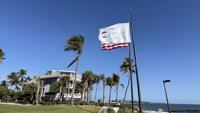
A South Seas flag flies over the Captiva Island resort, which recently won a key appellate court ruling supporting Lee County’s rezoning approval. Additional legal challenges remain before planned hotel and condominium projects can move forward.
David Dorsey
Thomas Hawkins, a law professor at the University of Florida, explained how a writ of certiorari works.
“You’re essentially asking the court to review the local government’s decision,” Hawkins said. “In that kind of litigation, you can only address three things: whether they followed the correct law, whether the decision was supported by evidence or whether they afforded procedural due process.”
As of May 27, Lee County had not issued any building permits related to the two development orders, Lee County Communications Director Betsy Clayton said.
South Seas issued a statement following the Court of Appeal’s decision, saying it clears “the way for the resort’s continued redevelopment efforts, including plans for a new hotel.”
“This decision provides important clarity regarding the resort’s long-approved redevelopment rights and allows South Seas to move forward with rebuilding and reinvesting in Captiva following the devastating impacts of Hurricane Ian,” the statement continued. “No judgment exists against South Seas, and the ruling enables Lee County to proceed with issuing building permits consistent with the county’s approved rezoning.”
South Seas called the new hotel a milestone in its long-term vision while supporting tourism, local jobs and the economic vitality of Captiva Island and Lee County.
“South Seas remains committed to responsible redevelopment that honors the island’s character and resiliency while creating the No. 1 family destination in the U.S.,” the statement concluded.
The CCA, on its affiliate website Protect Captiva, called Gannam’s ruling a misapplication of the law and said it is not finished fighting the resort’s planned expansion.
“The Appellate Court invalidated a settlement agreement that was reviewed and signed by separate attorneys for the county, CCA, South Seas, and then by a mediator and the judge — and was approved by a vote of the Board of County Commissioners at a public meeting,” the organization wrote. The ruling failed to address the Florida Constitution’s prohibition on government impairing contract rights, the CCA said.
South Seas is not finished with its expansion efforts. On March 31, the owners paid $45 million for 22 acres adjacent to the resort that belonged to the Rauschenberg Foundation.
Foley & Lardner, a law firm hired by The Ronto Group, one of the resort’s owners, created a 47-unit condominium association for 10.51 of the 22 acres on March 23 and filed it April 2 with the Lee County Clerk of Courts, naming it Sunset Drive and Wolff Way Land Condominium, records show. The name comes from a 1926 land plat with the same number of lots and the same road names.
Over time, those lots were acquired and consolidated into one parcel by the late artist Robert “Bob” Rauschenberg before ownership transferred to his namesake foundation and then was sold to the resort.
Lee County land development codes limit livable units to three per acre on that land, according to a zoning verification letter, allowing a maximum of 31 units on the 10.51-acre parcel.
The discrepancy between the 47 and 31 units could lead to additional legal hurdles for South Seas Resort, Lee County Property Appraiser Matt Caldwell said.
“What makes this interesting is Rauschenberg combined it into a single taxed parcel,” Caldwell said. “But they never vacated the plat. Their argument is they never lost the rights to all those lots. This gets right into the heart of the litigation since the state started requiring comprehensive planning and zoning in the 1970s.
“You’ve got cases like this all over the state, where you’ve got old subdivisions and modern planning, and they are not on the same page.”