
Inside Polk County’s Public-Private Microschool Partnership
The bell rings. The students shuffle in. The pressure is not the only thing making the humid open-air hallways a little uncomfortable. There are far fewer students in seats than there once were. Where did they all go?
As Florida families increasingly customize their children’s education through microschools, homeschool, charter schools, and Education Savings Accounts (ESAs), some public school districts are making an unexpected decision: instead of resisting the tide, they’re beginning to flow with it.
Nearly 30 years ago Florida embraced innovation with the opening of its very first charter school in 1996. Since then, the state has steadily positioned itself as one of the nation’s most aggressive education innovation and school choice laboratories, often serving as a beacon for educational freedom for other states to follow. That momentum accelerated in 2023 when Florida enacted universal school choice legislation, making every K–12 student in the state eligible for scholarship funding.
“Florida is leading the nation in school choice, placing the power back into the hands of parents, where it belongs,” said Commissioner of Education Manny Diaz, Jr. “Once again, Florida is at the top of the Parent Power! Index because of our commitment to providing maximum choice to Florida parents.”
According to Step Up For Students, Florida’s primary scholarship funding organization, more than 500,000 students participated in one of six scholarship programs during the 2025–26 school year. Meanwhile, 1.9 million students across the state now participate in some form of school choice, including district-operated magnet schools, charter schools, private schools, homeschooling, career academies, and microschool programs.
What, for some school districts, may feel like an unsustainable hemorrhage of exiting students prompting attempts to stop the bleeding at whatever cost, other superintendents are beginning to view this shift as a challenge, perhaps even an invitation to do what once seemed impossible . . . innovate.
In an interview discussing this exact posture adjustment, Step Up For Students journalist Ron Matus shared his perspective: “One of the most underreported and underappreciated angles to the mainstreaming of education choice in Florida is the remarkable extent to which public school districts have been part of that transformation. As charter schools and private school choice expanded during the first phase of choice, districts responded by ramping up hundreds of magnet schools, career academies, IB programs, and other high-quality choice options of their own.”
School districts are often critiqued for their inability to demonstrate flexibility without an act of Congress, and yet, somewhere between the mandates, board meetings, and budget reviews, there are leaders pushing against the grain to rewrite the narrative within the public school system.
Superintendents, often held at the mercy of their elected school boards, hope for enough support within their agendas to respond effectively to the door that exiting parents have left wide open, creating internal opportunities custom fit for families seeking something else from elsewhere.
The old adage goes, “the customer is always right,” and for the first time in a long while, we are watching the suits and ties of a mass-production model of schooling begin treating parents as such.
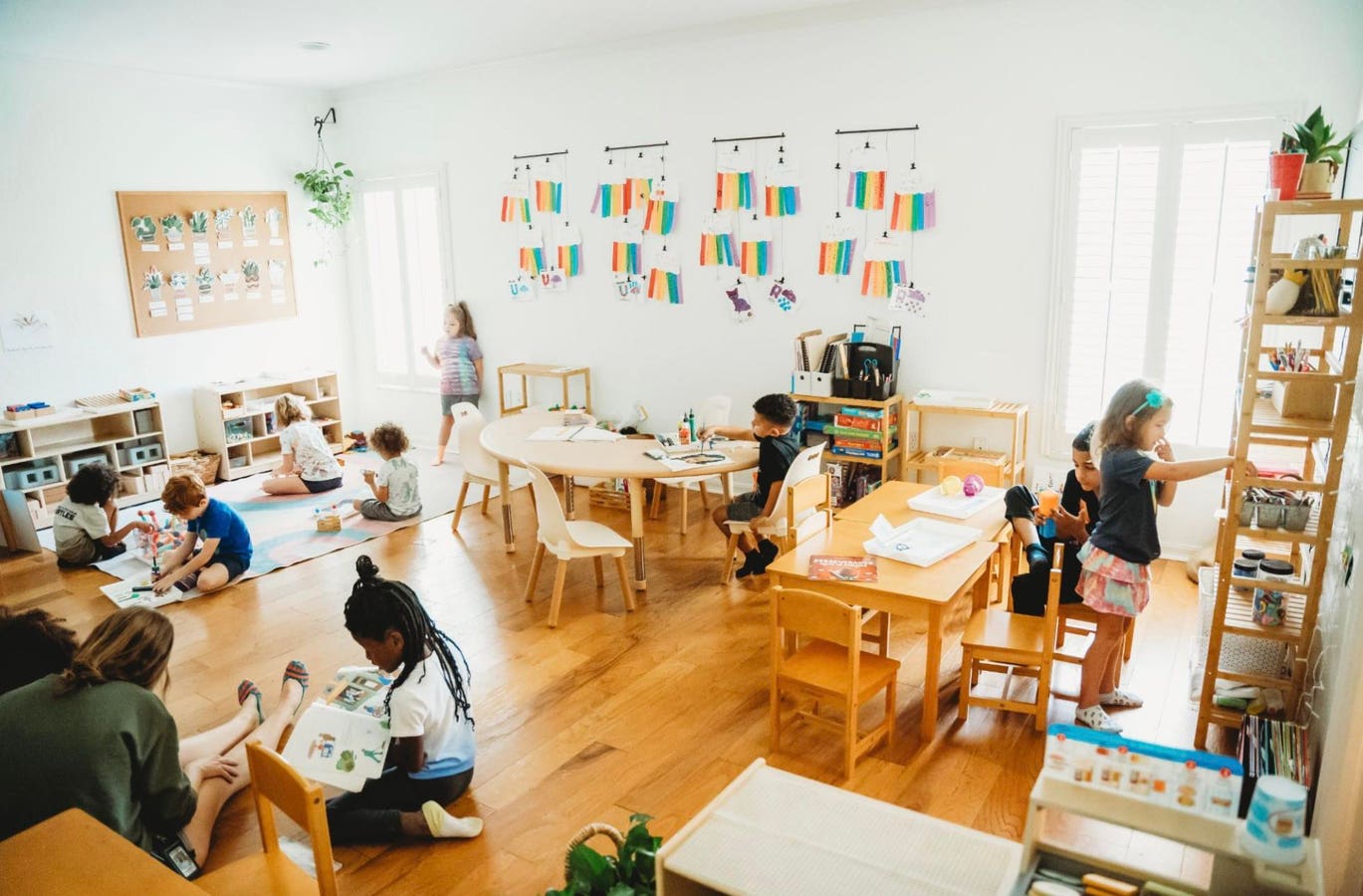
A student engages in hands-on, Reggio Emilia-inspired learning through loose parts exploration at WonderHere’s Lakeland campus; part of the child-centered approach now informing a new partnership with Polk County Public Schools.
Jordon Burk
Polk County Public Schools demonstrates a deep understanding that “one size” has never “fit all” and is determined to carve out untraditional paths for parents to find those choices within some of the otherwise emptying classrooms. Its decision to partner with WonderHere, a locally grown microschool network known for its research-based, project-driven educational methodology rooted in Reggio Emilia, Montessori, and Finnish educational principles, is just one example of this new wave of district-led educational innovation.
For more than a decade, WonderHere has operated with the belief that effective education should not cost children the simple joys of childhood: time, play, nature, rest, curiosity, and family. Through shorter academic blocks, personalized instruction, longer play periods, project-based learning, and relationship-driven environments designed to feel more like homes than institutions, the organization has spent years serving as a proof point that meaningful learning and rich childhood can and should coexist.
Now, Polk County Schools is building on its long history of educational innovation through school choice by stepping into this new public-private partnership, a new kind of risk rooted in the belief that families should have the choice . . . and that public schools should continue innovating to remain one of them.
“Families are looking for something unique, something different,” Superintendent Frederick Heid said. “Why not create that opportunity within our own system?”
Unanimously approved by the Polk County School Board in early 2026, the two-year pilot aims to bring WonderHere’s microschool-inspired approach directly into a district-operated public school classroom as a scalable innovation model.
And unlike many public-private educational relationships that operate at arm’s length, this partnership has required deep collaboration from the beginning. Meetings between the superintendent himself, district leadership, communications teams, academic officers, school administrators, and WonderHere’s executive staff have focused on everything from implementation and hiring to purchasing, training, and family communication.
As WonderHere and Polk County Public Schools work as thought partners, public school educators are being trained to lead a privately designed learning model.
And perhaps that was the point of school choice all along: not only the freedom for families to leave a system in search of a better fit, but the pressure for that very system to perhaps find its will to change.
The irony, perhaps, is that Florida’s controversial ESA expansion may ultimately benefit not only the families leaving traditional systems, but the public school system itself. In a moment when a lawsuit challenges the very existence of these programs, districts across the state are simultaneously adapting, innovating, and evolving because of them.
All eyes now turn toward districts willing to look up from what they have always done, look around at what others are doing, and decide whether they, too, are willing to make a change.