
Written by Kelly Sanchez on June 3, 2026

Advertisement
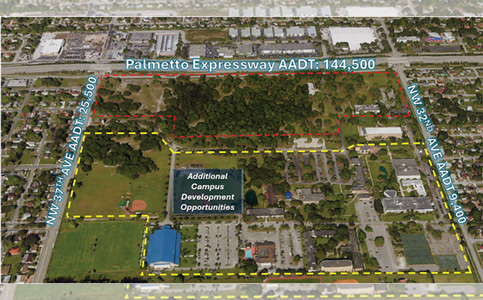
St. Thomas University has requested qualifications for a partner to develop up to 28 acres of its main campus and potentially redevelop other areas of its existing campus with a mixture of educational and commercial uses.
The campus development may include a hotel, mixed-use retail and dining, market-rate and workforce residences, student housing, and athletic and recreational amenities.
The development site between Northwest 32nd and 37th avenues is within a federally designated Opportunity Zone – a designation and program created by the Tax Cuts and Jobs Act of 2017 to spur economic growth and job creation in low-income communities while providing tax benefits to investors.
“Because of our growth over the last seven years, we are at capacity in our buildings and our housing,” said university President David Armstrong. “We’ve added over 1,000 beds since I became president to the university campus, and we need more, and probably more than we’ve had in the past… we have about 1,300 to 1,400 beds on campus, but we probably need another 1,000, and we are also looking for other opportunities for revenue….
“We are looking for developers who are willing to go into a long-term lease with the university because we won’t sell our land, we’ll always keep our land, but we would consider a long-term lease, and we’re looking for partners that will re-envision our campus, especially the frontage, which is on the Palmetto, with possibly hotel, some retail and workforce housing and student housing and any other types of facilities that can enhance our student experience and the residents’ experience.”
“For example,” President Armstrong said, “we’d like to build a natatorium. We have a national championship swimming team, but we’d also like to make sure that every child in Miami Gardens can swim by the age of 3, and so we’re looking for partners that can help us make that happen.”
“In addition,” he said, “we are looking to revitalize our campus and basically push all automobile traffic to the outside of the campus, so whether that means parking garages on the outside corners of the campus, so that we can create a pedestrian golf cart campus where people are walking and playing, enjoying the campus as a whole and not having to worry about traffic in the middle of campus.”

“We also want to see if developers would be interested in helping us build academic buildings, and so we’re leaving this wide open and telling the developers ‘Use your imagination, and let’s see what we can create.’”
Mr. Armstrong said the university is looking for a partner that helps it fund these initiatives by using its land, allowing the partner to make profit while the university gets the buildings it needs to grow its enrollment.
“The line I’ve been using is that we have an empty canvas, and let’s see how we can paint it together, because ultimately we wanted to achieve our goals to become one of the top 25 Catholic universities in the country and the great Catholic university of the South,” he said. “In order to do that, we need to have the campus to make that happen….
“We had a master plan, but we’re looking even bigger and better than our master plan to, again, move the university forward towards its goals, our strategic vision to pursue excellence, nine-year strategic vision, which we’re now in the year seven and a half, and also to enhance Miami Gardens and surrounding community.”
The estimated cost, Mr. Armstrong explained, will come down to “what is most fiscally responsible for the university and for any developers to be able to make their profit and enhance their position in the region.”
He said the university has “been getting great interest from the community and from developers across the nation” and “will probably take the month to look at who’s interested, and then we would start to glean that down to a smaller group, maybe to about 25 bids, and then eventually get it down to 10, to get it down to five, and then eventually pick the best situation, the best partner.”
“We want someone who wants to partner with the university and help us achieve our vision, and in that process, for them to have a profitable venture for their entity,” Mr. Armstrong said.
He later added that the sooner they can start, the better, but “we’re not going to do anything that will jeopardize our mission, our vision and our growth trajectory at this point, so it’s all about finding the right fit and the right partner to move us forward with the visions that we have to become the great Catholic university of the South.”