

Orlando Ballet presented a mixed repertory program — Balanchine, Godden, Gill — March 27 – 29, featuring three unique performances. (COURTESY OF ORLANDO BALLET)
Can you imagine a world without art? Without creative expression or cultural identity? Probably not, because our surroundings are immersed in it. From the fine arts to musical theater, art plays a pivotal and fundamental role in the infrastructure of our communities.
In recent years, funding cuts have rippled through the local arts ecosystem, forcing organizations to rethink accessibility. This has been an uncomfortable time for those involved in Florida’s vibrant arts and culture scene, but the community remains proactive and hopeful. Through collective philanthropic efforts, business sponsorships and grassroots fundraising, many of the groups ineligible for state funding have continued to thrive.
United Arts
The United Arts of Central Florida is an arts organization that has served as the fiscal agent for Orange County for 35 years through fundraising campaigns and advocacy. United Arts has raised approximately $203.7 million for local arts and culture organizations and awards about 125 grants to local artists and organizations each year.
Tom Hope, senior director of marketing and communications for United Arts, shared how recent budget cuts have forced local organizations to consider alternate ways to acquire funds, like private philanthropy. Nevertheless, through ongoing collaborative campaigns, United Arts continues to succeed in offering assistance to these organizations, raising over $10 million last year.
“The community is basically saying, ‘This is what we value. This is what we want,’” Hope said in an interview. “People vote with their dollars about what matters to them. So these kinds of direct appeals are probably going to be the way organizations are going to have to start operating.”
Orlando Museum of Art
Founded in 1924, the Orlando Museum of Art provides gallery tours, studio programs and workshops for adults and kids and features collections of American, African and Ancient American art. Thanks to a three-year, $400,000 grant from the Arts Bridges Foundation’s “Access For All” program, the museum offers free admission on the third Thursday of every month, attracting as many as 2,200 people in a single day, according to executive director and CEO Cathryn Mattson.
“We’re serving well over 10,000 people a year just on that one day alone, which tells you that there is a hunger for what we are providing,” Mattson said in an interview. “It’s our mission to make art available to everyone. We consider ourselves the people’s museum.”
Despite its impact on the community, OMA did not qualify for a General Program Support grant from the state in 2024. Mattson said this funding would have certainly helped, but it was not a catastrophic obstacle. She shared how OMA and most arts organizations rely primarily on county funding, business sponsorships and individual donations to fund exhibitions, programming and special events.
Within the last year, thanks to the support of donors, trustees and elected officials, the museum received $2.9 million in grants from Orange County, $2.4 million from a state appropriation for capital improvements and $530,000 from individual donors, totaling nearly $6 million. This will help with its current roof renovation and HVAC replacement projects.
Opera Orlando
Opera Orlando is a nonprofit arts organization delivering high-quality opera and educational programming to Central Florida since 2016. While the state has consistently provided funding for Opera Orlando in the past, the organization hasn’t qualified for state funding in two years and no longer budgets for it. In fact, only 10% – 15% of their budget is typically funded by Orange County and the City of Orlando.
Before state funding cuts in 2024, Opera Orlando had already budgeted for the funding they received the year prior, which totaled just under $100,000. So when news hit that they suddenly wouldn’t be receiving the expected funding, they had to consider potentially limiting programming.
However, this didn’t deter their ability to acquire necessary funds. General director Gabriel Preisser shared how Opera Orlando reached out to their donors for support, and thanks to one generous donor, they were able to fill the gap. Despite the uncertainty of accessibility to state funding, Preisser believes funding may be restored again.
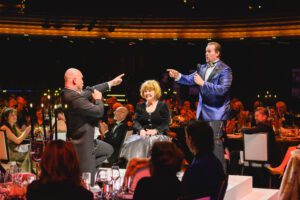
Nathan Stark (left), Margie Steinmetz (center), and Gabriel Preisser (right) perform at Opera Orlando’s “Silent Night” production at Steinmetz Hall in February. (COURTESY OF OPERA ORLANDO)
“We remain hopeful that the government leaders at the state level will realize that the arts are everywhere,” Preisser said in an interview. “We have some big advocates on our side, and things tend to ebb and flow with government elections. If [funding] doesn’t come back, I don’t think that’s the end of the arts by any means. The arts are inherently creative, and we find creative solutions to keep our audiences happy.”
Orlando Ballet
Established in 1974, Orlando Ballet is the only professional ballet company in Central Florida, serving over 42,000 people last year. It also operates the Orlando Ballet School, which offers professional training, summer intensives and youth programs to over 18,000 students.
Executive director Bradley Renner explained how despite the absence of state funding following the 2024 budget cuts, they were able to “weather the storm” by leaning into their financial reserves. Fortunately, they met the required ranking from the Florida Division of Arts & Culture for the current fiscal year. Renner said they are “blessed” to have received funding in addition to a grant from the National Endowment for the Arts.
“It’s always very disappointing whenever funding gets cut for any organization, but I think what it highlights is the importance of really making sure that you diversify your income streams,” Renner said in an interview.
For Orlando Ballet, revenue streams include their school’s tuition, their ticket sales and philanthropy. Renner said it’s necessary for organizations to inform their donor communities that “there is a greater need” for support now more than ever.
Renner championed Orlando Ballet’s ongoing commitment to diversity and inclusivity.
“We are and have always been an organization that is inclusive, and we want to celebrate everyone,” Renner said. “That is who we are — it’s what we do, and we make sure that our art reflects that.”
Orlando Family Stage
Founded a century ago, Orlando Family Stage is a professional theater company focused on empowering young people, improving wellness and mental health, fostering human connection, and actively combating the growing loneliness epidemic.
Zac Alfson, senior director of marketing for Orlando Family Stage, described the 2024 funding cuts as a “significant wake-up call.” The organization decided not to apply for state funding this past year and has been able to lean on community-based trust and investment, which has been critical to sustaining their work.
“For over a decade, we’ve worked alongside arts partners across Florida to rebuild state funding for the arts from near zero, advocating for its importance both economically and socially. To see that progress erased so quickly reinforced just how vulnerable the sector remains,” Alfson said in an email. “What’s been incredibly encouraging is how our community responded. We’ve seen a meaningful increase in individual giving and philanthropic support, with many donors expressing a desire to help us remain independent from unpredictable government funding.”
To adapt to the funding changes, Orlando Family Stage had to reduce their offerings by one production last season, while intentionally maintaining their full staff to preserve institutional knowledge and program quality. They were fortunately able to secure special funding this year and restore this production.
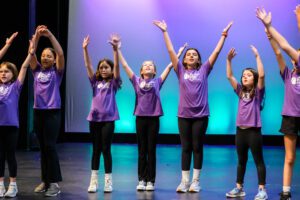
“While our programming is centered on young people, the experience is often intergenerational,” Zac Alfson, senior director of marketing at Orlando Family Stage, said in an email. “Families, caregivers, and community members all play a role in that shared experience.” (COURTESY OF ORLANDO FAMILY STAGE)
At its core, Orlando Family Stage’s priority is to minimize disruption to the families they serve and ensure their core programming remains strong and accessible. Through their ongoing support for educators throughout the state, they use theater as a tool to make learning more approachable. Additionally, in partnership with UCF’s psychology department, they actively study the impact of their work on early childhood development.
“An investment in Orlando Family Stage is an investment in Orlando’s children,” Alfson said. “The skills we help cultivate in young people today will shape the future leaders and citizens of Central Florida. The long-term, generational impact of that work is what’s truly at stake.”
Why supporting the arts matters
The arts are more than just an outlet for creative expression — they teach, heal, build empathy and fuel civic pride. Offering support now, whether through time, advocacy or monetary efforts, preserves the connectivity that makes our city uniquely vibrant.
Hope expressed how art not only impacts our economy but offers cognitive, emotional and social benefits.
“Art creates a more beautiful world, and it changes your outlook on the world,” he said. “Art is the thing that keeps you going in challenging times. It’s the difference between just surviving and living.”
Mattson said OMA is grateful for the support it has received, noting how the museum is important not only to Central Floridians but to everyone who visits our city.
“The arts are vital to any community. It’s what makes us human,” Mattson said. “Orlando is a very fast-growing city — one of the fastest in the nation. People want to come to communities where there’s a strong cultural base. It increases the vitality and attractiveness and contributes significantly to the economic well-being of a city, too.”
Preisser emphasized the significance of making art a priority because of its direct correlation to the well-being of our communities.
“Arts are proven to show mental health, physical health and quality of life improvement,” Preisser said. “So when we deprioritize the arts, we are deprioritizing ourselves and our own health.”
Renner added how it’s important to return to artistic expression in a world that is becoming more chronically online.
“Art is a reflection of who we are. It’s what makes up our cultural identity,” Renner said. “We have such access to so much content that it can almost feel overwhelming. And I think people are taking a step back and saying, ‘You know what? I want to go see a live experience.’”
Alfson shared how embracing the arts helps our communities cultivate identity, connection and belonging.
“When individuals engage with the arts, they begin to see themselves as part of something larger,” he said. “They better understand their place in the community and develop a deeper connection to the people around them. In a time when disconnection is increasingly common, that sense of belonging is essential to building a healthy, vibrant and resilient city.”