
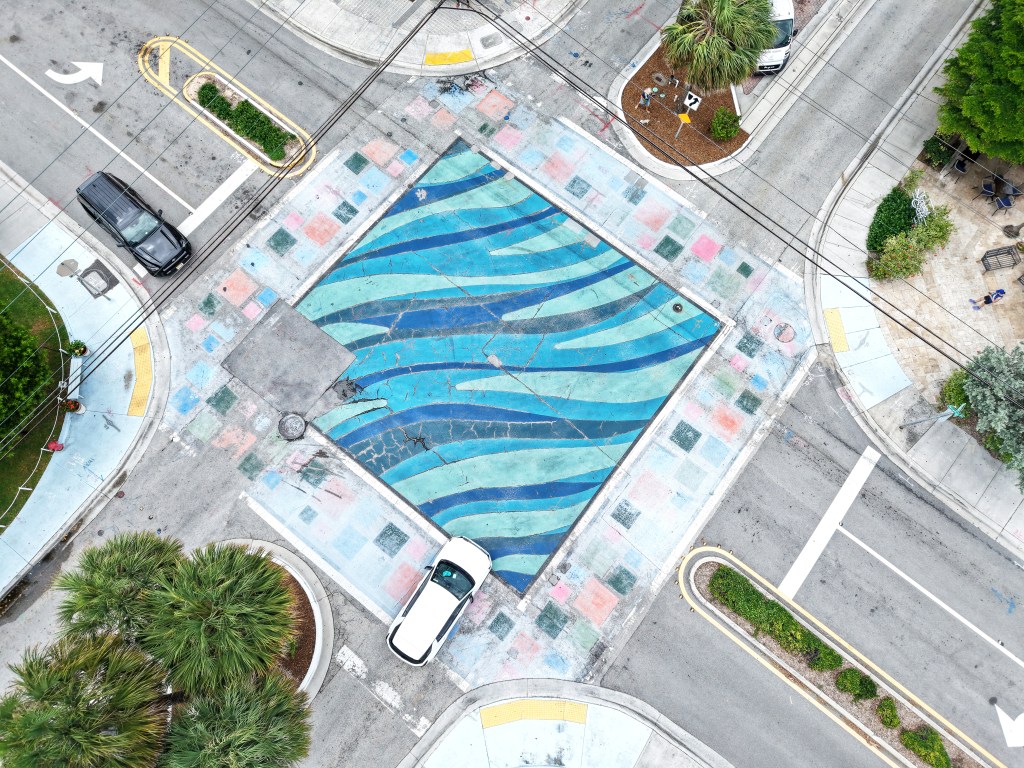
Fort Lauderdale, the lone city battling to keep its street art amid a statewide ban put in place last year, edged closer to the finish line after arguing its case during a hearing Wednesday.
Street art from Key West to Orlando disappeared after the Florida Department of Transportation said the street art designs had to go because they were distracting to drivers and posed a safety risk.
Critics argued that it was all a thinly veiled attack on the state’s LGBTQ community.
Fort Lauderdale’s street art would have been gone months ago if commissioners had bowed to a statewide crackdown.
But if the city loses its fight, its street art will disappear too.
On Wednesday, attorneys for both sides argued their points before a state administrative law judge.
The judge, Jodi-Ann Livingstone, told the attorneys she plans to issue a written order within 30 days.
Fort Lauderdale commissioners held a closed-door hearing Tuesday afternoon to discuss the case.
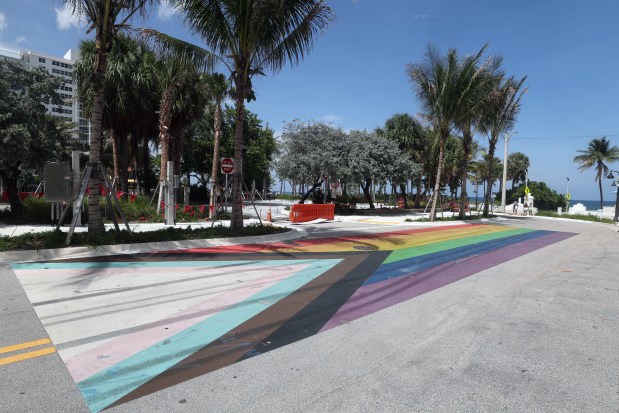 A rainbow street painting remains on Sebastian Street in Fort Lauderdale on Tuesday. (Mike Stocker/South Florida Sun Sentinel)
Mayor Dean Trantalis has historically declined to comment on the litigation.
“I’m asked not to comment on matters that are currently in litigation,” Trantalis said Wednesday. “Nonetheless, I remain hopeful that we will be able to achieve a solution that is consistent with the law and remains respectful of the wishes of the community.”
In August, the state sent letters to Fort Lauderdale listing 11 intersections with street art, including an LGBTQ-themed rainbow mural on Sebastian Street at the beach.
One street-art display ordered for removal — at Las Olas Boulevard and Southeast Third Avenue — had already been painted over as part of an intersection improvement project by the county.
The apparent goof had one city commissioner questioning how the state was coming up with its list of forbidden street art.
“I would like to know who’s putting these lists together,” Commissioner Steve Glassman said at the time. “Who are these street art police? And where are they getting their information? They’re citing street art that no longer exists or has even been recognized for improving pedestrian safety.”
It was unclear how that particular intersection wound up on the state’s list.
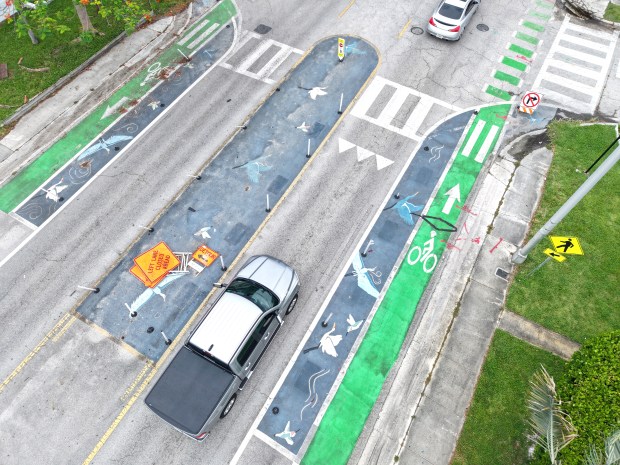 Street art is on display along Northeast 15th Avenue and 11th Street in Fort Lauderdale on Wednesday. (Carline Jean/South Florida Sun Sentinel)
On Wednesday, the state argued it reviewed each and every intersection before sending out its order.
Alex Fumagali, attorney for the state, pointed to testimony from Chief Engineer of Operations Rudy Powell saying the state conducted its own individual review of each location.
Fumagali argued that the state had not created a new policy but merely highlighted policy that already exists — as stated in Powell’s testimony.
Attorney Jeremy Rosner, representing the city, argued that the statewide ban on street art represented a “seismic shift” in Florida Department of Transportation policy.
For years, street art had been allowed as long as it did not interfere with traffic markings, Rosner said.
A new policy adopted in March 2025 was meant to prohibit future street art, Rosner added.
But in August 2025, the transportation agency adopted a new policy categorically prohibiting surface art in existing installations and seeking removal of existing street art without exception, Rosner said.
He argued that the change qualified as an invalid unadopted rule — an agency policy that acts like a regulation without going through the state’s formal rulemaking process.
Fumagali countered that the state has the right to require a traffic signal installed 20 years ago to be replaced if it no longer met current standards.
“Pavement markings are no different,” Fumagali said.
Susannah Bryan can be reached at sbryan@sunsentinel.com. Follow me on X @Susannah_Bryan