
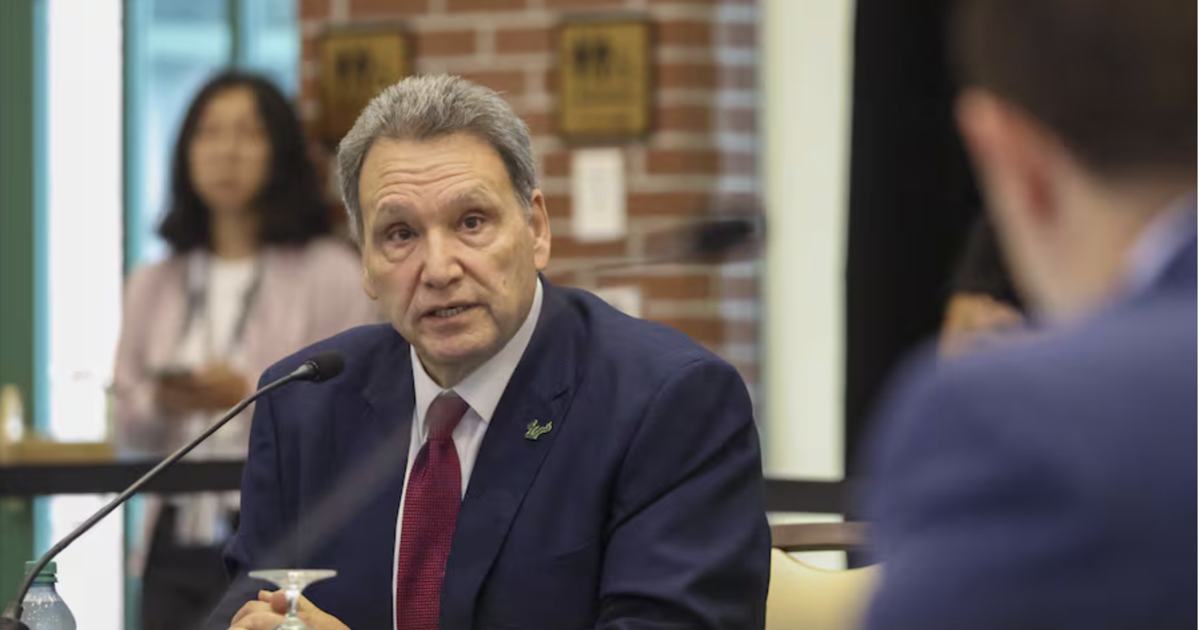
Moez Limayem, former dean of the University of South Florida’s Muma College of Business, is set to return as its next president.
USF’s trustees approved Limayem earlier in October, and the Florida Board of Governors is expected to confirm his appointment in early November.
Unlike Santa Ono, who faced political backlash after the trustees at the University of Florida approved him for its president, Limayem has encountered no opposition. Having already been vetted by the board during his appointment as the University of North Florida president, his confirmation should be smooth.
If confirmed, Limayem will guide USF through a pivotal time as it faces political pressures in higher education and seeks to boost its standing in the Association of American Universities, which it joined two years ago.
Here are some of the biggest issues awaiting Limayem.
Faculty turnover, discontent
A recent faculty survey conducted by the American Association of University Professors, found that more than a third of Florida professors are looking for jobs outside the state. Many cited concerns about academic freedom, cuts to diversity programs and pay.
Steve Lang, the president of USF’s faculty union, said professors on campus feel similarly. Some faculty members said at a listening session over the summer that they wanted a president who would protect academic freedom, noting it is crucial to retaining professors.
Frustration is growing because the faculty union has been bargaining with the university for a year and a half and has not reached a contract, Lang said.
He said this limbo can discourage faculty from other universities who apply to USF, because it often means stagnant, low salaries. About 10% of junior faculty have left USF every year this decade, Lang said.
Supporting younger faculty members is important, Limayem said in a series of public forums earlier this month. Every time a junior faculty member does not achieve tenure, the university has failed, he said.
Faculty impressions of Limayem are mixed so far, Lang said. Some are hopeful and waiting to see what he does as president. Lang said some faculty disagreed with positions he took at the Muma College of Business, including on the impact of teacher workloads.
Lang said he’s glad Limayem, a former business and information systems professor, is an academic, not a politician.
“He knows how tenure works,” Lang said. “He knows how assignments work. He knows how scholarships and service works in the academic world. He’s been there. That’s good. Now, can he turn that into a conversation between him and the Board of Trustees so that we can get a contract?”
Funding cuts, fundraising’s future
Federal and state funds for public universities will likely remain unstable — or drop further — if the federal shutdown drags on to next semester.
USF appeared in Gov. Ron DeSantis’ list of budget vetoes over the last few years. In 2022, the university lost out on $75 million for a new environmental and oceanographic sciences center. DeSantis’ most recent veto list included cutting nearly $4 million for a program training medical students to treat opioid overdoses.
At the same time, USF has set an ambitious goal: hitting $1 billion in research funding by 2030. Last year, USF achieved $738 million in research funding, and nearly 60% of that money was from federal sources.
Limayem said the way to keep funding up is through partnerships with organizations in Tampa Bay. It’s also by building relationships with private donors, he said.
Performance-based funding and fundraising in general were lacking when he got to UNF, Limayem said. He said the past two years, though, have seen the school’s highest fundraising levels.
The role of a president is much more outward-facing than it was a few decades ago because states are providing less funding, said Judith Wilde, a professor at George Mason University who studies presidential searches. A university president spends a lot of their job connecting with donors and other organizations while the provost might focus more on academics, she said.
Wilde said Limayem’s fundraising expertise was likely a reason he was selected.
Politics and free speech
Higher education has become increasingly political. In Florida, the DeSantis-appointed Board of Governors approved a handful of university presidents in the last year, many of whom have ties to Tallahassee.
Jeanette Nuñez, DeSantis’ former lieutenant governor, became Florida International University’s president over the summer. Marva Johnson, a former chairperson on the State Board of Education, was appointed as president of Florida A&M University. Manny Diaz Jr., the state’s former education commissioner, took over as the president of University of West Florida in May.
And two years ago, former House Speaker Richard Corcoran took the president’s seat at New College of Florida, working with DeSantis-appointed trustees to overhaul the school’s academic and cultural identity.
This fall, the state university system also encouraged presidents to investigate faculty who posted disparaging comments about Charlie Kirk’s assassination. Another flashpoint in the debate over free speech on college campuses, pro-Palestinian demonstrations, has not been forgotten.
Tampa Bay Students for a Democratic Society filed a lawsuit in early October against USF, alleging the university violated the group’s equal access to education and rights to free speech. The lawsuit claims the university published defamatory materials about the organization and created arbitrary policies that target pro-Palestine demonstrations. The group has been banned from campus since the encampment.
Limayem said in public forums that anyone at the university should be able to share their thoughts without fear for their safety. He said students need to learn to listen to those with other viewpoints.
Wilde said Limayem may have to make difficult decisions as president that put him between faculty and DeSantis. Ralph Wilcox, a former provost at USF and professor at the Judy Genshaft Honors College, said Limayem has built strong ties with elected officials across the state. Limayem himself touts his relationships with members of the board.
“Are people going to look more askance at him,” Wilde said, “because they know he’s going to have to follow, in all likelihood, the governor’s political moves with regard to universities?”
Development and USF’s next mission
Lang said former President Judy Genshaft and Wilcox communicated one main goal that they wanted faculty to share: to become a part of the Association of American Universities.
Now that the university achieved that status, Lang said he feels the university is lacking a mission. He said USF has recently focused on the football stadium and the Fletcher District.
USF trustees approved $407 million to the stadium project this year, which includes construction and infrastructure like green space, a roadway plaza and walkway improvements. Construction is underway and its set to be ready for the start of the 2027 season.
The Fletcher District, a controversial development pending approval by the board, would develop USF’s shuttered golf course into housing, a hotel, a conference center, green space and an academic building. Some groups and nearby residents are concerned the development poses wastewater, stormwater and other environmental threats for the adjacent forest preserve.
For Lang, neither project has much to do with supporting faculty and academics. Limayem has said athletics is tied to student success. His business expertise makes him uniquely qualified to handle the stadium development, corporate sponsorships and matters around name, image and likeness, Wilcox said.
The university’s medical and technology programs are also growing, Lang said. He pointed to the Bellini College of Artificial Intelligence, Cybersecurity and Computing, which started enrolling students this fall. The university received a $40 million dollar donation for the college in the spring, the largest gift in USF’s history.
Limayem said he’s confident USF can move from a rookie member of the Association of American Universities to a leader among the group.
“Universities all over the world will come right here to USF to see how we do it,” he said. “I think we have what it takes.”
But if USF wants to attract great scholars from the Massachusetts Institute of Technology, Stanford University and University of California Berkeley, Lang said, it’s going to need to either have laboratories or paychecks.
“Faculty want a compass, a vision that has more to do with the students and the community and the state that we live in,” he said. “I’m wondering if (Limayem) is going to do that.”