
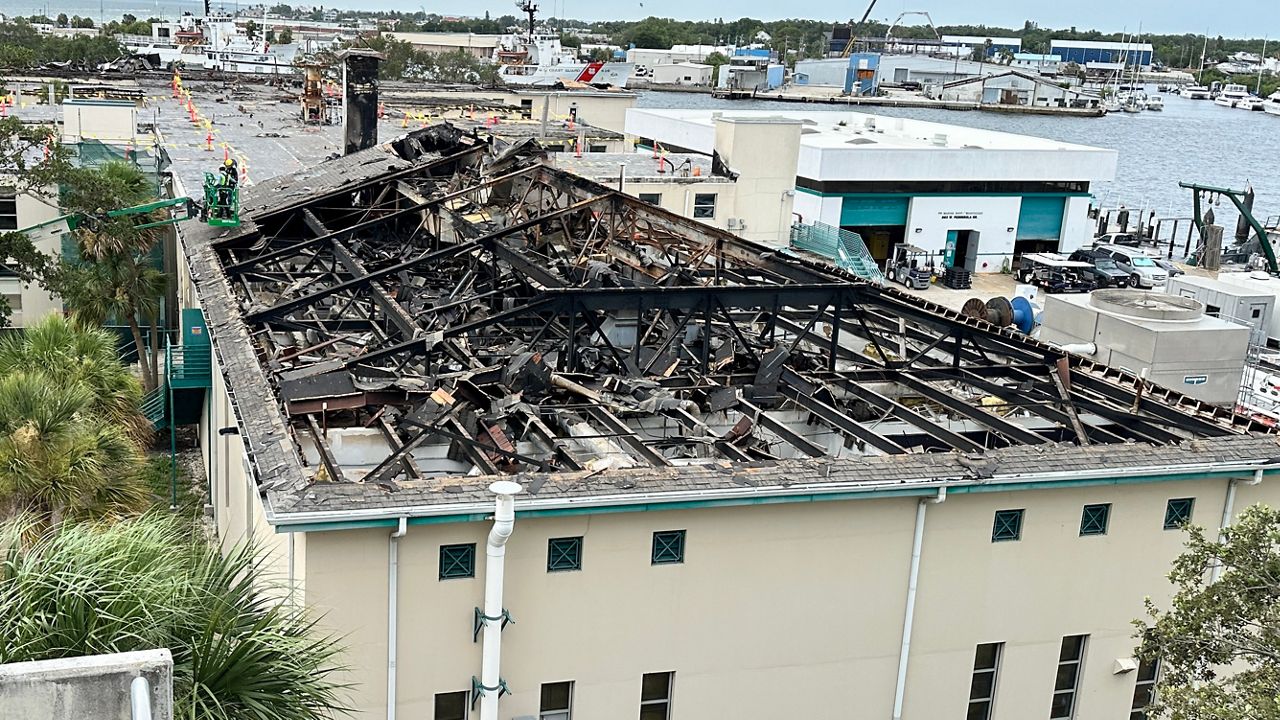
ST. PETERSBURG, Fla. — More samples than expected have been recovered from the College of Marine Science Lab on the University of South Florida St. Petersburg campus, which was destroyed by a large fire last month, according to Dean Tom Frazer.
“We feel really good about many of those samples,” Frazer said. “We can use them for their intended purpose moving forward.”
Frazer said crews were able to recover 37 freezers, 34 of which were still fully operational. Those samples have been secured in three portable trailer freezers on campus.
Biological Oceanography Professor Steve Murawski said while the samples appear to be in good condition, they need to be tested for viability.
“We’ve got the samples, but we have no way to analyze them,” Murawski said. “Our biggest need right now are for two instruments… we need to analyze all these samples for all kinds of contaminants.”
Master’s student Layne Leggett, 24, was halfway through her study analyzing barnacles from Tampa Bay for contaminants when the fire broke out. Leggett was worried all of her samples went up in flames but has been relieved to learn her samples survived the fire.
“Now we have to figure out if those items were contaminated with the smoke and water,” Leggett said. “The samples that were in the freezer and also samples that I had in dry storage did come out. And there is hope that those can be analyzed for the study.”
Many of the samples have been collected from around the world for USF’s globally recognized research. Professor Murawski said his samples from Tampa Bay and the Gulf go back 15 years to the Deepwater Horizon oil spill.
“Anytime there’s an oil spill in the Gulf, these are the samples we want to analyze,” Murawski said. “This is our gold. This is our archive… these tops are sealed really well. We’re hoping that no smoke got into them.”
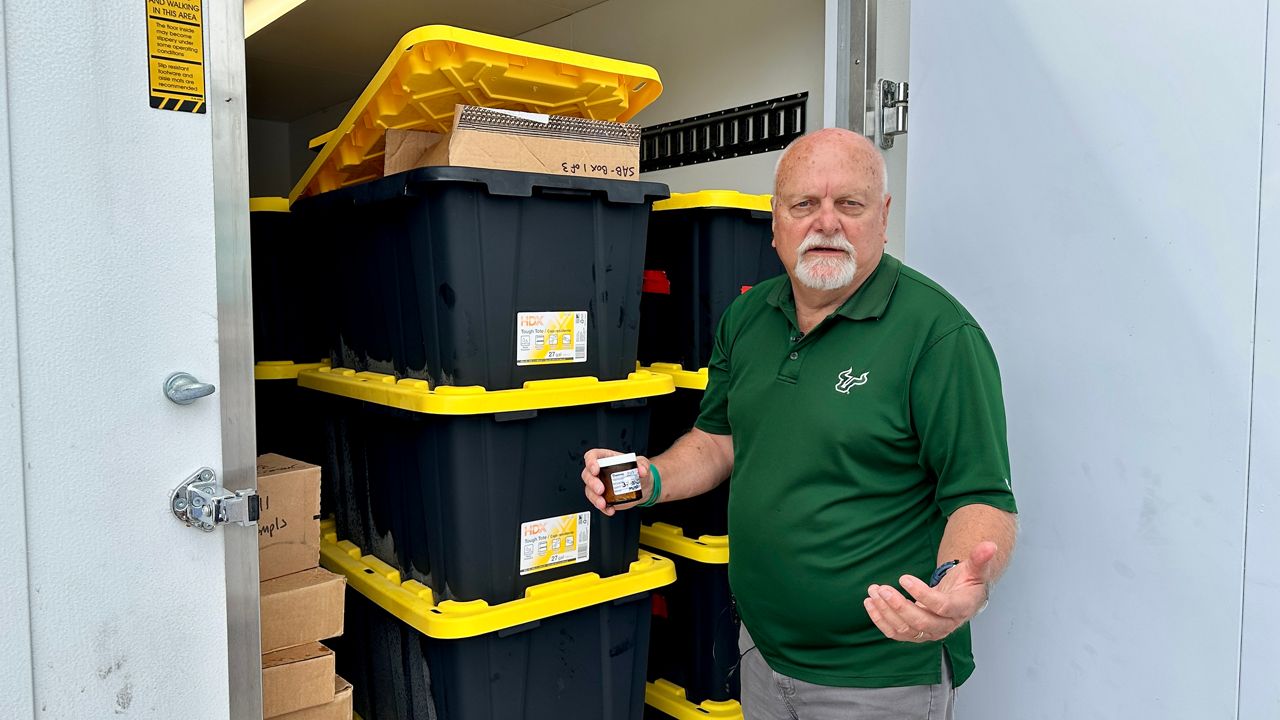
USF College of Marine Science Biological Oceanography Professor Steve Murawski shows a frozen fish sample from a bin that was recovered and has been secured in a portable trailer freezer on campus. (Spectrum News/Josh Rojas)
Murawski said he’s mindful that students have limited time and hopes the school can get a bridge loan or investment to buy the two instruments they need, a gas chromatograph-mass spectrometer and liquid chromatography-mass spectrometer, to continue doing research and speed up the recovery process.
“Rebuilding a major lab like this can take years, but these students don’t have years,” Murawski said. “Even though the lab was insured, and the instruments were insured, we all know how long it takes to get an insurance check. And so there’s very much a sense of urgency that if we’re going to be responsive not only to the people that funded our research but also competing for other grants, federal and state and private grants, we need to have the capacity to do this work.”
USF believes a lightning strike on May 2 caused the fire but has been waiting for the State Fire Marshall’s Office to make an official determination. The large fire, which took crews 3.5 hours to get under control, impacted more than two dozen labs, which study all disciplines of oceanography: biology, chemistry, geology and physics.
Dean Frazer said he’s thankful for the community’s support, and he’s also proud of how students and staff have been handling the tragic event.
“I just want to say thank you not only to the folks in the college but the people in St. Pete. Everybody has really gone the extra mile to help us out here. It’s really a time of need,” Frazer said. “We’re going to certainly build back better. We’re going to be stronger, and we’re going to continue to provide the science that really is important to this community.”