
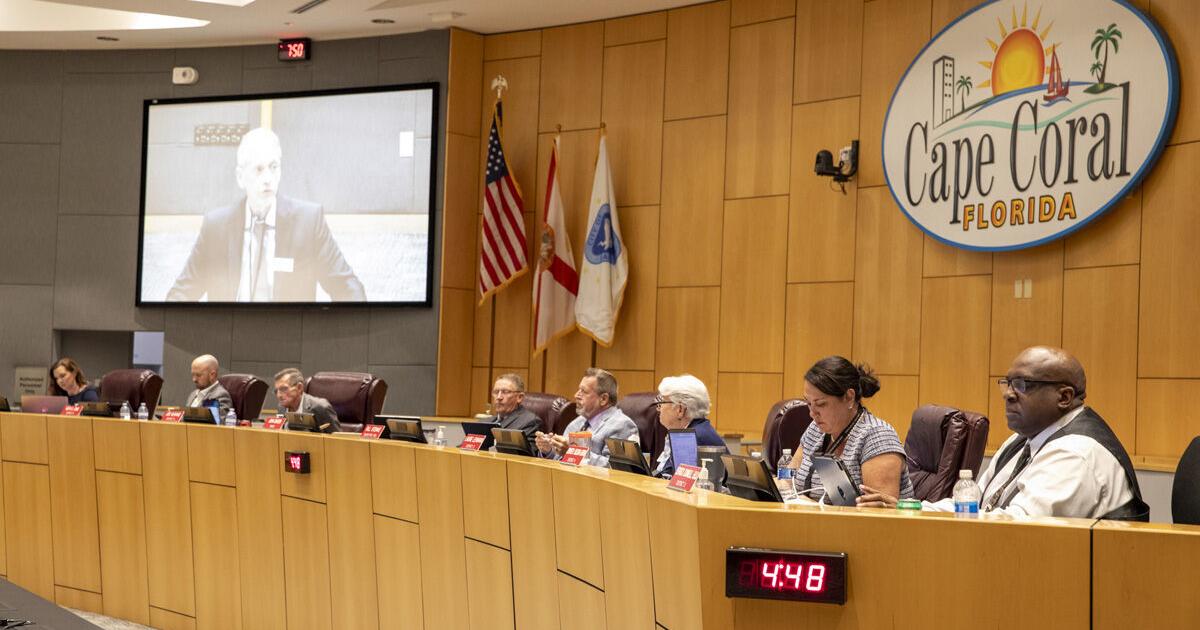

Cape Coral City Council members discuss budget planning during their June 3 meeting. Officials are weighing potential spending cuts and fee increases amid concerns about future property tax revenue.
Evan Williams
Cape Coral officials are considering budget cuts, fee increases or both to account for declining property tax revenue.
That is due to both slowing growth in property tax values this year and a statewide referendum that, pending voter approval in November, could eliminate a majority of the city’s property tax revenue in perpetuity.
“We have this big black cloud hanging over us right now,” Mayor John Gunter said. “We just don’t know how bad it’s going to rain.”
The first issue leaves the city short $5.7 million on its preliminary $1.5 billion fiscal year 2027 budget, city staff told council members during a June 4 workshop that kicked off budget planning for the coming year. The estimate is based on initial property tax values from the Lee County Property Appraiser, which are expected to be finalized by July 1.
The estimates show Cape Coral’s total taxable value increased from about $32.04 billion in 2025 to $32.79 billion in 2026, a 2.3% increase compared with last year’s 7.4% growth.
The second issue is a larger, long-term challenge for Cape Coral and other local governments throughout Florida that have long relied on property tax revenue to fund key services.
Pending 60% voter approval in November, a constitutional amendment (House Joint Resolution 1-F) would expand the state’s homestead tax exemption to $150,000 beginning Jan. 1, 2027, and to $250,000 the following year. The exemption would remain in place permanently, with future increases tied to inflation.
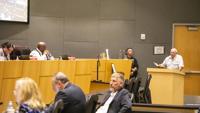
A resident speaks during public comment at the June 3 Cape Coral City Council meeting, where officials discussed budget challenges tied to slowing property tax growth and a proposed statewide property tax amendment.
Evan Williams
Although the measure would not affect Cape Coral’s budget until fiscal year 2028, and only if approved by voters, Gunter, Council member Joe Kilraine, City Manager Michael Ilczyszyn and other officials said they expect it to pass and are preparing now.
If approved, the amendment would reduce city revenue by about $28.6 million in 2028 and $46.6 million beginning in 2029, according to a city staff report. Florida Senate President Ben Albritton said in a press release that the amendment provides a path toward the eventual elimination of residential property taxes.
For context, $46.6 million is nearly 30% of the city’s current $158 million in ad valorem tax revenue. It also is roughly equivalent to the city’s combined planned spending on parks and recreation ($15 million), transportation ($13 million), code enforcement ($5.5 million) and the fire department ($17.6 million).
Potential solutions include budget cuts or raising fees to generate additional revenue. Options discussed include increasing the millage rate, local sales taxes, fire assessments or fees for amenities, such as golf courses and pickleball courts.
Council members offered differing opinions on whether to cut programs, raise fees or pursue a combination of both. During the June 4 workshop, they discussed potential reductions in parks and recreation, public works and police budgets, as well as smaller measures such as eliminating public meeting broadcasts.
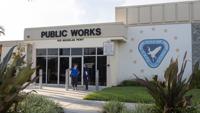
The City of Cape Coral Public Works building at 815 Nicholas Parkway. Public works spending was among the topics discussed as city leaders reviewed budget options during a June 3 council meeting.
Evan Williams
“We’re going to have to cut services or someone’s going to have to change their mind on increasing fees, right?” Council member Rachel Kaduk asked.
The city manager agreed.
Council member Bill Steinke said he is open to both approaches. “We’ve got all these moving parts, there’s absolutely no way we can stay status quo,” he said.
Council member Keith Long said he would support increasing the millage rate to ensure the police department receives its requested funding next year after Gunter suggested potential cuts to new law enforcement positions.
Gunter said he does not want to hire employees this year only to lay them off if the amendment passes.
Council scheduled another budget workshop for 1 p.m. July 15. Budget planning for fiscal year 2027 will continue through a series of workshops in August. Final public hearings to adopt the new millage rate and budget are scheduled for Sept. 10 and Sept. 24.
The amendment also would limit future tax assessments on businesses and restrict the use of remaining property tax revenue to schools, public safety, infrastructure, natural resource projects and employee retirement benefits. It would create a state trust fund to provide grants for core local government services.