
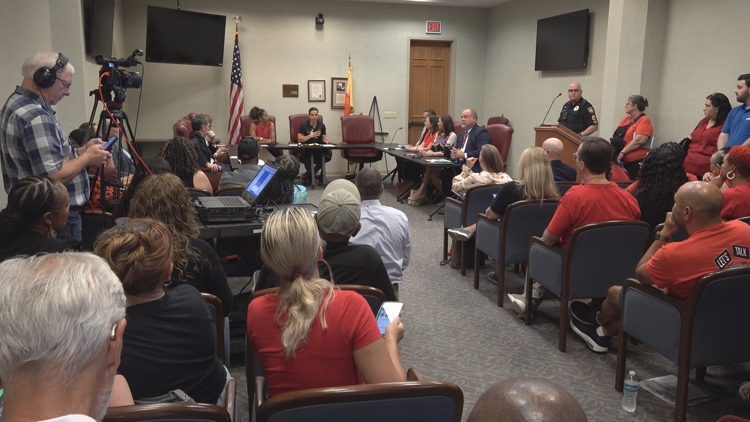
Duval County educators packed a community meeting Friday to voice concerns over a delay in passing an ordinance that impacts the school district’s 1-mill property tax referendum.
Two different meetings were hosted by Jacksonville City Council members Raul Arias and Matt Carlucci. They came days after the council’s finance committee voted to defer legislation that would place the renewal of the tax on the November ballot. Arias was one of four council members on the committee who voted to defer the ordinance.
The meetings drew members of the Duval County School Board, Superintendent Dr. Christopher Bernier and educators from across the district.
“Just because you can, doesn’t mean you should. Just because you can delay the vote until August, I’m not sure that you should delay the vote in August,” Duval County school board member, Cindy Pearson said.
Many of the educators in the room expressed frustration with the delay.
“They give up so much and the fact that people are questioning whether this is important. It’s disrespectful,” said Tammie Brooks-Evans, president of Duval Teachers United.
The 1-mill property tax was first approved by voters in 2022. It is not a new tax and would not increase taxes if renewed. The tax generates roughly $120 million for teacher salaries, arts and sports programs.
Finance Committee members who voted against advancing the ordinance said they were concerned about the cost to residents and wanted additional time to discuss whether the tax remains necessary.
Bernier said the funding is critical because of its impact on teacher retention and student success.
“The number one factor in student achievement are teachers. The research is so clear, right? Principals are second, but the distance between them is enormous in terms of the statistical impact of a teacher in a classroom, whether that’s at DuPont, whether that’s at Andrew Jackson, whether that’s over at Raines or down in Mandarin. They are the number one factor in this particular millage,” Bernier said.
According to the Office of General Counsel, the City Council’s role in the process is ministerial, meaning its responsibility is to pass the ordinance placing the 1-mill renewal referendum on the ballot. The council does not have authority over the contents of the referendum itself.
Educators at both meetings said the outcome could have a direct impact on their livelihood.
“I will lose $7,000 from my paycheck if this is voted no. And that will affect my family. I already work multiple jobs. I’m a school social worker,” one educator said.
“That referendum does give me more peace of mind. It makes me know that yes I can pay my bills. I can buy additional supplies for my kids,” another educator said.
Arias was moved by the stories he heard and said he would be willing to make a motion to take up the ordinance during Tuesday’s city council meeting.
“I’m not voting on whether increasing or not continuing the millage rate at the current rate, but what we are voting on is ensuring that the community has a voice, and I’m not gonna take that away from the community,” Arias said.
City Council President Kevin Carrico can choose to discharge the ordinance from the finance committee, allowing the full council to consider it at Tuesday’s meeting. If Carrico does not do so, another council member can make a motion to discharge the bill during the meeting.
The Duval County School Board must submit the referendum to the Supervisor of Elections by Aug. 18. The latest the city council can vote on the ordinance is July 28.