
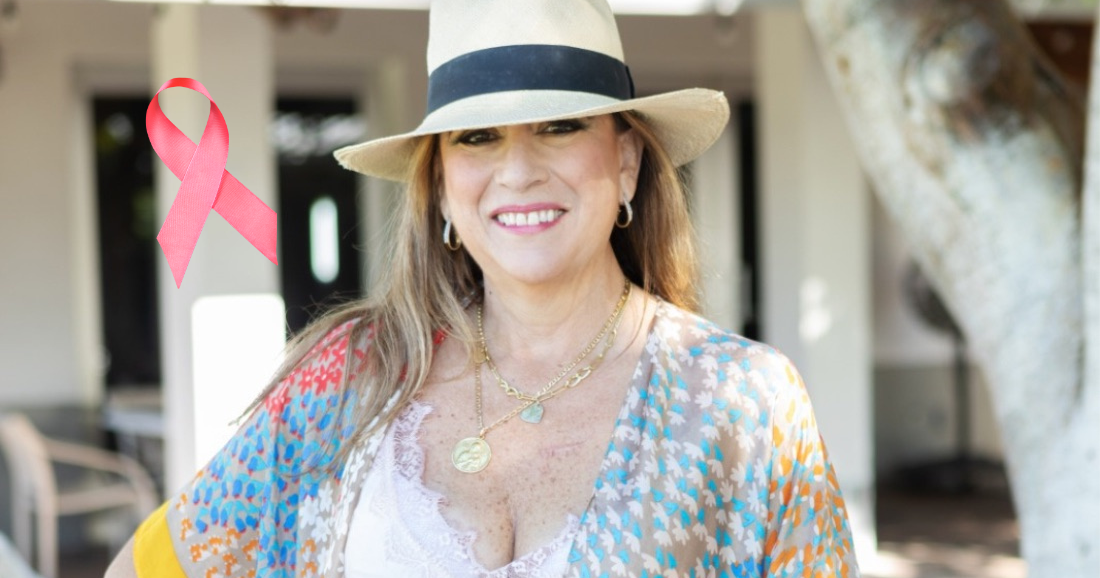
Just a year after being diagnosed with breast cancer, and following three surgeries, 15 hours of radiation treatments and continuous hormone therapy, Vivianna Franchy feels she’s been fortunate in a lot of ways.
A well-known real estate professional with Berkshire Hathaway HomeServices EWM Realty on Key Biscayne, Franchy spoke to Islander News during Breast Cancer Awareness Month to provide some insight on how she conquered her fears, how grateful she is for the support she’s received from physicians and family and the advice she’d offer others.
“The magic of the whole thing is that what really saved me from a larger problem is that I regularly do my checkups,” said Franchy, who recently returned from her 50th high school reunion back in her native city of Lima, Peru.
Incidentally, the Susan G. Komen Foundation suggests that for those at average risk to have a mammogram every year starting at age 40.
It was one of those mammograms from the Cleveland Clinic in Weston that detected something was wrong, even without a lump in Franchy’s breast tissue.
“They compared the mammogram and the ultrasound from the previous year, and then the year before that, and could see something was different,” Franchy said about a small speck. “What they can do now is amazing.”
What was diagnosed is called ductal carcinoma in situ (DCIS), a Latin term for cancer in the milk duct that is found “in its original place,” or not having spread.
Franchy said she wasn’t terrified of the diagnosis, even though an estimated 42,170 women (and 510 men) were expected to die from breast cancer in the United States this year, according to the American Cancer Society.
“I told the doctor that with all the diagnostics they have for cancer that I didn’t think it would be terminal if (caught) at the right time,” she said. “To be honest, I was extremely positive that it would be contained.”
Doctors explained the treatment options to her.
“They said they could take a bit of skin (biopsy samples), or the entire breast,” she said, easily settling on the first choice.
“But they had to do it three times,” Franchy said, explaining that there needs to be at least a 2 millimeter gap of cancer-free area in the duct before they could give her the all-clear sign.
“By the time the third surgery came, and I am a process-oriented person even at work, I figured if they can’t be sure … we could go for the complete removal but, thankfully, it didn’t go that far,” she said.
Doctors told her the carcinoma was “very localized, very small,” she said.
“It is considered Grade 0, it doesn’t get out in the mammaries (which would be Grade 1). It’s contained inside the area where the milk comes from,” she added.
According to several medical experts, DCIS is a highly curable condition. With proper treatment, the 10-year survival rate is more than 95%. However, if left untreated, DCIS can progress to invasive breast cancer in about 20-30% of cases.
So, why did this occur? Who knows?
According to the National Breast Cancer Foundation, some common links include early menstruation (before age 12), having a baby after the age of 30 or never being pregnant, starting menopause after age 55 or a previous diagnosis of breast cancer.
There is also the family gene factor in which Franchy was given a BRCA (Breast Cancer gene Analysis) test to determine if a person has inherited mutations. The results showed no indication of family cancer history.
“I don’t have the gene,” she said. “So, it’s a good thing. It may not repeat … (but) I still got it.”
According to statistical data, one person every two minutes in the U.S. is diagnosed with breast cancer. And, 1 in 8 women will be diagnosed with some form of breast cancer, according to the American Cancer Society.
Franchy’s radiation treatments lasted three weeks.
“I would finish tired, but I’d be back doing my thing (at work) later that day,” she said. “I push myself.”
The last third of her treatments is a hormone pill to be taken daily over a five-year span.
“That pill lowers your hormones, because cancer feeds from the hormones,” she’s learned.
Franchy feels fine these days, especially after enjoying a “beautiful” reunion with her childhood friends in Peru.
Two sisters, a brother and her son have given her the “extremely” emotional support she’s needed, but she won’t tell her mother about the ordeal so as not to worry her.
So, what advice would she give anyone with, or even without, a cancer diagnosis?
“What I would advocate, if I had the chance to be in front of someone, is don’t let time pass without getting yourself checked,” Franchy said. “Mammograms (and ultrasounds) save lives.
“In my case, they could detect this in time, so it won’t be as harmful.”
Viviana Franchy is a Real Estate agent with BHHS EWM Realty in Key Biscayne. She can be reached by visiting viviannadeluxe.com or by calling 305.798.6010. Instagram, @viviannadeluxe.