
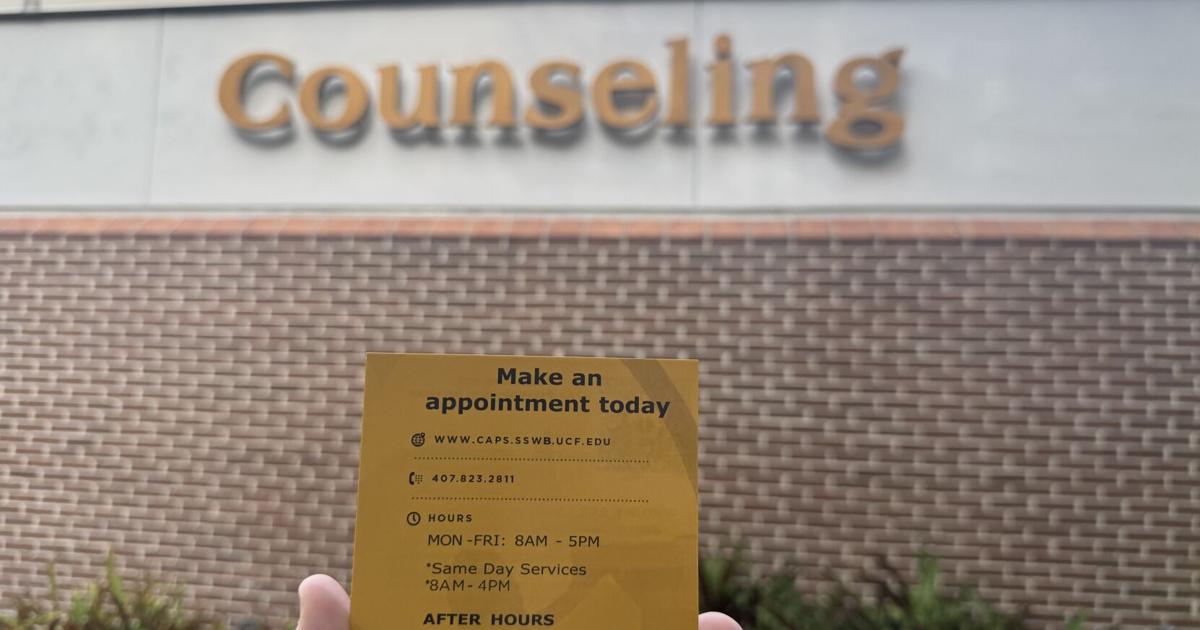

Informational cards that are provided inside the Counseling and Psychological Services building share their hours, contact details and service options to connect students to support.
Travis Hogan
UCF Counseling and Psychological Services provided nearly 26% fewer appointments to students over the past three years, according to an annual report, a shift the director said reflects how students are reimagining mental health care.
The report states that CAPS provided 27,392 appointments to students in 2021-22, but provided 20,365 appointments in 2023-24 — the most recent year listed on the report — a 25.57% drop.
UCF CAPS Director Karen Hoffman said in an email sent to The Charge the decline in appointments provided does not mean students are avoiding support. Instead, she said, it shows that students are finding help through a wider variety of tools and platforms, from single-visit counseling to online programs and self-guided resources.
“There has been a trend nationally that has seen a reduction in clients coming into centers for traditional therapy services, which impacts traditional ways we count utilization,” Hoffman stated in the email.
One factor influencing this change is that more students now arrive at UCF with prior therapy experience, Hoffman stated.
According to the report, 27% of UCF students have previously engaged in therapy before college, and, according to the email, 55% of CAPS clients reported receiving counseling before coming to the center. Many of those students may continue with their previous therapists, especially through telehealth, which was uncommon before 2020, Hoffman’s email read.
The expansion of online therapy and insurance-based telehealth options has also changed how students get care. Hoffman noted that students increasingly access therapy through outside platforms that offer long term continuity of care, giving them more flexibility than traditional campus appointments.
Another shift comes from the growing use of non-clinical mental health resources. Since 2021, CAPS has introduced several self-guided and online support tools, including Therapy Assistance Online, Togetherall and Wellbeing Online Workshops, that provide digital spaces for students to manage their mental health.
“Tools such as workshops, self guided resources, and digital mental health platforms are increasingly being used as standalone support or as precursors to clinical therapy,” Hoffman wrote in the email.
The report showed that 488 students registered for TAO, 301 joined Togetherall’s anonymous peer-to-peer online community, and 1,095 attended Wellbeing Online Workshops during the last academic year. These platforms allow students to engage with support privately and at their own pace.
Hoffman noted that students are also experimenting with newer technologies, including AI-powered tools like ChatGPT, as supplemental mental health resources. She stated this reflects how technology continues to reshape the way students seek care.
Even with fewer therapy appointments, CAPS still reaches about nine percent of UCF’s student population when clinical and non-clinical services are combined. That matches the center’s highest utilization rate from 2018–19.
That broader reach is part of CAPS’ goal to make support more accessible and flexible. Kayla Beswick, a CAPS specialist and student counselor, said therapy can help with both small and serious concerns and that seeking help early can make a difference.
“Therapy can be for all ranges of concerns,” Beswick said. “From simply wanting dedicated time to think about what’s going on in your life to working through a more serious issue, students deserve support at every stage.”
For many students, that flexible approach has made it easier to take the first step. Dean Bellinger, a sophomore majoring in mechanical engineering, said reaching out to CAPS felt intimidating at first.
“It’s hard to get over that hump.” Bellinger said. “I didn’t know what to expect.”
When he finally scheduled his first appointment, Bellinger said the process was easier than he thought. CAPS matched him with a therapist who fit his needs and communication style.
“They really try to find the perfect therapist for you,” Bellinger said. “It made a huge difference knowing I was talking to someone who got it.”
For Hoffman, the 26% decline is not a setback but part of a larger shift in how students define care.
“Students sometimes think they have to be at a breaking point to talk to someone,” Hoffman said. “But mental health exists on a spectrum, and we want them to know support is available no matter where they are on that spectrum.”