
A nearly $100 million South Tampa flood relief project has long divided neighbors, business owners and city leaders. Now, a business group is suing the city of Tampaover it.
The SoHo Business Alliance filed a lawsuit last week accusing the city of withholding public records tied to the South Howard Avenue project.
Proponents say that even short bursts of rain turn their streets into rivers. But a group of business owners have fought the project for months, raising questions about cost, traffic and street closures.
The group alleged in a news release that the city “is intentionally delaying the production of critical project documents to prevent public scrutiny before the Tampa City Council votes on the project’s future later this year.” Council members are expected to vote on whether to proceed with construction later this summer.
The lawsuit seeks a court order requiring the release of of records that the group says it requested in February, including external and internal communications, cost estimates, flood models and engineering contracts. The group says it has paid thousands of dollars in up-front costs associated with the requests.
The cost of the project has quietly ballooned from $65 million to nearly $100 million. The lawsuit said it is “expected to impose years of major construction activity, traffic disruption, and business interruption on South Howard Avenue businesses.”
The city, it says, “has a direct institutional interest in delaying the production of the requested public records until after the Tampa City Council has formulated and voted on its public policy position.”
City spokesperson Adam Smith declined to comment on pending litigation.
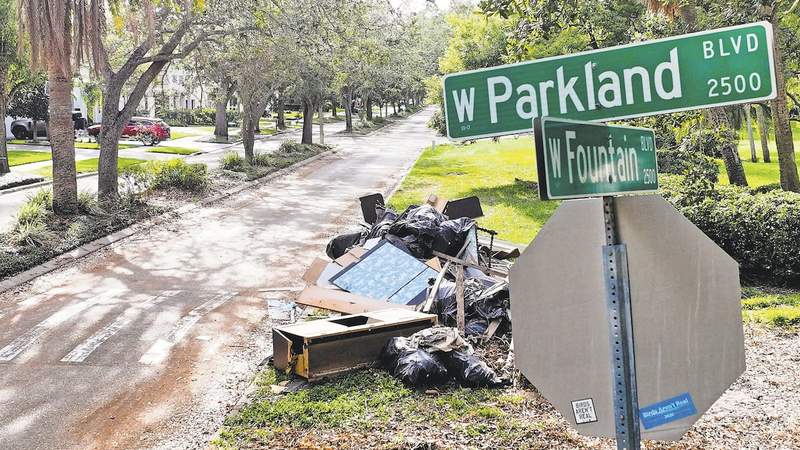
The proposed plan involves adding a culvertand pipes along stretches of West Swann and South Howard avenues to address persistent flooding in Parkland Estates, Palma Ceia Pines and surrounding neighborhoods. The City Council approved an initial contract with Kimmins Contracting Corp. in a 5-2 vote in 2024.
Questions about funding have swirled around the project for months as the scale and scope have changed.
Dennis Rogero, the city’s chief financial officer, said at a meeting in January that the City Council had already approved tens of millions of dollars. That includes $8.4 million from a stormwater fee assessed on taxpayers, a $10 million Florida Department of Environmental Protection grant, $10 million in bonds and $21 million transferred from another city fund.
That leaves a $50 million gap that, Rogero said, the city could try to cover with other state and federal grants. The city could also seek money from the Tampa Hillsborough Expressway Authority, Rogero said, or pull from the renewal of the county’s Community Investment Tax, a half-percent sales tax that pays for major public construction projects.
Some residents, meanwhile, say the fear of flooding outweighs questions about cost or traffic.
“If this project gets stopped, there is no project waiting in the wings,” Parkland Estates resident Steve Gerrish said at a City Council meeting earlier this year. “We cannot physically, mentally, emotionally withstand more flooding.”