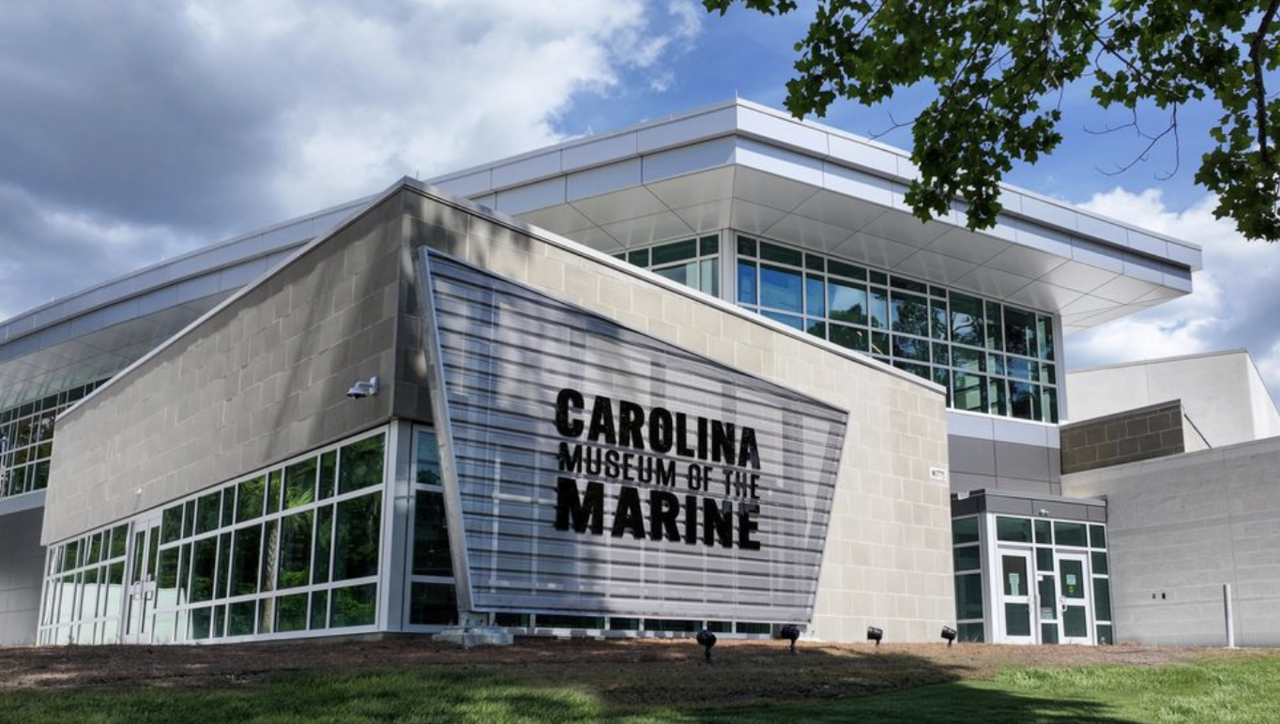
Monday was the official opening of the Carolina Museum of the Marine in Jacksonville. I recommend a visit. It is off Lejeune Boulevard near the complex convergence of U.S. 17 and NC 24. Set your GPS to 109 Montford Landing Road, is my advice.
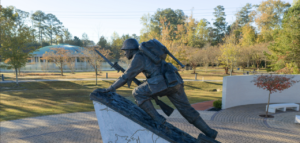 The Montford Point Marine Memorial at Lejeune Memorial Gardens. The dome of the Vietnam Veterans Memorial rises behind it. The Museum sits behind the trees to the right.
The museum is located on a part of the 27-acre Lejeune Memorial Gardens, and so it is adjacent to the Montford Point Marine Memorial, the Beirut Memorial, the Vietnam Veterans Memorial and the 9/11 Memorial Beam from the World Trade Center.
There is history inside the museum and there is history all around it. There is plenty to see if you want to spend a day.
I was able to tour the museum last week because they had a ribbon-cutting ceremony on Friday. The museum’s Great Hall was packed with notables. There were Marines and sailors of all ages. In attendance was retired Gen. Peter Pace, the first Marine to serve as chairman of the Joint Chiefs of Staff. Lt. Gen. Calvert Worth Jr, the commanding general of the II Marine Expeditionary Force, gave the keynote. Also present were retired Cpl. Kyle Carpenter, a Marine who was awarded the Medal of Honor for his actions in Afghanistan in 2010, and retired Marine Corps Maj. James Capers Jr., who will receive his Medal of Honor next week for actions in Vietnam nearly 60 years ago. Lt. Gov. Rachel Hunt was also in attendance and gave some remarks.
 People viewing exhibits at Carolina Museum of the Marine in Jacksonville.
Why it is here
The Marines have been in the Carolinas since 1891, when a detachment was sent to Naval Station Port Royal in South Carolina, the forerunner of the Marine Corps Recruit Depot, Parris Island, where Marines get basic training on this side of the country.
 Exhibit at Carolina Museum of the Marine in Jacksonville.
But the Marines’ big presence started on the eve of World War II. The prospect of a Pacific War meant that Marines were going to have to fight their way onto heavily defended islands, amphibious landings from ships to shore. They needed a place to train. In April 1941, construction was given the go-ahead on an 11,000-acre tract in coastal Onslow County that would become Camp Lejeune, which has grown to 156,000 acres.
During the war, other Marine installations were built in the Carolinas, what are now known as Marine Corps Air Station Beaufort – near Parris Island; Marine Corps Air Station New River, next to Camp Lejeune; and Marine Corps Air Station Cherry Point in Havelock, around an hour and some to the northeast from Camp Lejeune if you’re driving.
So, if you start the clock at the start of Camp Lejeune, there’s 85 years of Marine Corps history here. Today, there are more than 41,600 Marines based at the three North Carolina installations, and almost 7,000 in South Carolina. All told, the Marines in the Carolinas comprise nearly 29% of the active-duty Corps.
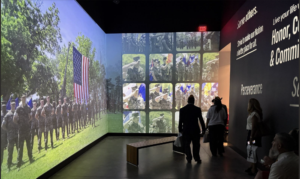 The museum’s exhibits and storytelling were developed by internationally recognized partners, including Ralph Appelbaum Associates, RRA, known for exhibit design with Smithsonian museum partners and other global destinations, and their consultant, Journey, known for immersive storytelling.
Some think of North Carolina as an Army state, because Fort Bragg is closer to the state’s major population centers. But North Carolina has roughly the same number of Marines as Army active-duty soldiers. The museum will be a good way for North Carolinians – especially the many newcomers in Raleigh and Charlotte – to learn the Carolina Marines’ story. Many folks go to our beaches and have no idea there are large numbers of Marines up and down the coast, behind fences and forests, constantly training and deploying.
There were a lot of folks who worked on the museum project over the years, because it took 26 years to turn the idea into what it has become, a $36 million, 25,000-square-foot building full of exhibits. The project got a major boost with a $26 million state appropriation five years ago, managed by Jacksonville N.C. Sen. Michael Lazzara, a Marine veteran. Private donations and assistance from local governments funded the rest.
The speeches
Before the ribbon-cutting, there were speeches. Here are excerpts:
Retired Marine Maj. Gen. Joe Shrader, the president and CEO of the museum: “The story of the Carolina Marines, sailors, and their families is inseparable from the story of the Carolinas. For generations, communities across North and South Carolina have stood beside those who serve. They sent their sons and daughters to war. They loved them at home, they mourn their loss, and they carry the burdens of service alongside them. The bond between the Marine Corps and the Carolinas is not temporary. It is a part of this region’s identity. That story deserved a permanent home, a place where future generations can better understand the meaning of service, of sacrifice, of duty, and love of country.
Retired Marine Lt. Gen. Mark Faulkner, chairman of the museum board: “This museum stands as a testament to something that is deeply rooted in our core: Honor, courage and commitment. It’s about remembering those who stepped forward in defense of our nation, those who answered the call and those who carried the fight to the enemy and prevailed. This is the beginning of a new chapter, the shifting from building this museum to sustaining it, to ensure it remains a place of learning, remembrance, and inspiration for generations to come, and that will require continued commitment.”
State Sen. Lazzara: “As a Marine this day carries a deep personal meaning to me. My time in the Corps shaped my course of life. The Marine Corps teaches discipline, sacrifice, responsibility, and service to something greater than yourself. Those lessons remain with you forever. [Former Marine Corps Commandant] Gen. Al Gray once said, leaders must truly care more about the people they lead than themselves. That philosophy helped shape generations of Marines in many ways. It reflects the spirit behind this museum and the people who made it possible. For decades, Jacksonville and Camp Lejeune have shared a bond unlike almost anywhere else in America. Children will walk through these halls and learn lessons no textbook could ever teach. Veterans will see their service remembered with dignity.”
Lt. Gov. Hunt: “Places like this remind us that freedom is never guaranteed; it is protected every day by people willing to serve something bigger than themselves. In the Eternal Flame stands a powerful reminder that the service and sacrifice of the Marines and our veterans and our military families will never be forgotten.”
Lt. Gen. Worth: “Since raising those first two battalions of Marines back on 10 November 1775, our service has been unwaveringly focused on warfighting any time, any place, and being most ready when the nation is least ready. The Carolina Museum of the Marine stands as a physical testament to how Marine warriors have answered that call of service across generations. The museum ties those serving in this new digitized, multi-domain, micro-second battlespace of today to the hard lessons learned on historic battlefields of bygone eras. Most importantly, the museum represents a real opportunity for those who come here to immerse themselves in the rich history of our Corps. They’ll learn more about not only the Corps, but the most important thing about the Corps: The people are the foundation. They have been for as long as the Corps has existed, and they will be far into the future. Honor, courage, commitment. Those are the backbones upon which we drop all of the new technology.
There’s a lot
After the ceremonies, I had a chance to walk through the museum. You can go to the museum’s website here to see what’s there, because I didn’t see everything. There is a lot to experience. Kids will enjoy this and grownups too. It is hard to get on military bases nowadays, but this kind of brings the bases to the public. The theme is “Meet the Marine. Be Inspired,” and I think the museum does that.
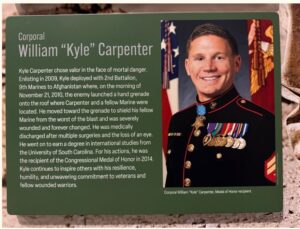 Kyle Carpenter
I walked aboard an LVT, an amphibious Landing Vehicle, Tracked, which brought Marines ashore in their island-hopping across the Pacific. You can learn from one exhibit that Marines carry field packs and other equipment that can weigh more than 100 pounds.
The museum explains the concept of the MAGTF, the Marine Air-Ground Task Force. Marines deploy aboard Navy ships with everything they need to fight – aircraft, artillery, ground vehicles and logistics. They can deploy in Marine Expeditionary Units – like the 22nd, 24th and 26th based at Camp Lejeune, which field 2,200 Marines at a time – or as a very large MAGTF – like the II Marine Expeditionary Force that Lt. Gen. Worth commands, which can involve up to 90,000 Marines.
The purpose of Marine aviation, you learn, is to provide close air support for Marine ground forces. And you also learn that construction on the airfield at Cherry Point began just 17 days before Pearl Harbor, and was the East Coast hub for training Marine aviators for service in the Pacific.
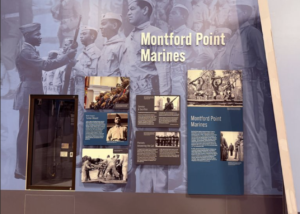 Carolina Museum of the Marine tells the story of first Black recruits during World War II.
There is a section on Montford Point that helps give a sense of where you are and why there is a Montford Point Marine Memorial next door. In the summer of 1941, President Roosevelt ordered the armed services to recruit African-Americans. The Marines responded by creating a separate recruit training camp at Montford Point, rather than sending Black recruits to Parris Island or Camp Pendleton on the West Coast. Some 20,000 Black Marines passed through Montford Point between 1942 and 1949. If you drive down Montford Landing Road looking for the museum and you go too far, you will arrive at what is now Camp Gilbert Johnson, home to the Marine Corps Combat Service Support Schools, where Marines learn supply, logistics, finance, and motor transport maintenance. It is named for one of the first Black drill instructors in the Marines.
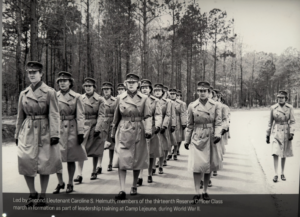 2nd Lt. Caroline S. Helmuth (above) leads the thirteenth Reserve Officer Class at Camp Lejeune. The first women Marines served here during World War II.
There’s a section as well about the women who served from 1943 to 1945 as part of the Marine Corps Women’s Reserve at Camp Lejeune, filling clerical, technical and administrative posts, freeing men for deployment. The exhibits tell their personal stories.
You can also see a Vietnam-era Huey helicopter on display,one of the early variants and the first one issued to the Marine Corps in the 1960s at Camp Lejeune.
You will also learn some of why Camp Lejeune is named for Maj. Gen. John A. Lejeune, the 13th commandant of the Corps. (He retired in 1929, and was promoted to lieutenant general on the retired list in 1942, shortly before his death.) He had the vision in the 1920s to start the transformation of the Marine Corps to a more mobile, amphibious force, anticipating a future war in the Pacific. I sat through a video that taught me about Lejeune’s strategic foresight.
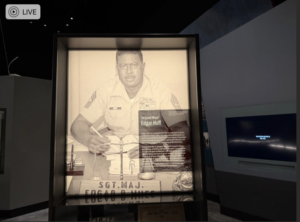 Sgt. Maj. Edgar Huff Sr., a Montford Point Marine in World War II, was the first Black sergeant major in the Marines.
One of the strengths of the museum is that it tells the story of the Carolina Marines through the stories of individual Marines, like Kyle Carpenter, mentioned above, the youngest living Medal of Honor recipient, who threw himself on a live grenade in Afghanistan to shield a fellow Marine. He is 36.
Some other details
Admission at the Carolina Museum of the Marine starts at $8 for ages 4-15; $14 for ages 16-54 with lower rates for seniors, veterans and active-duty personnel. The museum is open Tuesday to Sunday, 9 am to 5 pm. Self-guided exploration of the Museum takes around two hours.
The MAGTF Cafe is operated by veteran-owned The Milk Road Coffee Shop in Jacksonville. And there’s a gift shop.
Some credits
This next paragraph about the museum’s design and construction partners came straight from a museum news release, because I didn’t want to re-invent the wheel:
Ralph Appelbaum Associates, RRA is known for exhibit design with the Smithsonian Museum, including the National Museum of African-American History and Culture, the National Air and Space Museum, the National Museum of African Art and the Smithsonian Arctic Studies Center. Ralph Appelbaum Associates collaborated with CJMW Architecture in Winston-Salem, N.C. Pennsylvania’s Oehme Brothers War Horse Garage restored World War II vehicles and armor. Greensboro, NC-based Samet Construction led construction as general contractor in association with HICAPS Construction Management, also based in Greensboro.