
At a recent men’s health symposium in Miami, the message from doctors, nutritionists and mental health professionals was direct: men cannot wait for a crisis before taking care of themselves.
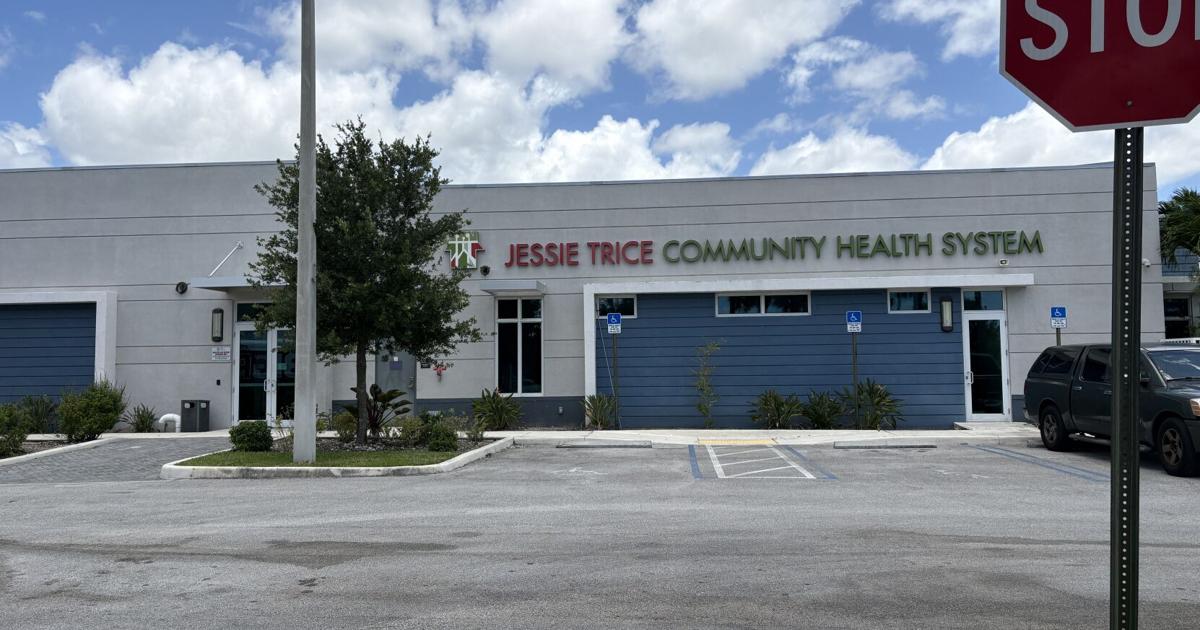
That much was clear as community leaders and residents gathered at JTCHS Barbara Jordan Community Health & Wellness Center to mark Men’s Health Month this past weekend. Hosted by the Jessie Trice Community Health System (JTCHS) and Mount Hermon AME Church’s Sons of Allen Men’s Ministry, the event brought men together for health screenings, panel discussions and practical advice on heart disease, nutrition, mental health and preventive care.
Ryan Hawkins, CEO of JTCHS, said the goal was to reach men where they are.


Sheet facts displayed on the halls of JTCHS for the Men’s Health Symposium.
(Amelia Orjuela Da Silva for The Miami Times)
“Men are the most underrepresented group in the healthcare field,” Hawkins said. “We see very few men making their appointments.”
He noted that too many men prioritize family, faith, work and community while putting their own health on the back burner.
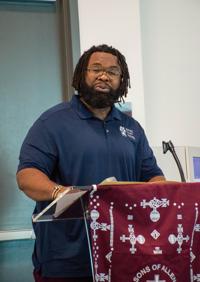
Ryan Hawkins, CEO of JTCHS, speaking at the symposium.
(Amelia Orjuela Da Silva for The Miami Times)
“When men are healthy, families are stronger. When families are stronger, communities become stronger. And when communities are stronger, we all rise together,” said Hawkins.

Preventive kits were given to men who attended the symposium.
(Amelia Orjuela Da Silva for The Miami Times)
A church’s role in prevention
The Rev. Nathaniel Robinson III, senior pastor of Mount Hermon AME, said the church has a responsibility to address men’s health. He says faith communities are trusted spaces.
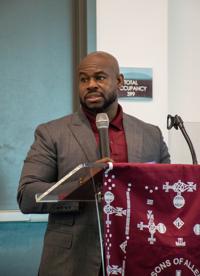
The Rev. Nathaniel Robinson III, senior pastor of Mount Hermon AME, speaking at the symposium.
(Amelia Orjuela Da Silva for The Miami Times)
“There is definitely a significant disparity in men’s health, particularly African American men,” Robinson said, citing cardiovascular disease, prostate cancer, diabetes and mental health as major concerns.
For Robinson, health is also a matter of faith and stewardship.
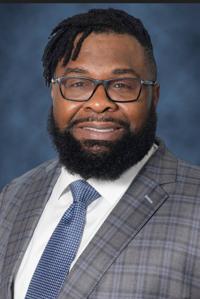
“When men are healthy, families are stronger. When families are stronger, communities become stronger. And when communities are stronger, we all rise together.” -Ryan Hawkins, JTCHS CEO
(JTCHS)
“Everything we have comes from God, in particular our bodies,” Robinson said. “If we aren’t good stewards of that body that God gives us, then how can we expect God to trust us with anything else?”
Marcus Miller, president of the Sons of Allen Men’s Ministry, said the symposium was designed not just to inform but to empower.
“We want to educate and empower our men to take ownership of their health habits,” Miller said. “They have a chance to interact with health professionals who can give them some guidance and instruction on what to do next.”
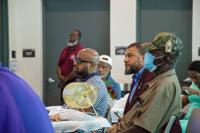
Men listen to the heart health presentation.
(Amelia Orjuela Da Silva for The Miami Times)
Heart health
The heart health panel, led by interventional cardiologist Dr. Rimsky Denis, focused on the urgency of preventing cardiovascular disease, particularly among Black men.

Dr. Rimski Denis, an interventional cardiologist, during his presentation.
(Amelia Orjuela Da Silva for The Miami Times)
Denis stated that heart disease remains the leading cause of death worldwide, with an especially heavy burden in Black communities.
“One in four African Americans will die from heart disease,” Denis said. “Every 40 seconds someone in the United States dies from a heart attack.”
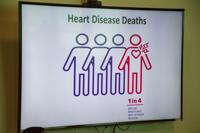
One in four African Americans will die from heart disease.
(Amelia Orjuela Da Silva for The Miami Times)
He explained that coronary artery disease (CAD) — characterized by blockages in the arteries supplying blood to the heart — is one of the most dangerous forms of heart disease because it can lead to heart attacks or death if left untreated.
“One in 20 adults above the age of 20 years has CAD or some degree of CAD, and we know that roughly two in 10 deaths from coronary artery disease happen in adults less than 65 years old,” Denis said.

“If you are Black and going to the hospital with a heart attack, you’re less likely to receive evidence-based treatments, particularly those treatments that are deemed to be more costly or new.” -Dr. Rimsky Denis
Denis walked attendees through the leading risk factors for CAD — which include hypertension, diabetes, obesity, smoking, elevated cholesterol, alcohol abuse and physical inactivity — emphasizing that most are modifiable through early intervention.
He also introduced the audience to lipoprotein(a), a genetically inherited cholesterol particle carried by roughly one in five people worldwide that significantly increases cardiovascular risk but remains largely unknown to the public.
“If you haven’t had a lipoprotein(a) level checked, this is my plug this morning,” he said. “Speak with your cardiologist so you can assess whether or not you’re at increased risk.”
According to Denis, systemic disparities mean African Americans are less likely to receive evidence-based treatments compared to white patients.
“If you are Black and going to the hospital with a heart attack, you’re less likely to receive evidence-based treatments, particularly those treatments that are deemed to be more costly or new,” he said.
Researchalso shows that Black patients are less likely to receive implantable cardioverter-defibrillators (ICDs), which prevent sudden cardiac death by correcting dangerous heart rhythms.
Despite these disparities, Denis stressed that routine medical visits can prevent or identify these conditions early.
“Prevention is better than to treat or to cure,” he said. “No one has to die from heart disease. No one has to get a stent. If you simply mitigate and aggressively address these risk factors, you won’t need one.”
Food as medicine

Nutritionist Ashley Carter during the nutrition panel.
(Amelia Orjuela Da Silva for The Miami Times)
Nutritionist Ashley Carter, co-founder of non-profit EatWell Exchange, which uses nutrition education to decrease health disparities,emphasized that nutrition plays a significant role in heart health, diabetes prevention and hormone production. She encouraged attendees to focus on realistic, sustainable habits rather than overnight transformations.
One of the biggest misconceptions Carter addressed was the idea that carbohydrates should be eliminated. She reminded attendees that fruits and vegetables contain carbohydrates, which serve as vital fuel.
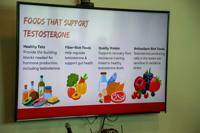
Foods that support testosterone.
(Amelia Orjuela Da Silva for The Miami Times)
“Our brain can only use carbs for fuel,” Carter said. “If you say, ‘I’m never eating carbs,’ how’s our brain going to get energy?”
Instead of elimination, she recommended balancing plates: filling half with fruits and vegetables, and dividing the remaining half between protein and carbohydrates.
“If you’re not eating any vegetables right now, start with a quarter of your plate,” Carter said. “Quarter is a starting point, but then we’re moving toward half.”
Carter also warned attendees about hidden sodium in common seasonings and packaged foods. Pointing to a container of Adobo seasoning, she noted that the label listed 350 milligrams of sodium in just a quarter-teaspoon serving.
“Does anybody use a quarter teaspoon of seasoning? Never,” Carter said. “So think about that. If the label says 350 milligrams for a quarter teaspoon, what happens if we use more? We have to multiply.”
TheCDC recommends adults consume no more than 2,300 milligrams of sodium per day, as excess intake is linked to high blood pressure, stroke and heart disease. Carter noted that instant ramen noodles can contain over 1,100 milligrams of sodium per serving, nearly half the daily limit.
To manage sodium without losing flavor, Carter suggested reading labels, using fresh herbs, choosing lower-sodium seasonings and rinsing canned vegetables, which decreases sodium by 50%.
Through EatWell Exchange, Carter teaches communities how to cook affordable, healthy food that still honors their cultural flavors.
Mental health

Dr. Tym Tylor, outpatient director of Behavioral Health Services for JTCHS.
(Amelia Orjuela Da Silva for The Miami Times)
For many Black men, conversations about mental health are often avoided or hidden behind cultural expectations of toughness. However, Dr. Tym Tyler, outpatient director of Behavioral Health Services for JTCHS, argued that these conversations are essential for healing.
According to the U.S. Department of Health and Human Services Office of Minority Health (OMH), in 2024, Black adults were 11% less likely than U.S. adults overall to report having a mental illness in the past year and 36% less likely to receive a mental health treatment.

Attendees participate in a mental health exercise during the symposium.
(Amelia Orjuela Da Silva for The Miami Times)
Tylor linked many modern struggles to generations of historical and racial trauma.
“Our history in this country started with trauma,” Tylor said. “You can’t get better if you don’t understand where you came from.”
He explained that unresolved, painful experiences can manifest as anger, anxiety and emotional struggles.
Tylor challenged traditional ideas of masculinity that discourage men from expressing emotion or seeking help.
“What does it mean to be a man?” he asked, noting that the pressure to solve every problem alone often prevents men from seeking therapy.
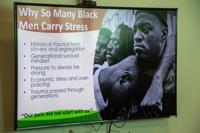
Tylor linked many modern struggles to generations of historical and racial trauma.
(Amelia Orjuela Da Silva for The Miami Times)
Tyler stressed that mental health exists on a spectrum but affects everyone.
“You’re not crazy,” he said. “It’s OK to talk.”
He encouraged healthy coping strategies such as exercising, journaling, limiting exposure to stressful news and building strong support systems.
“There is always hope on the other side,” Tyler said. “It’s a journey.”