
Written by Miami Today on June 10, 2026

Advertisement
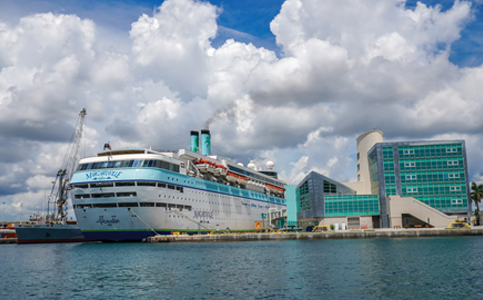
The first preferential berthing agreement in seven years with a new cruise line powered toward an inaugural sailing in January as a county committee hailed the coming of the Margaritaville at Sea Beachcomber to a PortMiami homeport.
The cruise line, founded in 2022 with a single vessel, will offer short to mid-length Caribbean cruises in the newly acquired and refurbished vessel as the fleet grows to three ships. The five-year agreement anticipates a positive $23.15 million impact to the seaport using existing terminal space.
“I can think of no better place to homeport our new flagship vessel the Margaritaville at Sea Beachcomber,” Kyle Anderson, the cruise line’s chief commercial officer, told the county’s Airport and Seaport Committee on Monday before the vote of approval on the preferential berthing.
“Over the past few years we’ve grown from a single ship operation sailing from one home port to one destination on one itinerary to a multiple-ship operation sailing to over 20 destinations across the Caribbean and Mexico,” Mr. Anderson said.
“Our flagship Beachcomber will be the fullest expression of our brand with 10 dining options, 12 lounges and bars, and the world’s first artist-curated live music venue at sea.”
The cruise line, Mr. Anderson said, was established in partnership with the Margaritaville Hospitality brand founded by late Key West music icon Jimmy Buffett.
The plans, Mr. Anderson said, call for predominantly seven-night itineraries to the Eastern and Western Caribbean.
The ship to be based here previously sailed in Europe under another line labeled the Costa Fortuna. It’s to undergo a major makeover to become the Beachcomber.
The ship’s preferential berthing rights will be at Terminal C on specified dates, with about 170 trips to the port over five years. The line will pay a per-passenger fee that will rise 3% each year. A mix of incentives are intended to “encourage efficient use of existing cruise terminal capacity, an important strategy for accommodating future cruise growth within the port’s limited land and infrastructure footprint,” said a memo to commissioners from Jimmy Morales, the county’s chief operating officer, who left the county last week.
Before the committee approved the preferential berthing agreement and sent it to the full county commission for a final vote, members referenced the current flux at the seaport focused on the potential loss next year of its sole fueling source on Fisher Island.
In a complex effort to deal with that pending loss, the county last week parted ways with seaport director Hydi Webb and top county administrator Mr. Morales over their efforts to secure the present fueling site. Mayor Daniella Levine Cava next announced the county would seek an eminent domain purchase of that site after residents of Fisher Island sued to block the county.
“I just want to be cautious, and I ask with all the issues that are going on is it a good idea to be entering into long-term agreements with new cruise lines and be granting berthing rights?” asked Commissioner Natalie Milian Orbis.
“We have been in discussions for almost a year regarding this new contract,” replied Frederick Wong Jr., who at the time of the meeting had been interim port director for five days.
As Mr. Wong tried to explain terms of the berthing agreement, Commissioner Oliver Gilbert interrupted to again ask if the long-term agreement is a good idea.
“Absolutely,” Mr. Wong replied.
“You don’t have any hesitation that we’ll have an issue with berthing rights?” Ms. Orbis asked again.
“No hesitation,” Mr. Wong replied.
As the session at Miami International Airport was concluding and commissioners hailed the change in meeting there rather than in downtown Miami, Mr. Gilbert, who had sought eminent domain for the fueling site last fall without support, agreed that he loved being at the airport and gibed “Maybe we could have a meeting at the seaport. Maybe in the fuel farm.”