
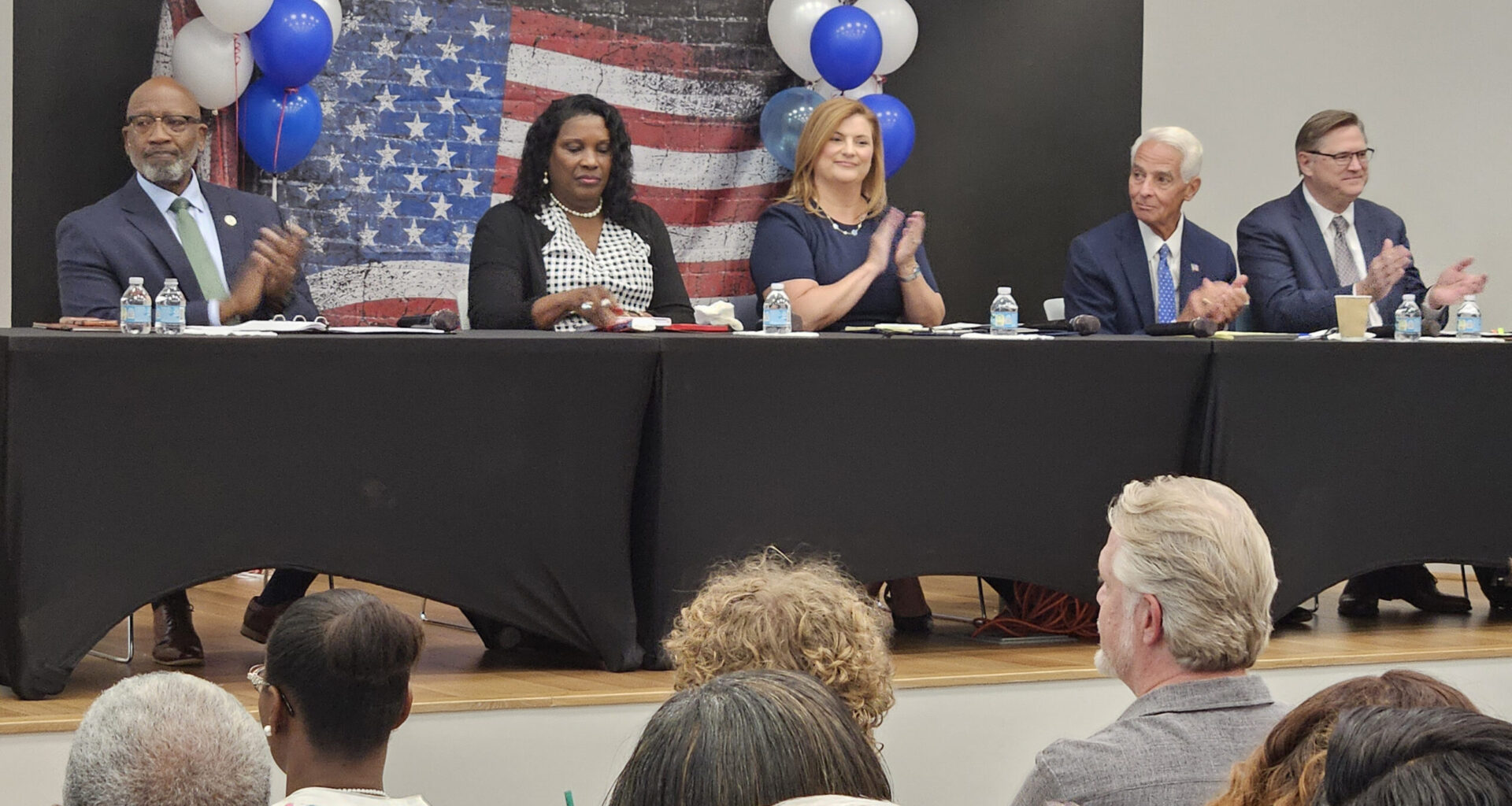
St. Petersburg Mayor Ken Welch spent the campaign’s first major debate defending his record from nearly every direction, as challengers attacked his handling of hurricane recovery, the collapsed Tampa Bay Rays deal, utility issues, transparency at City Hall and the failed Moffitt Cancer Center proposal.
The debate, hosted by the NAACP St. Petersburg Branch No. 5130 at the President Barack Obama Main Library, offered voters a closer look at the candidates trying to win their vote on election night and the issues that differentiate them.
The sharpest exchanges came between Welch and former Gov. Charlie Crist, the early polling leader in the crowded race, who used the debate to argue St. Petersburg has fallen short under Welch’s leadership.
It also showed the contours of a race where Crist is trying to consolidate support as the best-known challenger, Welch is defending a first term marked by crisis and controversy, City Council Member Brandi Gabbard is positioning herself as a substantive alternative to both, Jail Administrator Maria Scruggs is mounting a grassroots campaign, and former Shore Acres Neighborhood Association President Kevin Batdorf is working to prove he belongs despite not identifying as a politician.
St. Petersburg Fire Chief Jim Large did not attend the debate even though NAACP members noted he was invited, and nobody mentioned Paul Congemi.

Welch has largely run on his record and vision outlined through a first term marked by the COVID pandemic, rising affordability pressures, multiple hurricanes and the collapse of the previous Tampa Bay Rays stadium and Historic Gas Plant District redevelopment deal.
Crist, perhaps the most recognizable challenger in the race, has emphasized a “people first” message and argued St. Petersburg has stalled under Welch’s leadership. He entered the race with significant financial support and has leaned into critiques of communication, City Hall direction and missed opportunities including the failed effort to bring a Moffitt Cancer Center campus downtown.
Crist took aim at Welch’s handling of recent hurricanes, including an reference to Welch leaving the emergency operations center during a storm response.
“We’ll be at the emergency operations center when it’s necessary and not leave it and go home,” Crist said. “We need leaders who will be on the job. I will be on the job. I always have been. I always will be.”
Welch quickly pushed back, stating the city was “very prepared for the 2024 hurricanes.”

“Charlie, you were in Minnesota, so I don’t know how you know if we were prepared or not,” Welch said.
Welch said it was only after the storm had shifted away from St. Petersburg, and with the city no longer in the cone, and after his shift at the emergency operations center ended that he went home to check on his family.
The exchange was one of several direct confrontations between Welch and Crist, who provided the most heated exchanges of the night.
Later after Crist criticized the city’s response to Shore Acres and other neighborhoods, Welch challenged him to be specific and doubled down on a claim Crist was not in the state during the hurricanes — a claim Crist quickly rebutted.
“I just want Charlie to be more specific about how the response could be better. You were not even in the state during these hurricanes. So what specifically are you talking about?” Welch said.
“There were 15,000 damaged properties, no preparation would stop those properties from being damaged. We were agile, we were responsive. I want you to be clear about how the response would have been better if you had been in town.”
Crist responded sharply by saying his fiancée was in Shore Acres and the couple was flooded.
“That’s the truth, and that’s my rebuttal,” Crist said. “I’m disappointed in you, Mayor. You ought to be more candid with folks, and be more honest, and be more straightforward, and take care of places like Shore Acres and Southside.”
Crist also criticized Welch over the failed Moffitt Cancer Center project, saying St. Petersburg lost an opportunity to bring a respected cancer center to the city.
“It’s the Moffitt Cancer Center. Their main purpose and goal — they’re not contractors, not developers, they’re not home builders — their purpose is to cure cancer. And we turned them down because they wouldn’t build more housing units? What’s going on? To me, that defies common sense,” Crist said.
“To me its personal, and it’s probably personal to everyone of you in this room. Almost every one of us have had somebody we’ve lost to cancer.”
Welch rebutted that criticism and said Crist again did not know the details behind the ordeal. He said the proposal included Moffitt and another partner that wanted to build luxury housing and sought a $19 million subsidy from the city.
“You shouldn’t be talking about it if you don’t know the in and outs. It wasn’t just Moffitt, it was TPA Moffitt. They had a partner that wanted to build luxury housing next to it, and what they wanted was a $19 million subsidy from the City of St. Pete to build there,” Welch said.
“They would not budge. They would not add additional affordable housing. They also wouldn’t just make a payment that we put in our own housing fund. We had to stand on principle.”
Crist used his rebuttal to point to a broader pattern.
“It looks like the effort to keep the Rays has failed. It looks like a Moffitt Cancer Center coming to St. Petersburg has failed. It looks like we have dropped the ball on the Mahaffey Theater. It’s failing,” Crist said.
“These are a history of failures in the last five years of this current administration that I think a lot of people are tired of. I’m not the only one running for this office, there’s quite a few of us up here.”
Crist was later asked by the audience why he had not been more active locally if he believes the city has so many problems. He said Welch was hired as Mayor five years ago, not him, and that he is now offering voters a change.
“I’m in the game, and I’m on the field, and I’m doing it for you. I don’t need to do this. But having been Governor and Attorney General and your Congressman, I know I have the experience that can be brought to bear to help you and to help this city to get us moving forward,” Crist said.
“The Mayor inherited a city that was run well, run well by (Rick) Kriseman and Mayor (Rick) Baker. That was a nice thing to inherit, and what we’ve seen since then has been movement backward.”
Welch argued repeatedly that he also stood on principle after previous Rays ownership backed out of plans for a new ballpark to replace Tropicana Field and redevelop the surrounding Historic Gas Plant District. He said the city and county had put together the best public funding package they could, only for the team and its development partner to seek additional public money after hurricanes hit the region.
“We signed 12 agreements, and then after the hurricanes they came back and said we need more money to stay here,” Welch said. “And I said, not another dime. We were a traumatized community. We had a long road of restoration and rebuilding before us, and I said no to the Rays.”
Welch would later say the Rays’ decision to walk away from the deal is the reason he is drawing so many challengers.
“I think that I’ve got five people running because the Rays walked out of their deal,” Welch said. “If the Rays had followed through with their commitment and we saw construction in the Historic Gas Plant, I don’t think that I’d have five challengers.”
But he also acknowledged one mistake tied to the deal: awarding bonuses to city staff who worked on the agreements before the project was fully executed. He defended the rationale for the bonuses, noting that staff worked nights, weekends and holidays on what was expected to be a multibillion-dollar redevelopment project, but that the reward was premature.
“The mistake was believing the Rays were going to follow through with what they signed,” Welch said. “I should have waited until that was executed and the dirt was turning. I didn’t do that.”
Meanwhile, Gabbard opened by saying the city is at a crossroads and needs proactive leadership. While Crist and Welch consistently took jabs at one another, Gabbard largely used the debate to emphasize the finer points of her platform.
“Make no mistake, I am not here tonight running against anyone. I am running for the future of St. Pete,” Gabbard said.
Gabbard emphasized her City Council experience, saying she understands the city budget, policies and processes and would prioritize accountability, transparency and collaboration at City Hall.
She also highlighted her experience representing a district heavily affected by hurricanes and flooding. She said her office served as a “triage” point for residents navigating the permitting department after recent storms — painting a contrast to Welch’s perceived response.
“People should not have to figure out how to become a contractor in order to repair their homes after a storm,” Gabbard said. “My office took that seriously and personally, because I was going through it too.”
On the Gas Plant District, Gabbard said she took a politically difficult stand by leading a City Council vote asking the administration to slow the developer selection process. She criticized the idea of selling all of the land to one developer.
“The residents of this city deserve for us to have a comprehensive planning exercise that tells us what the right move forward with the most vital resource we will ever have in this city is,” Gabbard said. “I stand by that vote. I thank my fellow city council members for standing with me on that … and we will not go backwards on giving away our most valuable resource to the highest bidder.”
Gabbard also criticized heightened focus on the Gas Plant District redevelopment that could have come at the cost of other projects.
“For many years, over the last five, we had very few wins because all of our eggs were in the basket of the Gas Plant,” Gabbard said. “We cannot be that way. We have to be looking at projects across our city.”
Asked why voters should expect a different outcome from her administration after she previously supported Welch, Gabbard said response to the 2024 storms changed her mind, and what ensued with the failed Rays deal changed the city’s destiny.
“We need a city that is moving forward together, not a city that is left behind because of a project that fell apart,” she said.
The candidates also spent significant time discussing Duke Energy and whether St. Petersburg should explore a nonprofit or publicly owned power model as the city approaches the end of its 30-year agreement with the company. City Council recently approved plans to commission a study that could cost up to $590,000.
The discussion offered one of the night’s clearest policy contrasts. Gabbard pointed to her work on Council advancing the study, Welch said his administration had already begun evaluating the idea but warned that lower bills are not guaranteed, Crist said a study may be useful but questioned the cost and whether similar studies by other communities could instead be used as a reference point, Batdorf said he doubts the city can run a utility or would actually reduce costs, and Scruggs said Jacksonville’s public utility model shows the idea is worth exploring.
Gabbard said she was recently certified as a “Dump Duke” candidate. She said the study could help determine whether public power is feasible or strengthen the city’s negotiating position with Duke even if the publicly owned utility proposal does not come to fruition.
“We have a generational opportunity to negotiate with Duke from a place of power and a place of knowledge,” Gabbard said.
Welch warned the question is more complicated than simply redirecting profits now going to Duke shareholders, noting that lower bills are not guaranteed and that the city would still need to acquire the necessary infrastructure from Duke to make a transition possible.
“The issue is how do you acquire that billion dollars-plus of assets to actually run a municipal electric utility?” Welch said. “That’s why we need the numbers that this feasibility study will bring back.”
Crist said studying the issue is reasonable but questioned whether St. Petersburg could learn from Clearwater’s recent study before spending more than $600,000 in taxpayer money.
“It can be cost-saving or not,” Crist said. “I’m concerned, too, about acquiring all the assets that Duke has and the expense that that would impose upon all of us.”
Scruggs said she supports exploring a public utility model and cited family in Jacksonville who receive electricity, water and sewer services through the Jacksonville utility system.
Batdorf said he is not confident the city can run a power utility, citing concerns about the city’s water department.
Scruggs opened her remarks by highlighting more than 40 years of public-sector experience. She entered the debate as the only mayoral candidate to qualify for the ballot by petition, evidence that her campaign has grassroots strength despite limited financial resources.
An administrative supervisor for Orange County Corrections, Scruggs has pitched herself as an alternative for voters frustrated with established politicians. She argued the city is in an affordability crisis and said officials need to focus more directly on putting money in residents’ hands through small-business support and livable wages.
“Before we can talk about affordable housing, we’ve got to focus on putting money in the hands of people,” Scruggs said. “That’s how you begin to address affordability.”
Scruggs was one of the sharpest critics of city transparency. Asked about city spending and contracting, she said she would give the city an “F” on transparency in procurement. Scruggs highlighted a complaint she filed with the Florida Commission on Ethics tied to a procurement process for STEM services, and said her concern was not about advocating for a particular vendor but about whether the process was transparent.
“My question was, why did staff not have the same communication that their public records reveal that they were having with the vendor that got the grant months before?” Scruggs said.
She also criticized city bonuses tied to the Rays deal and questioned whether the city had verified how much money was returned after the bonuses came under scrutiny.
“You just cannot hand out money to city employees,” she said.
Batdorf, a longtime real estate broker and former Shore Acres Neighborhood Association President, has positioned himself as an outsider candidate and sharp critic of City Hall.
He has argued the city needs a new direction on infrastructure, storm preparedness, permitting and development management, while criticizing career politicians who have already had a turn at the wheel. He introduced himself as the “unpolitician” in the group. He leaned heavily into his experience in Shore Acres after recent hurricanes during the debate, saying he was thrust into a leadership role after flooding devastated his neighborhood.
“It became difficult to deal with the administration, who was busy working with the entire city,” Batdorf said. “The way to overcome that is through media attention, through working with our legislators and making things happen. And that’s what I did.”
Batdorf also accused Welch of treating Shore Acres differently because of his criticism.
“If you piss off the Mayor, you’re going to feel it,” Batdorf said. “So yeah. Shore acres suffered after Helene because I was very critical of the process of what was happening. Services were withheld.”
The forum closed with another pointed exchange over immigration enforcement and a 287(g) agreement with the U.S. Immigration and Customs Enforcement.
Batdorf said he would not scrap the agreement, and elicited the evening’s only “boo’s” after referring to illegal immigrants as “criminals.”
“I believe that our Police Department needs to provide safety for all of our residents,” Batdorf said. “And if that means helping with taking criminals out of our city, then they have to do their job.”
Crist said he believed Police Chief Anthony Holloway “probably did the right thing,” but said he was disappointed if Holloway did not consult with Welch before signing the agreement — painting Welch as unplugged from the decision.
“You’re talking about making a partnership with an agency that’s under scrutiny, as we all know, and justifiably so,” Crist said.
Gabbard said she met privately with Holloway about the agreement, and said the chief has the community’s best interest at heart. Gabbard added that she was disappointed to hear the claim that there may not have been collaboration up front.
“I believe that our chief always has the best interest of our community at heart,” Gabbard said. “It is his job to uphold the law, and sometimes that may not look the way that we necessarily want it to.”
Scruggs took the clearest stance against the agreement, saying she would immediately ask that St. Petersburg be removed from it.
“It is not necessary for a local municipality to be a part of that agreement,” Scruggs said. “It is pure political.”
Welch pushed back on the premise of the question and characterization by other candidates, saying he did have conversations with Holloway and that the agreement followed direction from the Governor.
“It was an order from the Governor,” Welch said. “It was not a choice at the local level whether to comply with that or not.”
In closing, Welch defended the city after enduring nearly two hours of criticism of his administration by challengers after his job.
Welch argued many affordability pressures, including the price of gas and groceries, are national trends outside City Hall’s control. He also pointed to outside recognition of St. Petersburg as a place to live and start a business.
“I’m not going to allow folks just to talk us down so that they can have a point to run on,” Welch said. “Make the decision for yourself. I said when the hurricanes came we’d have a long rebuilding process, and St. Pete is back on its feet.”
The race has already become one of the most closely watched local contests in Tampa Bay, and the audience reflected the intrigue with at least 100 people in the room and dozens more left outside the door without entry once the room reached capacity.
Organizers also said more than 200 people were watching online.