
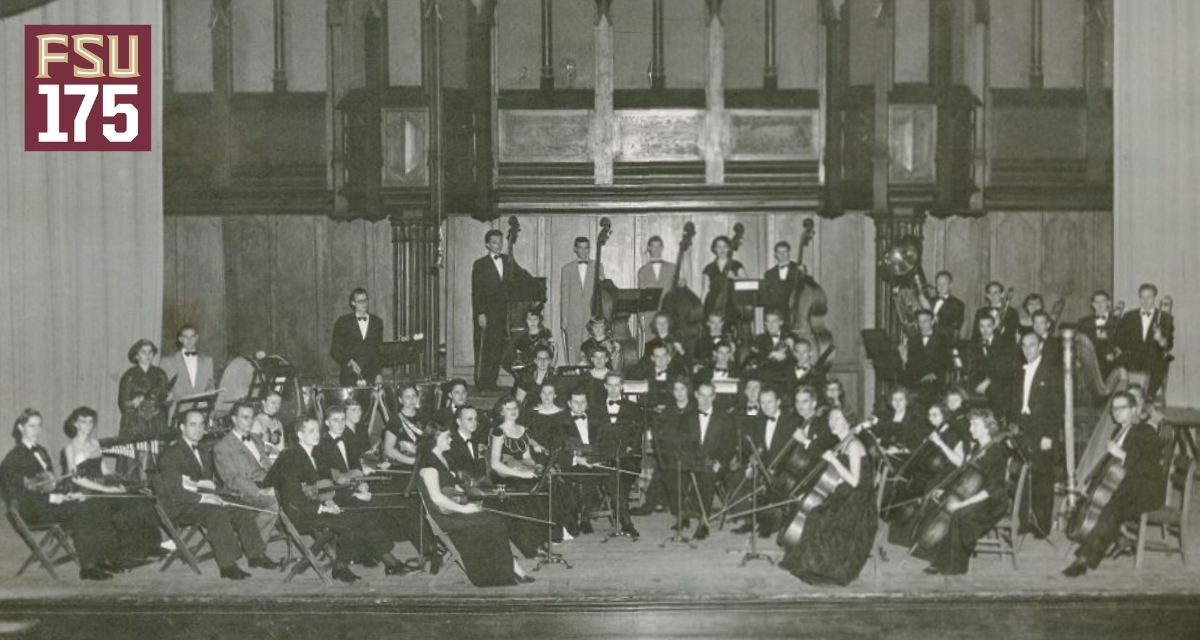
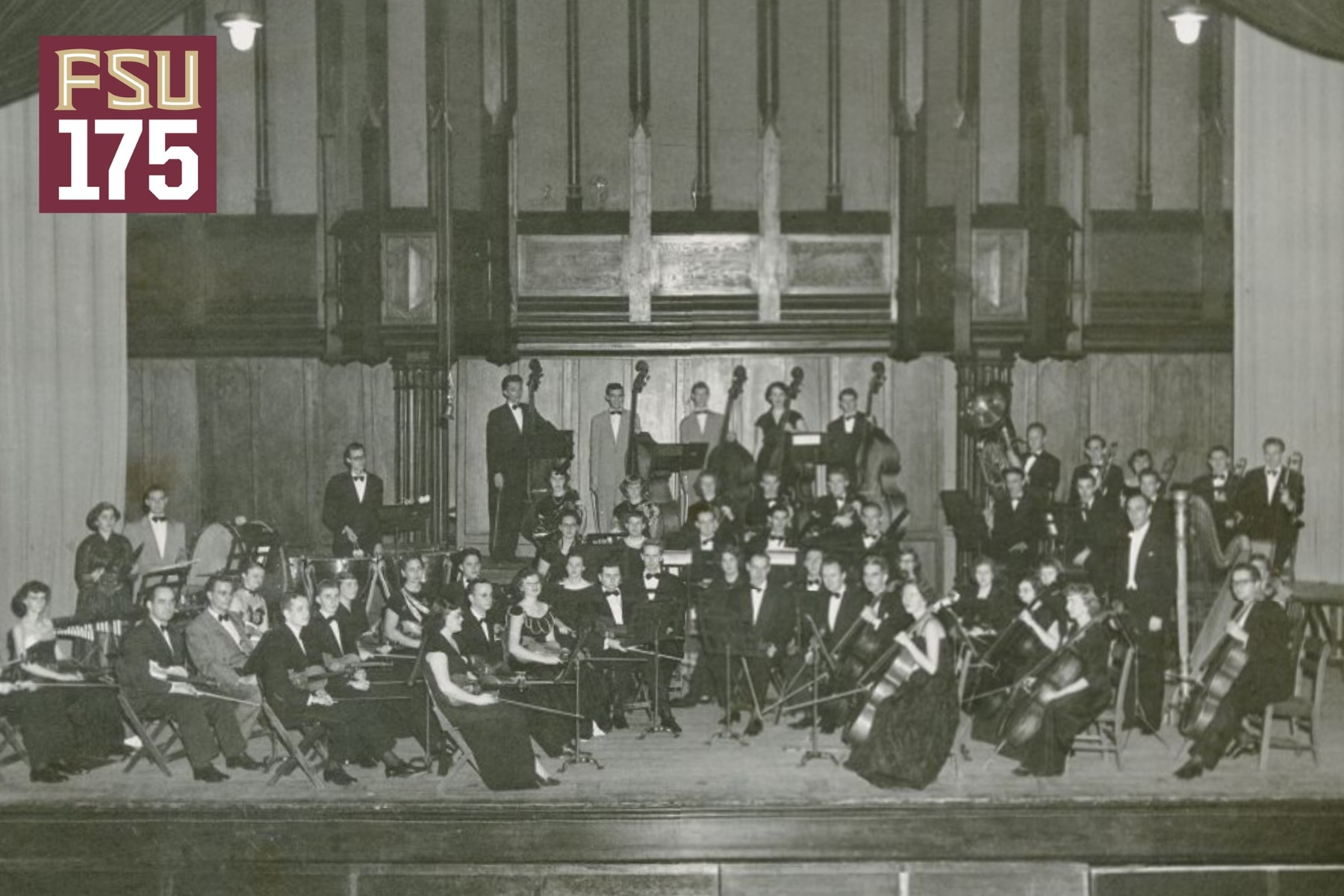
 The FSU Symphony Orchestra during a concert performance, circa 1960. (University Archives)
Long before Florida State University became known for its research enterprise and nationally ranked academic programs, the arts were helping shape the life of the university.
Music, theater and visual arts were among the earliest academic offerings at the institution that would become FSU, predating many of the STEM and professional programs taught at the university today.
Over the decades, those programs have grown into nationally recognized schools in music, film, theater, dance and design while bringing world-class artists, exhibitions and performances to campus.
Today, as Florida State celebrates its 175th anniversary, the arts remain central to the university’s identity by enriching campus life, connecting the university with the community and preparing generations of artists, performers and creators.
Four dancers perform on a stage during a modern dance performance, 1954. (University Archives)FSU film students capture a scene on set, while classmates ready a production slate. (University Archives)In 1909, art student Agnes Granberry designed the university seal banner featuring three torches and motto. (FSU Voices)Six students paint on Landis Green with an instructor in 1964. (Mike Moreno)
Even some of the university’s most enduring symbols emerged from the arts.
In 1909, Agnes Granberry, an art student and member of the Florida State College for Women Class of 1912, created the original design for the university’s seal and motto: three torches alongside the Latin phrase “Vires, Artes, Mores,” or “Strength, Skill, Character.” The design reflects the school’s mission to develop students physically, mentally and morally and remains one of the university’s most recognizable symbols today.
“The arts have long helped define the Florida State experience,” said First Lady Jai Vartikar, FSU’s ambassador for the arts and chairwoman of the university’s 175th anniversary celebrations. “The talent and creativity offered by these students is beyond compare, and I’m proud to support programs that continue to enrich our campus and community.”
1. 1900 — Music instruction begins at Florida State
The university’s music program begins with a single instructor teaching vocal and instrumental music at Florida State College. Over the next century it grows into the Florida State University College of Music, now one of the largest and most respected music schools in the nation.
Ella Opperman led the early music program, later becoming its first dean. (University Archives)The Opperman Music Hall bears her name as a tribute to her foundational leadership. (University Archives)
2. 1911 — Ella Scoble Opperman leads the music program
Opperman becomes director of music and later serves as the university’s first dean of music and helps transform the program into a formal academic discipline. Today, Opperman Music Hall in the College of Music complex honors her legacy and remains a central performance venue for student ensembles.
3. 1926 — The university presents its first official orchestra concert
Students from Florida State College for Women perform the institution’s first documented orchestra program. A century later, the College of Music recreated that 1926 program to celebrate the orchestra’s 100th anniversary.
The Chorus and Symphony Orchestra gather for a joint rehearsal, 1950. (University Archives)Students in the Music Camp Chorus pose for a group portrait outside Opperman Music Hall. (University Archives)
4. 1942 — Florida State launches its Summer Music Camps
The camps bring young musicians from across Florida to Tallahassee for intensive training and ensemble performance. Today the camps continue to serve hundreds of middle- and high-school musicians each summer.
5. 1950 — The marching band adopts the name “Marching Chiefs”
The band grows from a small student ensemble into one of the largest collegiate marching bands in the country. Today the Marching Chiefs include more than 400 members and perform for crowds of more than 70,000 fans each fall at Doak Campbell Stadium, making them one of the most visible performing arts traditions at Florida State.
FSU’s world-renowned marching band has earned global acclaim and widespread recognition. (Florida State University)Music faculty member Tommie Wright performs during a broadcast on WFSU-TV. (University Archives)In 1950, the FSU marching band officially adopted the name “Marching Chiefs.” (University Archives)The Marching Chiefs have grown to include more than 400 members. (Matthew McConnell/Florida State University)
6. 1950 — Music faculty member Tommie Wright composes music for the FSU Fight Song in 20 minutes during his lunch break
Professor Wright, a gifted pianist, taught in the FSU School of Music for 59 years after being hired in 1949 by President Doak Campbell. His musical treatment of lyrics by Doug Alley included the now-famous chant F-L-O-R-I-D-A, S-T-A-T-E and premiered at Homecoming in 1950.
7. 1954 — Florida State launches one of the nation’s earliest music therapy programs
The program pioneers the use of music to improve physical and emotional health. FSU’s music therapy program continues to train clinicians who work in hospitals, schools and rehabilitation centers.
8. 1955 — Carlisle Floyd’s opera Susannah premieres at Florida State
The opera debuts on campus before going on to become one of the most widely performed American operas of the 20th century. Floyd serves on the music faculty from 1947-1976 and helps shape the university’s opera program.
Carlisle Floyd taught at FSU from 1947-1976 and shaped the university’s opera program. (University Archives)A 1982 Fine Arts Festival program from Florida State University. (University Archives)
9. 1968 — The Fine Arts Festival expands arts programming at Florida State
The festival combines visiting artists with performances and exhibitions by FSU faculty and students. The event helps establish FSU as a cultural hub for the Tallahassee community.
10. 1971 — The Fine Arts Gallery moves into the Fine Arts Building
The gallery gains dedicated exhibition space for the first time on campus. It later becomes the Florida State University Museum of Fine Arts, which continues to present exhibitions and educational programs.
A 1971 photograph of the Fine Arts Building, which became the new home of the Fine Arts Gallery, housing campus exhibition and studio spaces. (University Archives)Today, the Fine Arts Building serves as a creative hub housing the College of Fine Arts, various departments and a museum. (Anna Prentiss/Florida State University)Theatre students apply makeup backstage before a performance, circa 1960s. (University Archives)Students continue this legacy, showcasing their talents during a live performance on stage. (College of Fine Arts)
11. 1973 — The School of Theatre is established
The program grows into a nationally respected training ground for actors, directors and designers. FSU theatre graduates have gone on to careers on Broadway, in television and in film.
12. 1979 — Composer Aaron Copland visits Florida State
The legendary American composer spends a week on campus working with students through concerts and master classes. His visit highlights the university’s growing national reputation in music.
13. 1981 — The Festival of New Music launches
The biennial festival showcases contemporary composers and innovative new works. It continues to bring leading composers and performers to campus.
14. 1983 — Ellen Taaffe Zwilich wins the Pulitzer Prize in Music
FSU faculty composer Ellen Taaffe Zwilich becomes the first woman in history to receive the Pulitzer Prize in Music. She later returns to FSU as a faculty member and remains closely associated with the College of Music.
FSU faculty composer Ellen Taaffe Zwilich becomes the first woman in history to receive the Pulitzer Prize in Music. (University Archives)FSU film students collaborate on a project, showcasing the hands-on approach established with the founding of the College of Motion Picture Arts in 1989. (University Archives)
15. 1989 — The Florida Legislature establishes the College of Motion Picture Arts
The program is created as a conservatory-style film school focused on hands-on collaborative filmmaking. It quickly develops a national reputation for training directors, producers and writers.
16. 1999 — Opening Nights launches at Florida State
The inaugural “Seven Days of Opening Nights” festival revives campus performing arts presenting. Today, Opening Nights brings internationally acclaimed performers to Tallahassee and connects artists with students through master classes, classroom visits and community events throughout the year.
FSU students attend a guest lecture featuring the production team of Morgan Freeman’s Symphonic Blues Experience in October 2025. (Opening Nights at FSU)FSU assumes stewardship of The John & Mable Ringling Museum of Art in 2000, expanding its leadership in arts education. (University Archives)
17. 2000 — Florida State assumes stewardship of The John & Mable Ringling Museum of Art
The partnership expands FSU’s role in museum leadership and arts education. The Ringling now serves as the state art museum of Florida and a major cultural destination.
18. 2004 — The College of Motion Picture Arts is recognized by the Directors Guild of America
The DGA recognized the film school for its distinguished contribution to American culture through film and television.
In 2004, the College of Motion Picture Arts was recognized by the Directors Guild of America. (Jim Moran College of Entrepreneurship)The College of Fine Arts united FSU’s programs in theatre, dance, visual arts and design under one academic unit in 2005. (College of Fine Arts)
19. 2005 — Arts programs unite under the College of Fine Arts
The college brings together Florida State’s longstanding programs in theatre, dance, visual arts and design under one academic unit. Sally McRorie, who previously led the School of Visual Arts and Dance and the College of Visual Arts, Theatre and Dance, serves as the college’s first dean. Today, the college continues to train artists, performers and designers across a range of disciplines.
An 84-year-old Ruby Diamond stands smiling next to the campus sign for the Westcott Administrative Building and Ruby Diamond Auditorium. (University Archives)The concert hall reopened in 2010 after a major restoration and acoustic upgrade. (Florida State University)The Ruby Diamond Concert Hall is located on the first floor of the Westcott Building. (Florida State University)
20. 2010 — Ruby Diamond Concert Hall reopens after a major renovation
The historic hall undergoes a major restoration and acoustic upgrade. Today it hosts concerts by visiting artists as well as performances by university ensembles.
21. 2017 — Film alumnus Barry Jenkins wins the Academy Award for Best Picture for Moonlight
Jenkins becomes one of the most celebrated graduates of the College of Motion Picture Arts. His success highlights the national impact of FSU’s film program.
22. 2017 — FSU alumnus J.T. Rogers wins the Tony Award for Oslo
Rogers earns the Tony Award for Best Play for Oslo, bringing national attention to the university’s theatre alumni and their impact on American drama.
Alumnus Barry Jenkins stands with former FSU President John Thrasher after winning the Best Picture Oscar for Moonlight. (Florida State University)FSU alumnus J.T. Rogers won the 2017 Tony Award for Best Play for Oslo, bringing national attention to the university’s theater program. (UNCSA)In 2021, School of Dance professor Jawole Willa Jo Zollar received the MacArthur Fellowship. (John D. and Catherine T. MacArthur Foundation)
23. 2019 —The Torchlight Studios Center for Cinematic Innovation is established
It’s created to ignite a revolution in cinema and bridge the gap between education and industry through three divisions: The Torchlight Cinematheque brings together the most daring, transformative films and artists from across the globe; the Torchlight Forge, with virtual sets and immersive storytelling, is redefining how stories are told; Torchlight Pictures is where genre filmmaking comes alive with purpose.
24. 2021 — Jawole Willa Jo Zollar receives a MacArthur Fellowship
The School of Dance professor and Urban Bush Women founder becomes the first FSU faculty member to receive a MacArthur Genius Grant, recognizing her groundbreaking work in dance, artistic expression and civic engagement.
In 2025, FSU acquired the former Regal Cinemas theater at Governor’s Square to expand facilities for the College of Motion Picture Arts. (College of Motion Picture Arts)Carrie Carusone sits with FSU film school students at the new facility, formerly Governor’s Square theater complex in Tallahassee. (Carrie Carusone)
25. 2025 —FSU acquires former Regal Cinemas theater at Governor’s Square
The theater expands facilities for the College of Motion Picture Arts and provides a dedicated venue for screenings and premieres. It allows students to showcase their films to public audiences.