



Storm clouds gather over the Peace River and the bridge connecting Punta Gorda and Port Charlotte. Charlotte County officials say Florida’s proposed property tax referendum could significantly reduce local government revenue, affecting funding for infrastructure, public safety and other county services.
Getty Images
Charlotte County commissioners voiced concerns about the potential consequences of a proposed property tax relief referendum after county staff outlined its projected impact on local government finances, growth management and public services.
The referendum, authorized by the Florida Legislature through House Joint Resolution 1 and scheduled for the Nov. 3 ballot, would expand the homestead property tax exemption for Florida homeowners. If approved, qualifying homesteaded properties would receive a $150,000 exemption beginning in 2027 and a $250,000 exemption in 2028 and beyond, with future adjustments tied to inflation.
Residents establishing homestead status after Jan. 1, 2027, would be required to maintain Florida residency for five years to qualify for the full exemption.
During a recent Charlotte County Commission meeting, department heads described what they believe could be significant financial and regulatory impacts if voters approve the measure.
Commissioner Stephen R. Deutsch criticized provisions that could reduce local government control over land-use decisions and development regulations.
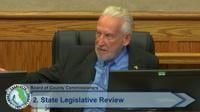
Charlotte County Commissioner Stephen R. Deutsch discusses the potential impacts of Florida’s proposed property tax referendum during a county commission meeting. Deutsch expressed concerns about reduced local control over zoning and development decisions.
Charlotte County government
“It looks like the state Legislature is getting to the point of completely neutering our local zoning regulations,” Deutsch said.
His comments followed a presentation by Planning and Zoning Director Shaun Cullinan, who said portions of the legislation would shift certain permitting and zoning authority from local governments to the state.
Cullinan said the proposal would allow manufactured and container homes in areas where site-built homes are permitted, although local governments would retain authority to adopt design standards. He also said some development approvals could move through administrative processes rather than traditional public hearings.
Commissioners expressed concern that reduced local oversight could limit residents’ ability to influence development projects in their neighborhoods.
The referendum’s financial implications generated the strongest reaction from county leaders.
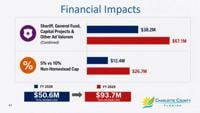
A Charlotte County financial analysis projects significant revenue reductions tied to Florida’s proposed property tax referendum. Officials estimate losses could approach $94 million annually by fiscal year 2029.
Charlotte County government
Legislative Manager Eve Sweeting said county projections show a loss of approximately $38.2 million in revenue in 2028 affecting the sheriff’s office, general fund, capital projects and other ad valorem-supported services. The projected loss would increase to $67.1 million in 2029.
Overall ad valorem revenue losses are estimated at $50.6 million in 2028 and $93.7 million in 2029, an increase of about 85% in just one year.
Assistant Finance Director Francine Lisby said nearly every area of local government would be affected except the Charlotte County Public Schools and private schools that receive voucher funding.
Lisby said about 41 cents of every local property tax dollar supports schools, while 31 cents funds the Charlotte County Sheriff’s Office. Another 18.82% supports countywide projects and services.
Lisby said the county’s healthy reserve balances have played a critical role in responding to recent hurricanes and other emergencies. However, current projections show those reserves could be exhausted within several years if no adjustments are made.
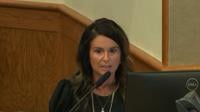
Charlotte County Assistant Finance Director Francine Lisby explains how local property tax dollars are allocated during a commission presentation. Lisby said the proposed referendum could affect funding for numerous county services.
Charlotte County government
“If no changes are made, we would deplete our reserves by 2032,” Lisby told commissioners.
County officials also warned that funding pressures could affect public safety operations.
Although the county is not required to maintain current funding levels for the sheriff’s office, staff projections indicate the agency’s reserve funds could be depleted by 2030.
Commissioner Dr. Chris Constance said the financial outlook could affect the county’s ability to borrow money for future projects. “We might not be able to borrow,” he said. “We will be begging Tallahassee for money; we are going to be completely beholden.”
Commissioner Bill Truex said he envisioned standing in line with 67 counties and 411 municipalities. “Some of these cities aren’t going to make it,” he said.
The referendum’s potential impact extends beyond county government.
Punta Gorda City Manager Melissa Reichert previously estimated the city could lose approximately $1.24 million in revenue during fiscal year 2028 and about $2.4 million in fiscal year 2029 if the measure passes.
Commission Chair Joe Tiseo said he is not opposed to tax reform but questioned why lawmakers moved forward without first conducting a formal economic impact analysis.
Sweeting confirmed that no such study was completed before the legislation advanced. Lisby added that lawmakers approved the proposal within a 48-hour period.
Tiseo said the expanded exemption could encourage more people to relocate to Florida, increasing demand for services at the same time local governments face declining revenue.
The discussion comes as Charlotte County continues to review applications for several large-scale development projects.

A Charlotte County presentation illustrates how local property tax revenue is distributed among schools, law enforcement, county services and special districts. Officials say the proposed referendum could affect multiple funding sources.
Charlotte County government
Residents have regularly attended commission meetings to oppose rezoning requests and higher-density development proposals. Commissioners expressed concern that changes to state law could reduce opportunities for public input on future projects.
Tiseo noted that some development approvals could move forward without the traditional notification process that alerts nearby property owners and informs residents through public notices.
Cullinan said certain projects could be reviewed administratively regardless of existing comprehensive plan or zoning designations.
County officials also noted that the legislation would require local governments to provide additional budget information to the state and conduct public workshops focused on spending reductions.
Tiseo said if the state assumes greater authority over local decision-making, it also may bear greater responsibility for infrastructure and other services traditionally managed at the county level.