
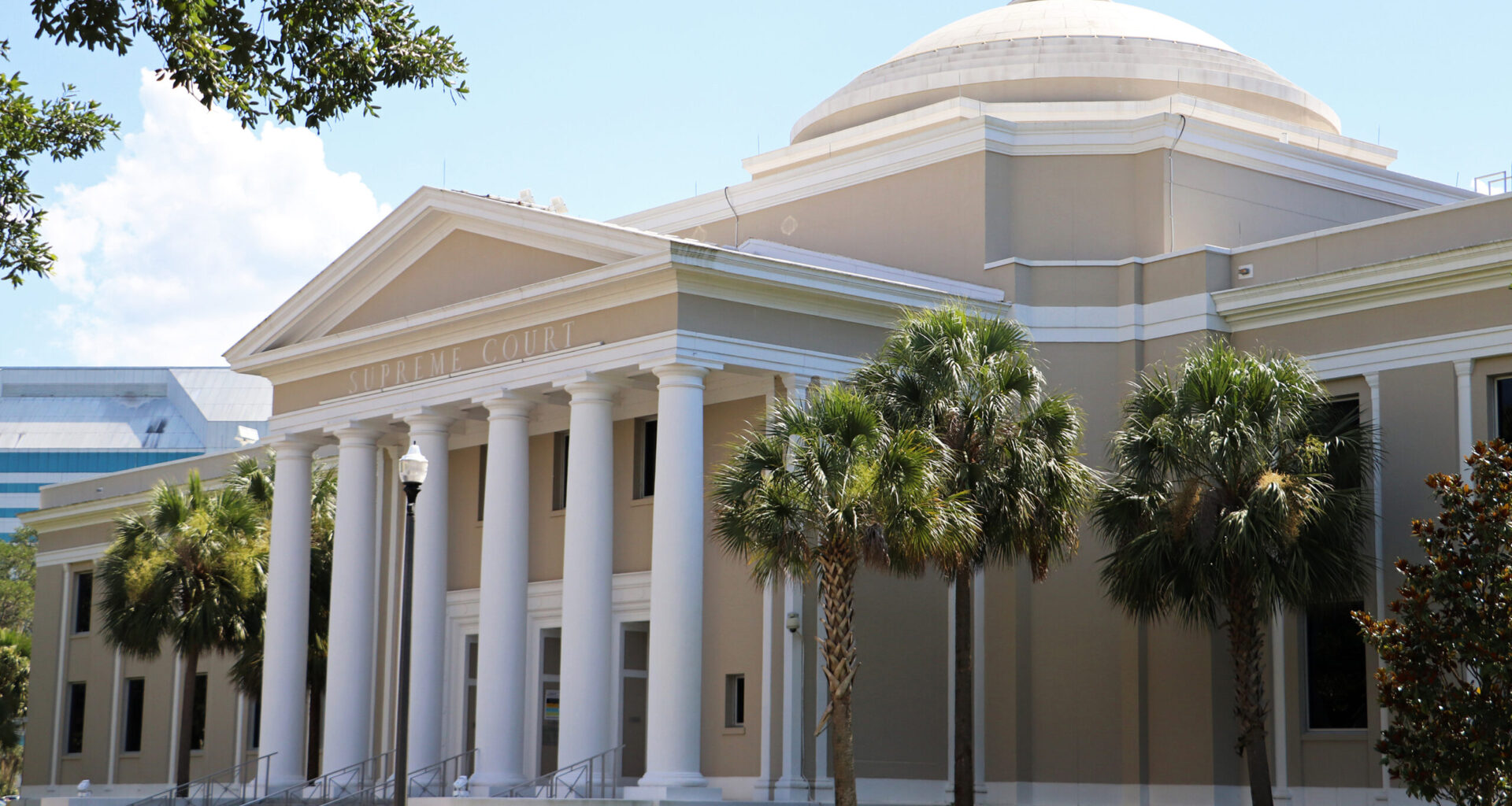
Efforts to stop implementation of a new congressional map in Florida hit a final roadblock. The Florida Supreme Court denied a petition from voting rights groups urging justices to put cartography on hold for the Midterms.
Equal Ground Protection Fund and other groups argued it would harm voters if a map goes into effect this year that is later determined to be illegal. But a Leon County circuit judge already denied a request for an injunction on the map, a decision the 1st District Court of Appeal declined to reverse.
Supreme Court justices say they won’t step into the process.
“At this time, we do not have jurisdiction over that matter, and we do not simply assume that the 1st District’s decision will provide an appropriate basis for this Court’s review,” reads a decision from a 6-1 majority.
Gov. Ron DeSantis cheered the decision.

“The Florida Supreme Court has REJECTED the challenge to the state’s redistricting plan and new map,” he posted on X. “This assures that the recently enacted map will be in place for the 2026 election.”
Plaintiffs argue the new congressional map blatantly violates the Fair Districts amendment in Florida’s constitution, and that a map signed only last month should not be used in the Midterms with that question outstanding.
The map cuts in half the number of congressional districts where Democrat Kamala Harris won a majority of votes for President in 2024, from eight to four. Under the new lines, 24 districts were carried by Republican Donald Trump.
Only Justice Jorge Labarga dissented. He said candidate qualification for Congress ends this week at noon, and that lower courts had wrongly stalled on the consideration of arguments against the map.
Labarga recalled the appellate court also caused delays on a challenge to a congressional map implemented in 2022. That challenge was only on new lines in North Florida, and the Supreme Court, while ultimately upholding the map, still admonished appellate judges for refusing to pass the case through to the state Supreme Court to expedite review.

“And yet, for a second time in fewer than three years, in a substantively similar context, the district court has elected a path of delayed appellate review. Only this time, the votes of even more Floridians are at stake,” Labarga wrote.
Labarga notably was the only dissenting justice on the 2025 decision upholding the congressional map approved in 2022, which was also designed by DeSantis’ office.
“Unfortunately, for now, and with a filing deadline and an election fast approaching, we will not have the opportunity to review the issues of statewide importance raised in the petitioners’ efforts to enjoin Florida’s 2026 congressional map,” Labarga wrote.
But Justice Adam Tanenbaum responded directly to Labarga in his own concurring opinion with the majority. He said it would be wrong for the high court to effectively rule on the outcome of the case at such an early stage of the process by granting an injunction.
“A temporary injunction just provides the trial court a tool to protect, if necessary, its jurisdiction until it can decide the case before it on the merits and afford the complete relief directed by law if the facts, sufficiently proven, warrant it,” Tanenbaum wrote. “Though the trial court must make some threshold, cursory prediction of a plaintiff’s ultimate success at a final hearing, the trial court is mostly assessing its own need regarding jurisdiction rather than a plaintiff’s substantive entitlement to an injunction. The determination does not truly bear on whether there has been an infringement of a substantive right.”