
ORLANDO, Fla. — Since its founding in 1776, the United States has pursued innovation and technological breakthroughs with a relentless drive impacting almost every corner of every community.
“It was back in the 60s when Ivan Sutherland realized that computers were powerful tools but operating them with switches and knobs was not going to be the future,” said Carolina Cruz-Neira, Executive Director of the University of Central Florida’s Pegasus Research Institute and Institute for Simulation and Training (IST).
“The future was to be able to have a more natural way to communicate with the computer, so he created the first interactive display and developed a pen where he would draw on a screen, which was the very beginning of visual simulation and that was born here in the United States,” said Cruz-Neira referring to Sutherland’s revolutionary Sketchpad computer program that he developed in 1963 as a PhD student at MIT.
Recognized internationally as one of the top innovators for virtual reality, Cruz-Neira has spent more than 30-years combining visual simulation with real-world elements and enhancing the human connection through interactive technologies, advanced computer science and systems engineering.
“I do a little bit of everything, including digital twins, along with art and design, for a holistic approach to our larger-scale systems. It’s the ability of having a human inside the computer for an immersive experience in the digital world,” said Cruz-Neira referring to the methodology that allows industry and government partners to test new technologies safely and cost-effectively before implementation in the real world.
Currently, Cruz-Neira is working with NASA on its historic missions to return humans to the moon and send the first humans to Mars for exploration. She and her team demonstrated a simulation with a robotic rover driving through an extreme amount of dust on the moon’s surface.
“This is to help researchers develop better materials and components that might be on the surface of the moon and Mars to be very durable and very safe to use. Here at the university, we do the deep science of the simulation, the physics of the simulation of the soil, the physics simulation of the top layers of the surface of the moon and Mars,” Cruz-Neira continued.
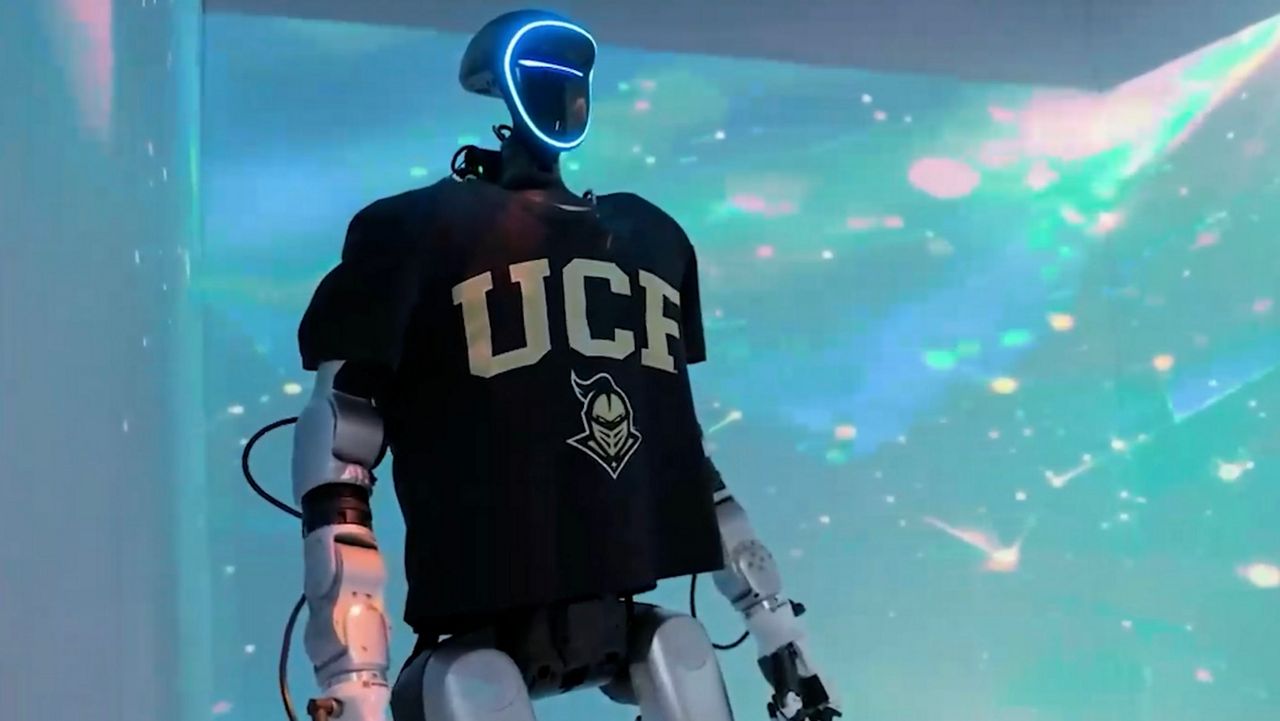
Under the umbrella of UCF’s Institute of Simulation and Training, it’s Mixed Emerging Technology Integration Lab (METIL) is also advancing critical research in artificial intelligence, blockchain, digital twins, cybersecurity and simulation-based learning.
“As a systems integration lab, we have an opportunity to take some of the latest and greatest emerging technologies and put them together,” said METIL Director David Metcalf who has spent more than 20 years researching in the areas of simulation training and several other digital engineering specialty areas.
“We are sitting here inside the DEEPspace, and that stands for Digital Engineering and Experiential Prototyping space. This brings all those skills that we discussed together and gives students the opportunity to lean into those digital engineering skills, which are the next generation [of] skill sets,” Metcalf continued.
Metcalf is also leading UCF teams that are advancing the human connection where physical presence and physical touch are no longer needed, and you don’t need glasses to experience their 3D environments.
“We have military, energy, space and health, and we’re doing things across all of those sectors, and those partners give us real-world opportunities for the student to work shoulder to shoulder with generals, admirals, vice presidents, directors of research and really get that experience that’s going to make them more valuable when they come out of their programs,” said Metcalf as his team demonstrated one of their projects using the latest 3D holographic technology and a haptic glove where if feels as if you are actually touching and moving real objects.
Feeling the weight of history and UCF’s critical place in it, both Metcalf and Cruz-Neira are hopeful that young adults, especially for America’s 250th anniversary this year, reflect on what brought us here and continue pushing the boundaries to see how far we can go.
“We stand on the shoulders of giants. Some of the early innovators that created some of the first driving simulators and the first flight simulators; some of the first medical mannequins, which are used for emergency rooms, teaching hospitals and the battlefield to train all those high consequence things that need extra simulation,” said Metcalf.
“I think it’s important that the younger generations don’t take so many of these things for granted, because we are not done yet. We still have to find it exciting enough to keep pushing,” said Cruz-Neira.