
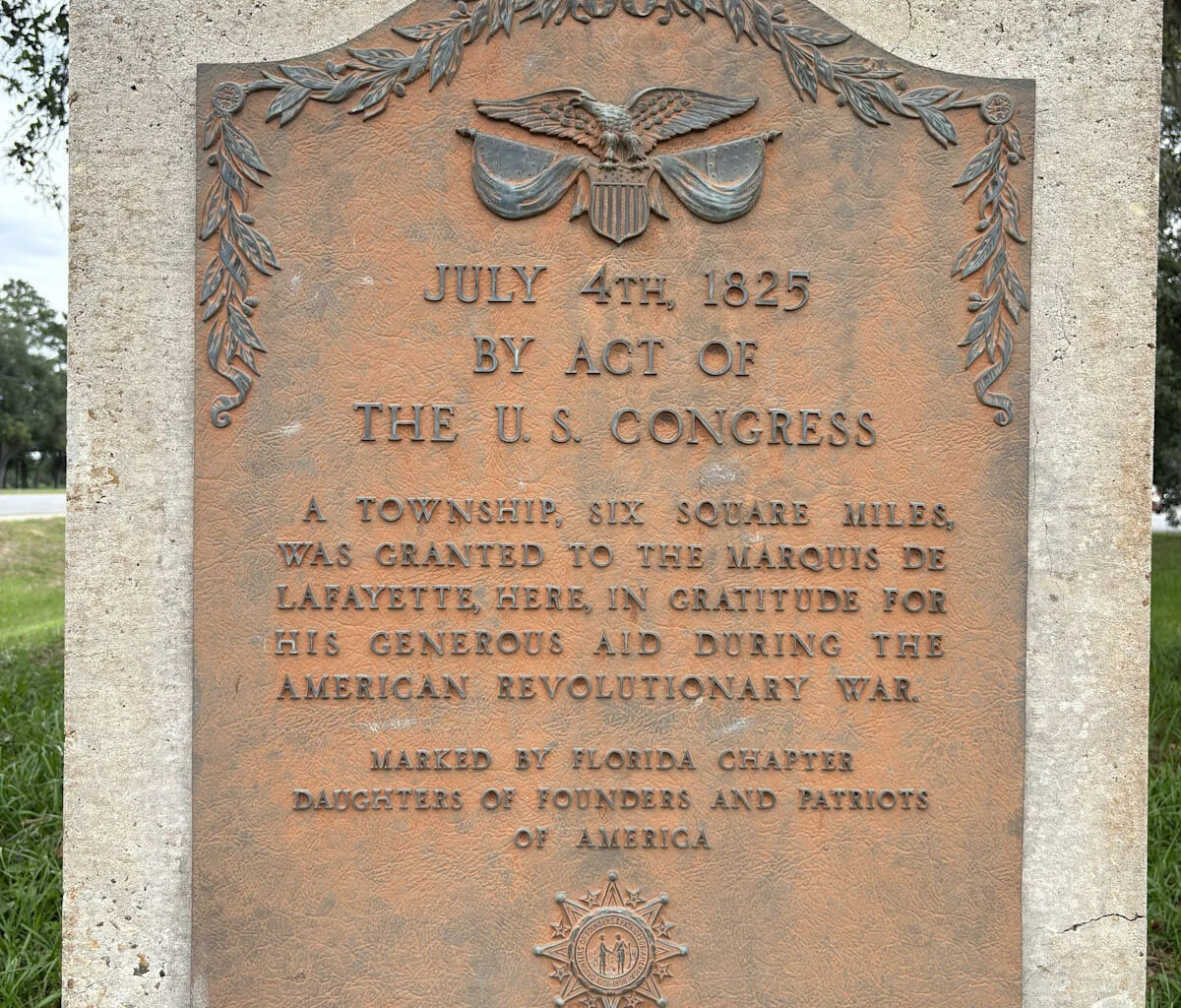
In 1824, U.S. Congress gave the Marquis de Lafayette a 36-square-mile plot of land in gratitude for his service during the Revolutionary War.
That land grant, which he never personally visited, shaped Tallahassee, and to this day remains a touchstone to an American hero from France in Florida’s capital city.
There’s a narrow strip of grass a mile east of the state Capitol. In it is a stone monument with a July 4, 1825 date. It marks one of the most important developments in Florida history: the establishment of a “township” used as the point from which much of the state is measured into parcels of land.
Across a busy highway from a shopping mall, the monument marks one of the fixed points for a congressional land grant to the Marquis de Lafayette, a French nobleman who used his money and skills as a politician and soldier in the fight for America’s independence.
The Lafayette township literally measured across the Florida landscape a vision of democratic self-government that the Marquis shared with future presidents George Washington, John Adams, and Thomas Jefferson.
Yet the capital that grew up around that marker, like Lafayette, time and time again has shown there can be distance between one’s beliefs and actions.
Lafayette was a General in Washington’s army and helped give the colonists several key victories. However, Lafayette was also important as a statesman, helping to legitimize the American Revolution in France and in other European countries.
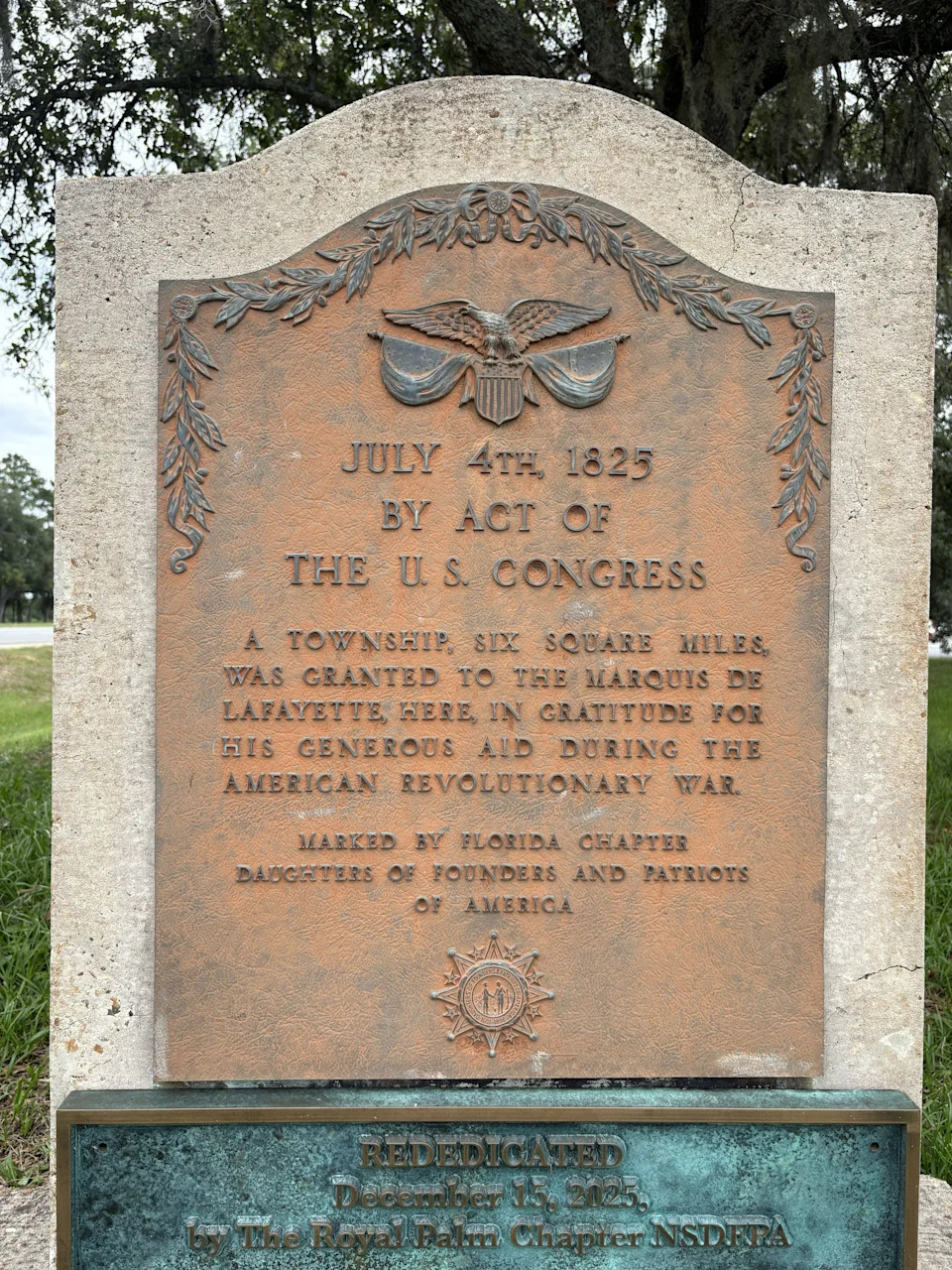
A marker at U.S. 27 and East Lafayette St designates the southern border of the 6-square mile township Congress awarded the Marquis de Lafayette. The marker is off Apalachee Parkway and directly across from Governor’s Square Mall.
“Lafayette is more complicated than being just an idealist,” said Rafe Blaufarb, the Ben Weider Eminent Scholar in Napoleonic Studies at the Florida State University Department of History. Blaufarb, an expert on the American Revolution and Napoleonic France, said at one time Lafayette was a hero on both sides of the Atlantic.
“But it went to his head,” Blaufarb said.
When the French Revolution broke out in 1789, Lafayette became a strong man at the head of a citizen militia, then fled to Austria.
To critics like Napoleon Bonaparte, Lafayette was politically naïve, and to radical Jacobins, he was a weak moderate. They dismissed him as an “empty-headed political dwarf” unable to comprehend the hard realities of politics.
“So in the U.S., Lafayette is a hero of liberty, a democrat, a supporter of republics against monarchies. In Europe, he is a kind of paramilitary strongman with political ambitions who supports kings against republics and betrayed his own country when it was at war,” Blaufarb said.
But in Florida as the nation gears up to celebrate its 250th birthday, the Lafayette legend is about 1776 and 13 colonies at war with the British Empire.
Of Lafayette’s role in convincing the Court of King Louis XVI to provide money and other aid to the American Revolution, Jefferson said, “In truth, I only held the nail, he drove it.”
On the battlefield, Washington referred to him as a loyal “son.”
As an expression of thanks, Congress awarded the Marquis a grant of 36 square miles of forest, streams, and lakes just east of the capital of the newly established Florida territory.
The grant was a perfect square of six miles by six miles. Today, highways, an interstate, big box stores, neighborhoods, parks, schools, and hospitals crisscross and dot the six-by-six-mile tract.
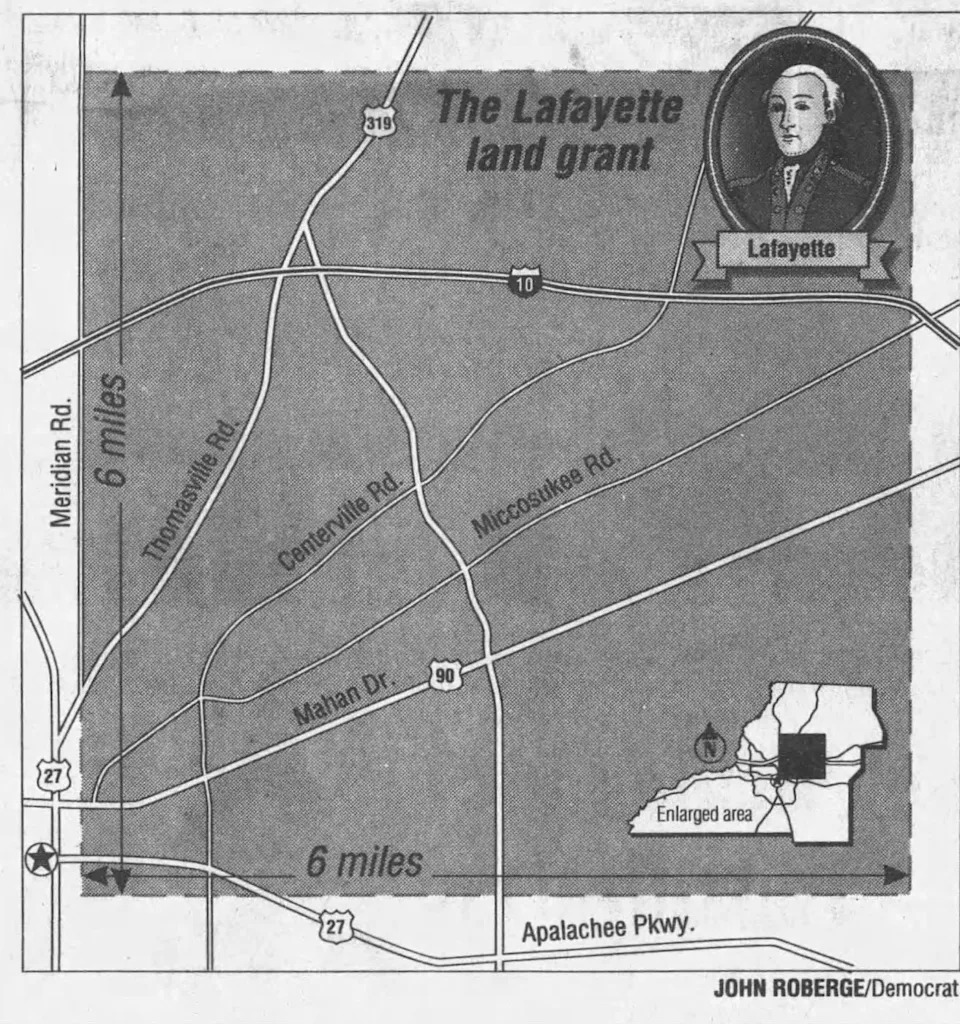
The Lafayette Land Grant as illustrated by then Tallahassee Democrat artist John Roberge.
On a map the township stretches from Apalachee Parkway, or U.S. Highway 27, to the north across Interstate 10 and the city limits. And it runs along the Parkway from the edge of downtown east toward Buck Lake.
The northern boundary is what are now the Killearn and Bradfordville neighborhoods, far beyond anything Tallahassee was in 1825.
The western line tracks north from Gadsden Street at Apalachee Parkway along Meridian Road through downtown, past Lafayette Park.
The southwest corner of the grid coincides with the Tallahassee meridian, the point from which all land in Florida is surveyed.
The grant did more than map land. It helped shape the character of the capital that grew around it.
Land ownership fixed in a precise grid encouraged development along straight corridors. The Lafayette grant steered Tallahassee’s growth to the east along corridors that would become U.S. 27 and 90, or Apalachee Parkway and Mahan Drive.
“In 1831, Lafayette, who opposed slavery, sent three friends and 60 Norman peasants to create a free labor colony on his land. On the banks of Prairie Lake, the colonists planted grape arbors and olive, lime and mulberry trees. But the crops failed, the French farmers were beset by illness and the colony was abandoned in a matter of months,” longtime Democrat columnist and historian Gerald Ensley wrote in 2002.
In 1833, a year before he died, Lafayette sold his township for $46,520 to land speculators, who sold it off in pieces.
Lafayette’s influence in a city that he never visited is felt in another way. Lafayette is an American Revolutionary hero and idealist who was mocked by his fellow Frenchmen.
It’s a split legacy. One that’s shaped by political combat and shared by both the man and the city.
Tallahassee is where former territorial Gov. Keith Call told Confederates that with seccession they had “opened the gates of hell.”
A century later, the 1956 Bus Boycott by Black residents gave an early boost to the Civil Rights Movement. Coincidently, the heart of Tallahassee’s historic Black neighborhood is known as Frenchtown.
And for the first election of a new millennium, an attempt by officials in Tallahassee to recount the 2000 presidential ballots pushed the nation to the brink of constitutional crisis.
More recently, Tallahassee’s resident-in-chief, Gov. Ron DeSantis, has been a front line soldier against “woke” policies and an unprecedented mid-decade redistricting of congressional districts to cement a GOP advantage.
Since its inception as a frontier capital, Tallahassee the city and Lafayette the man have been kindred spirits standing in that messy, confusing place where democratic ideals clash with political realities.
James Call is a member of the USA TODAY NETWORK-Florida Capital Bureau. He can be reached at jcall@tallahassee.com. Follow on X: @CallTallahassee.
This article originally appeared on Tallahassee Democrat: Lafayette never saw Tallahassee but helped guide its growth