
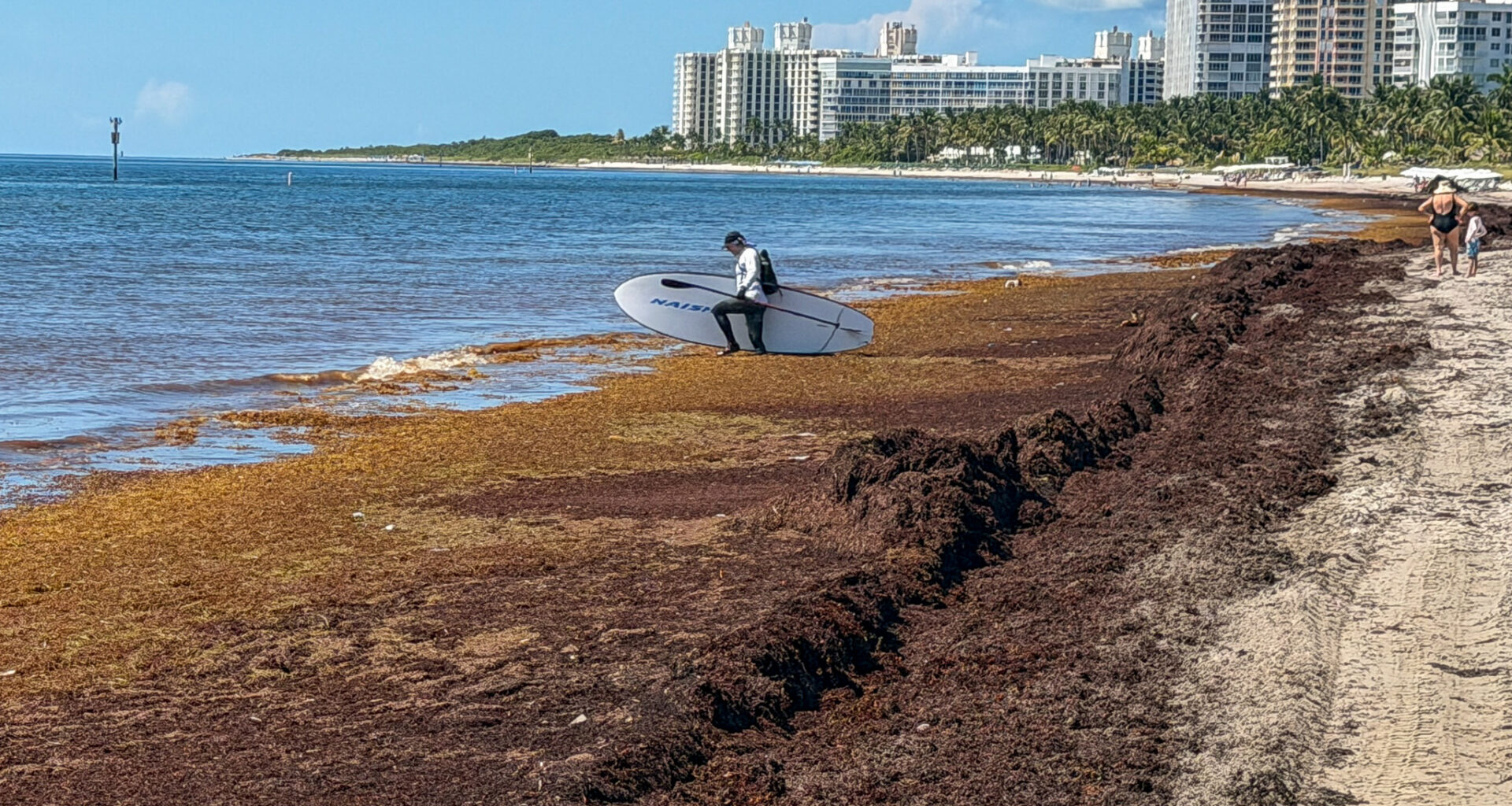
It took a break for a while, but just in time for the World Cup, the sargassum is back.
Stinky mounds of seaweed — sometimes as high as three feet tall — are filling up Key Biscayne’s Atlantic Ocean beaches.
It was so thick Sunday morning that a tractor — hired by the Village of Key Biscayne to clear the stuff — got stuck in the slimy mass. It was rescued (towed) by another tractor as residents watched from umbrellas near the Key Colony condo.
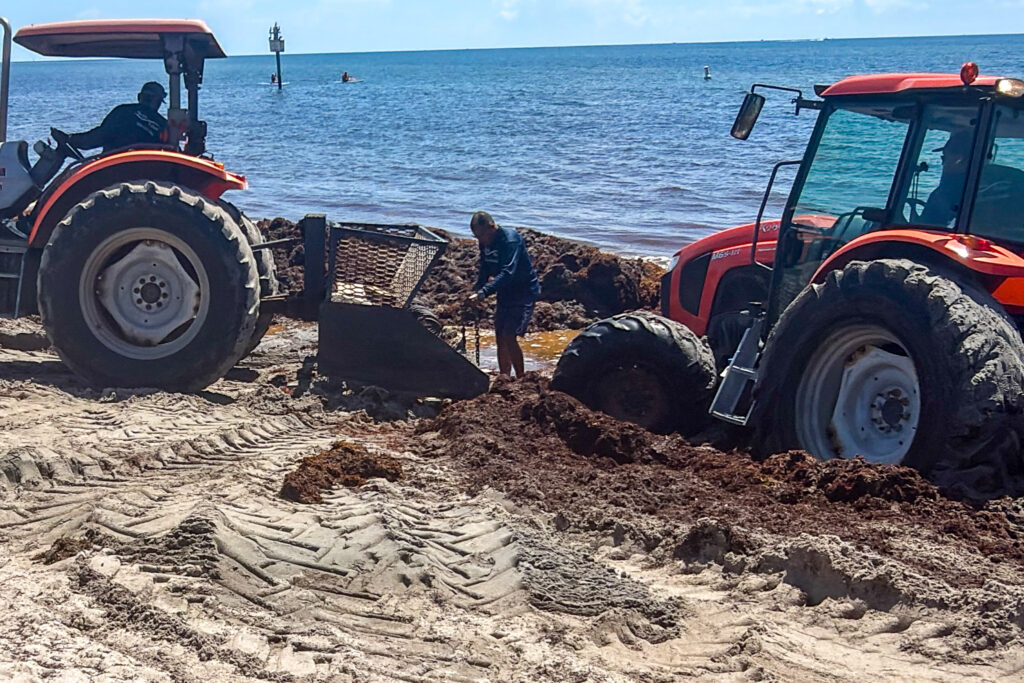 Alex Fernandez, a Beachraker operator, hooks up a chain between two units on a beach in Key Biscayne, Fla. The tractor on the right had become stuck in mounds of sargassum as deep as three feet. Scientists say sargassum flow across the region is increasing and that this may be a record year (KBI Photo/Tony Winton)
“Ironic,” said Dr. Chuanmin Hu, a sargassum expert. “A sargassum towing machine is being towed.”
Hu, a professor of marine science at the University of South Florida, said that while he can’t make a prediction for Key Biscayne specifically, the trend for 2026 is definitely up. Researchers track sargassum across the Caribbean and have noticed that giant blobs of seaweed are observably moving toward beaches this year.
“Sargassum amount in most regions is likely to increase in June. Beaching events around the Caribbean and southeast coast of Florida will continue and likely increase,” Hu’s lab reported in its May update.
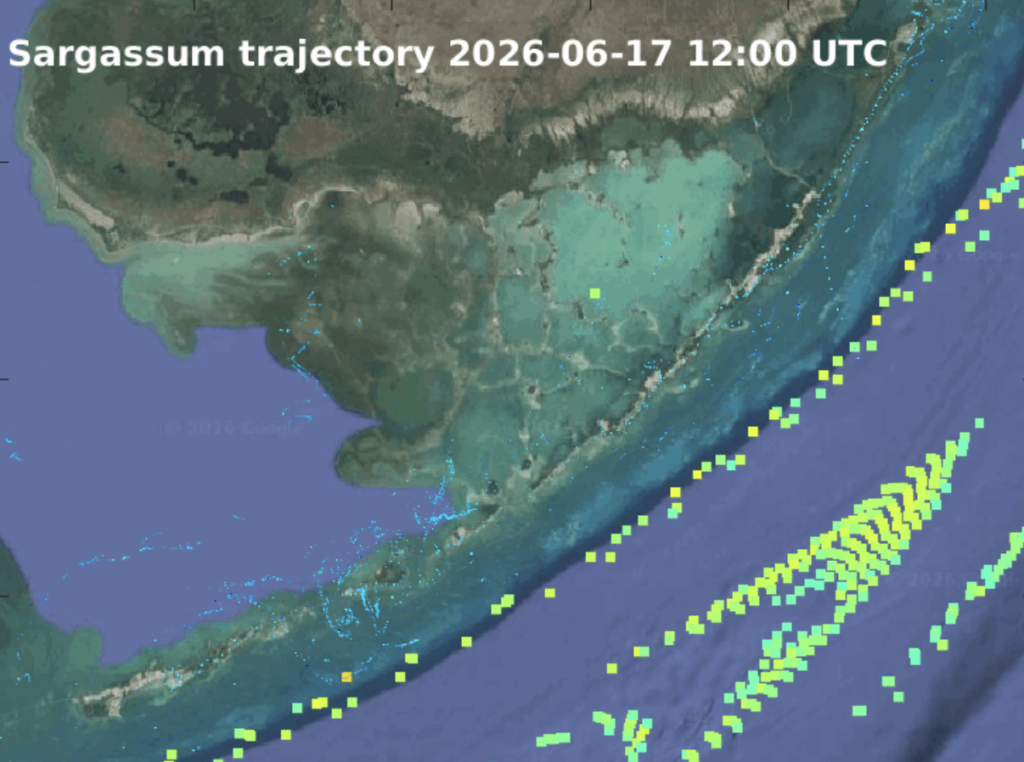 A screenshot from an experimental model by the University of South Florida, Ocean Circulation Lab that shows a forecast of sargassum conditions for June 17, 2026. (KBI via University of South Florida)
On Key Biscayne’s beach Sunday, people just coped. A man with a paddleboard carefully navigated his way across the expanse of seaweed, before launching into the water.
Typically on a weekend, the island’s condos lay out chairs for beachgoers. But despite the sweltering heat, there were relatively few people present at midday, with the unwelcome aroma of decaying seaweed filling the air.
Two visitors from Argentina, enthused about the World Cup, crossed the 20-foot sargassum barrier and swam anyway. “We came here for vacation. We don’t like it too much,” said Juan Ignacio.
Never miss a story! Sign up for our FREE newsletter
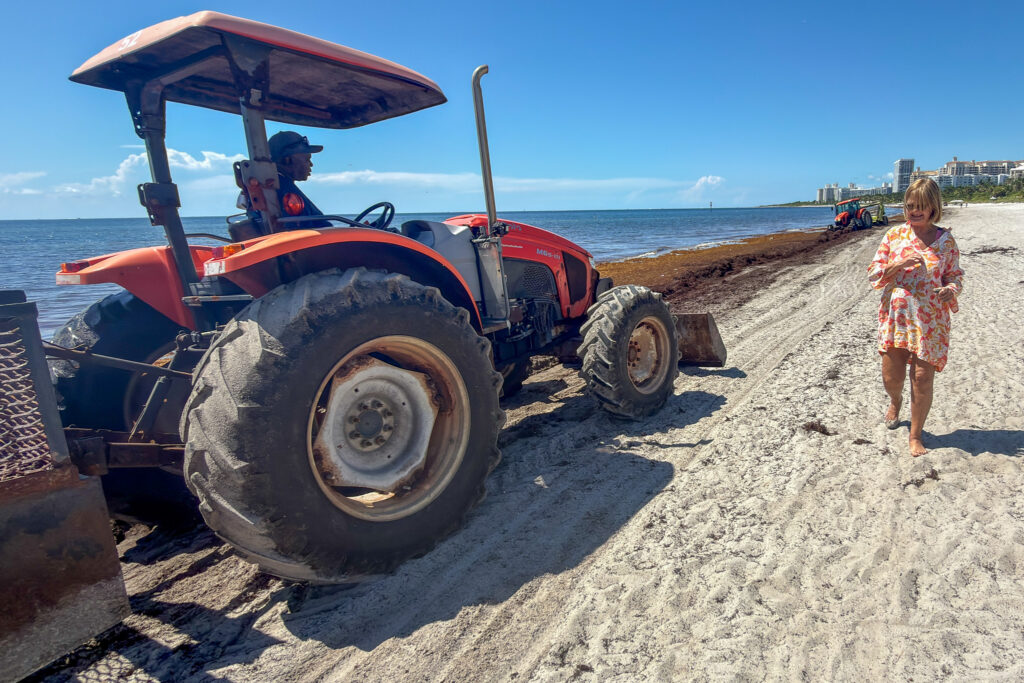 Annie Rothe looks on as two beach raking units remove sargassum from a beach in Key Biscayne, Fla. Sunday June 14, 2026. (KBI Photo/Tony Winton)
Annie Rothe, who was walking alongside the tractors, said she is accustomed to sargassum from the Dominican Republic. The seaweed — believed spawned by excess nutrient pollution — makes its way to Key Biscayne and many other locations.
“You just have to deal with it. There’s not much you can do, because it’s all the chemicals that are poured into the ocean,” Rothe said.

Editor-in-Chief
Tony Winton is the editor-in-chief of the Key Biscayne Independent and president of Miami Fourth Estate, Inc. He worked previously at The Associated Press for three decades winning multiple Edward R. Murrow awards. He was president of the News Media Guild, a journalism union, for 10 years. Born in Chicago, he is a graduate of Columbia University. His interests are photography and technology, sailing, cooking, and science fiction.