
Florida’s upcoming referendum on property taxes means taxpayers and voters should become more knowledgeable on the subject. The campaign for and against it has barely begun, but it’s already top-heavy with spin and distortions. We will try to sort it all out.
Voters will decide in November whether to increase the homestead exemption on non-school taxes from $50,000 to $150,000 for 2027, and to $250,000 in 2028, followed by a plan for full elimination in later years.
Supporters promise desperately needed tax relief, and opponents warn of a looming fiscal disaster. If it passes, property taxes would decline significantly, but cities and counties claim they would have to drastically cut services or scramble to replace lost revenue by increasing fees and shifting the tax burden to renters and small businesses.
State revenue experts estimate the first-year impact would be $1.2 billion across Broward, and $1 billion in Palm Beach County.
In Broward as in much of Florida, the amount of property tax revenue grows every year because growth never ends. Cities, counties and school districts get more money every year, even if they don’t raise the tax rate. This is what Gov. Ron DeSantis means by a revenue “windfall” that local governments use as a “piggy bank.”
He has a point. When mayors and commissioners boast that they don’t raise taxes, they are referring to the tax rate — not the amount people pay.
They’re not telling the whole story. They should.
When property values rise, more money flows to City Hall. This is why Florida requires taxing bodies to disclose the “rolled-back rate,” the tax rate that would produce the same amount of revenue as last year, excluding new construction.
This chart from Broward County Property Appraiser Marty Kiar shows next year’s projected increases in the taxable value of property for Broward cities. It is a vital factor taxing authorities use to build their budgets, for the fiscal year starting Oct. 1 (in a future issue, we will publish a similar chart for Palm Beach County).
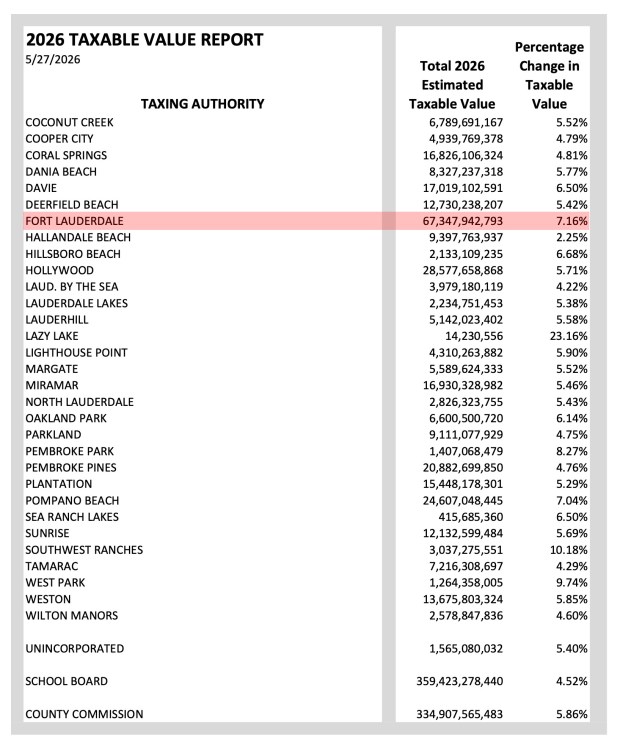 Every Broward city shows a projected yearly increase in the taxable value of its property, so every taxing authority will have a broader tax base from which to collect taxes next year. (Broward County Property Appraiser/Courtesy)
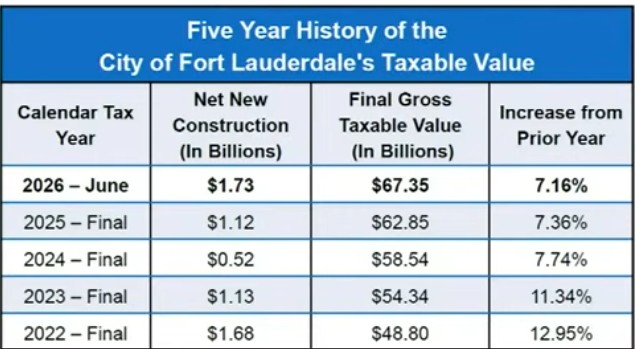
In Fort Lauderdale, taxable property values would rise by 7.2% next year, more than any other large Broward city. It would expand the city’s property tax base by $4.5 million.
That means the city’s property tax rate of 4.2 mills — unchanged for two decades — could be applied to an even larger tax base, generating more tax money without raising taxes.
The expanding downtown skyline is an obvious symbol of its healthy tax base. It continues to see strong growth in luxury condos, rentals, hotels and other commercial projects. Fort Lauderdale also has a smaller share of owner-occupied or homesteaded properties than its similarly-sized neighbors — Pembroke Pines, for instance.
The voter-approved Florida housing assessment cap, Save Our Homes, caps annual increases for owners of homesteaded properties at 3% or the rate of inflation, whichever is lower. Owners of vacation homes do not qualify for the cap, so their assessments can rise up to 10% a year.
As you ponder whether to vote “yes” or “no” on Amendment 3 in November, be aware of the many property tax implications.
The Sun Sentinel Editorial Board consists of Opinion Editor Steve Bousquet, Deputy Opinion Editor Dan Sweeney, editorial writers Pat Beall and Martin Dyckman, and Executive Editor Gretchen Day-Bryant. To contact us, email at letters@sun-sentinel.com.