
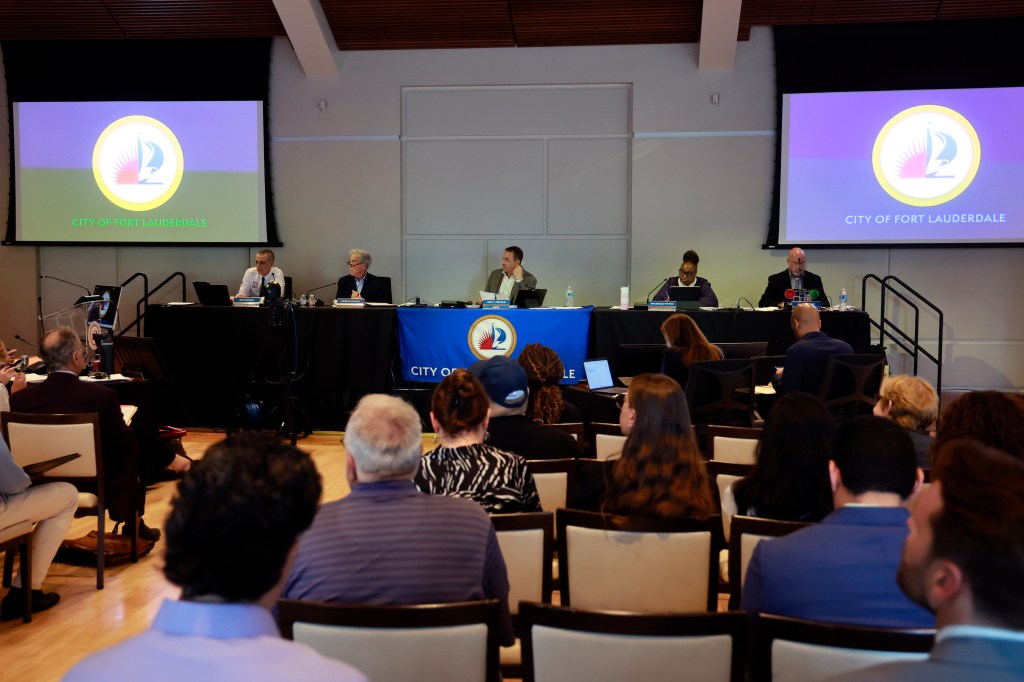
In Fort Lauderdale, there’s been talk of increasing the tax rate to balance the budget in case voters across the state say yes to property tax cuts in November.
The final decision is up to the city commission, a diverse quintet who don’t always agree.
Commissioner John Herbst is dead set against any increase in the tax rate, saying it “flies in the face” of the statewide referendum that would reduce the property tax burden on residents across Florida.
During a City Hall meeting this week, Herbst suggested the city go the other way and lower the tax rate ever so slightly.
“I’m not looking to slash and burn, but I think we can make a step in the right direction that shows the taxpayers that we take the financial distress they’re experiencing seriously,” he said. “Oil prices have battered our economy. Rising insurance rates have battered our homeowners.”
The city’s property tax rate — $412 per $100,000 in assessed property value — has remained the same for 19 years.
Commissioner Steve Glassman argued the rate should stay the same for the 20th year.
“I don’t think this is the right year to look at a millage rate decrease,” Glassman said. “I’m not in favor of that at all. I’m also not in favor of an increase. I think we should leave it alone and focus on how we can make cuts and how we could do things in a leaner way. I’m looking forward to that discussion. We have a lot of things on our plate right now.”
Mayor Dean Trantalis was out of town and could not attend the meeting. But in early June, he questioned whether the city might increase its tax rate to make up for voter-approved property tax cuts that could be on the way.
This week, Commissioner Pamela Beasley-Pittman said she’d like to look into increasing the city’s tax rate.
Vice Mayor Ben Sorensen said he’d prefer to lower the tax rate or keep it where it is.
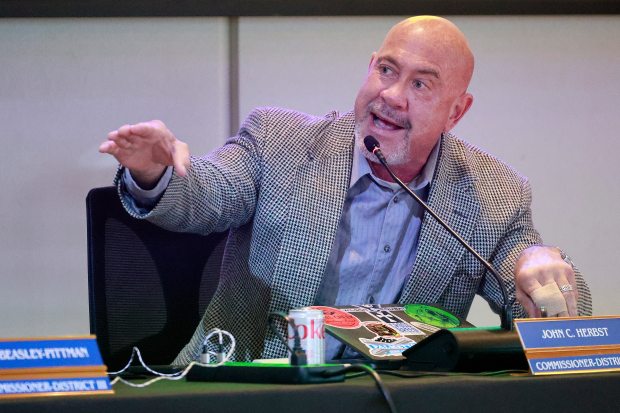 Fort Lauderdale Commissioner John Herbst, shown in 2024, says he will not support a plan to increase the city’s tax rate to make up for lost revenue in the event Florida voters say yes to a tax break in November. (Mike Stocker/South Florida Sun Sentinel)
For two decades now, commissioners have been reluctant to hike the tax rate, a move that typically leads to a fierce public outcry.
Financial consultants hired by the city have warned that one day Fort Lauderdale will have no choice but to increase its municipal tax rate to keep up with rising expenses.
If the city’s tax rate were to remain the same, the shortfalls will grow dramatically with each coming year, according to Kyle Stevens, a managing consultant with Stantec Inc.
The property tax cuts, if approved by voters, would only compound the problem.
If voters say yes to a tax break in November, Fort Lauderdale would be short $25.3 million in fiscal year 2028 and $44.8 million in fiscal year 2029, according to Stantec.
If voters say no to the tax break, Fort Lauderdale would still have a budget shortfall of $8.9 million the first year and $16.9 million the second.
Bill Brown, chair of Fort Lauderdale’s budget advisory board, echoed the advice of Stantec in addressing the commission this week.
“We are facing a turning point in our budget,” Brown said. “The expenses are far exceeding the revenues coming in. As you know, 61% of our budget is public safety and salaries and benefits. We’re mindful of the fact that the pie is only so big. There is a perception out there that the city is kind of bloated with the number of employees and our salaries.”
If the property tax cut referendum passes in November, Fort Lauderdale will face one of its most challenging budget years yet, Brown said.
With a tough budget season ahead, Fort Lauderdale City Manager Rickelle Williams told the commission she asked her team to show fiscal prudence when preparing their budgets for the next fiscal year.
“And although the team heard what I shared, I think shifting the mindset is probably something that we’re a little bit challenged with,” she told the commission. “And so even with that guidance, our departments came in with requests to the tune of $22.8 million and 92 new positions.”
Her recommendation: One new position. The new hire would be assigned to the city clerk’s office.
Williams said she and her team are looking at making strategic reductions.
“We’ve cut positions — six to be exact,” she said. “We are now budgeting for attrition across various departments. And we’re really looking at the bigger picture in terms of how we invest.”
Fort Lauderdale will continue to focus on making improvements in public safety, infrastructure, capital projects and technology, Williams told the commission.
“We think these are the primary areas where investments need to be made, not just for fiscal year 2027, but beyond,” Williams said.
She then listed the challenges ahead.
“We have a global conflict that is impacting inflation and the cost of goods and services,” she said. “We have property tax reform that will be decided by the voters. We have union negotiations with police and fire, our two largest personnel groups. We also have a City Hall project that the commission is contemplating. All of these factors have weighed into our approach in what we’re recommending for (next) year’s budget.”
Herbst, who spent 16 years as Fort Lauderdale’s city auditor before winning election to the commission, argued there’s room for cuts in the city budget.
“I’d be happy to go through the budget line by line and point out where I think those reductions should be,” Herbst said.
Olivier Cale, a member of the city’s budget advisory board, suggested Fort Lauderdale go on a diet with regard to its spending.
“We’re in a critical situation,” Cale told the commission. “We continue feeding the beast. And we don’t have the revenue to justify that anymore. Sixty-eight dollars out of every $100 we generate in revenue goes to salaries and fringe benefits and it’s going to get worse and worse.”
Cale recommended the city manager “do the dirty job that probably should have been done a few years ago and stop the bloating and growth” at City Hall.
“Let’s do real budget cuts without reducing service levels significantly,” he said. “Let’s get on a diet. And let’s provide reasonable relief for the residents.”
Susannah Bryan can be reached at sbryan@sunsentinel.com. Follow me on X @Susannah_Bryan