
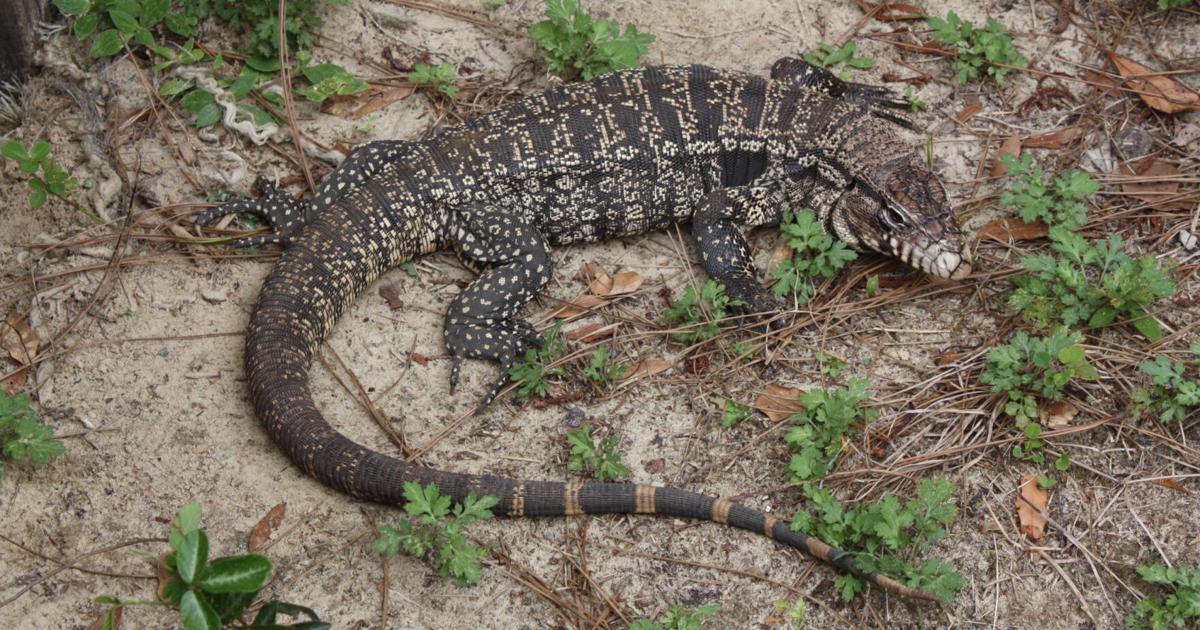
An invasive lizard has been spotted in Georgia, and wildlife experts are sounding the alarm to residents.
Georgia wildlife experts have seen an increase in the Argentine black-and-white tegu this year. They tell Local 3 that nearly eight sightings have been confirmed in southern parts of the state.

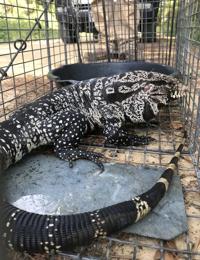
Denise Shepherd/Georgia DNR
Some refer to the reptile as dog-sized lizards, as they can grow up to four feet long and weigh up to 10 pounds.
The tegus are native to South America and are not protected in Georgia.
“They do have really big claws, really sharp teeth,” said Daniel Shollenberger, herpetologist with the Georgia DNR Wildlife Resources Division. “I always tell people, ‘I would rather hold an alligator than a tegu that size.’ Like, they’re very nimble, and if they don’t want to be held, they can bite. It’s a pretty nasty bite.”
The invasive lizards pose a risk to protected wildlife in Georgia. According to the agency’s website, tegus can spread exotic parasites to native wildlife and cause bacterial contamination of crops. Research shows they can also carry salmonella.
“They love to eat eggs, lots of reptile and bird eggs … birds that nest on the ground, turtle nests, tortoise nests, even raid alligator nests in Florida, and that’s a really big concern for our native wildlife,” said Sollenberger.
Sollenberger tells Local 3 News that tegus thrive in areas with climates similar to South America, which includes areas of Georgia and Tennessee.
Most sightings are in Toombs and Tattnall Counties in Georgia, with some as near as Walker County.
If you see a tegu, you’re encouraged to try to take a picture of the animal and upload it to the agency’s sighting map.
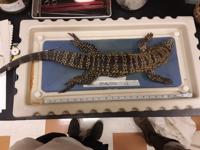
Georgia Southern University
If possible, residents can kill the lizard with a firearm or try to trap the animal in a small cage. Sollenberger says you can lure the lizard into a cage using a chicken egg.
As far as how the tegus got here, there are a few possibilities, according to Sollenberger.
“They probably came from the pet trade. And we don’t know if that was, like I said, that a few animals that got released together, or was it a female that was gravid, had eggs in her, and then these are all her offspring and their offspring. But we know they didn’t get here naturally,” said Sollenberger.
He says there is a population of tegus in Florida, but due to the distance between those and the ones sighted in Georgia, wildlife experts do not believe they are from the same group.
Tegus are illegal to own as a pet in Georgia and require the same license as a zoo, or to own a zebra.
The agency says there are not enough of them to tackle this invasive species alone and hopes to make Peach State residents more aware.