
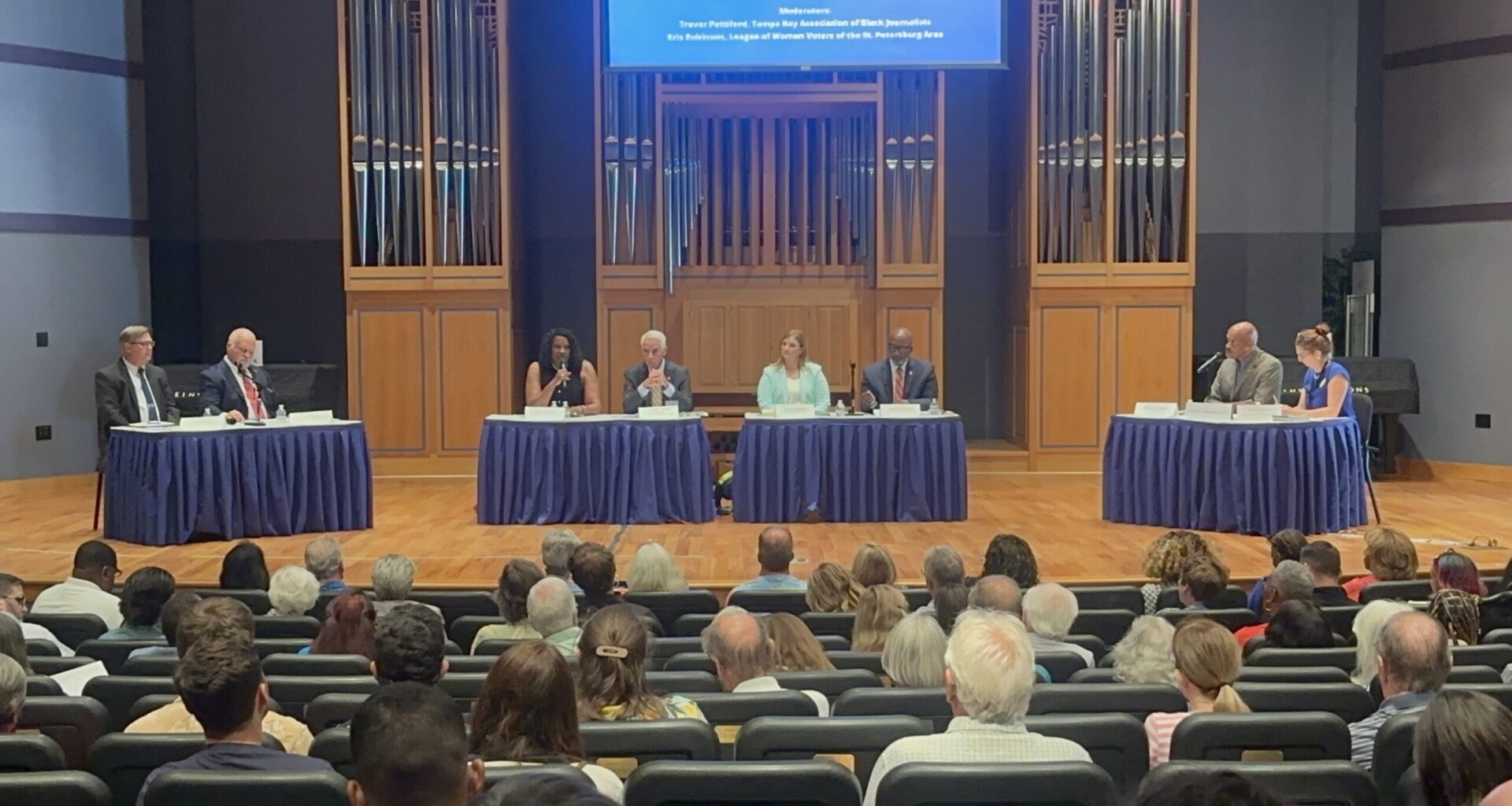
St. Petersburg’s mayoral candidates met again Thursday evening for the race’s second debate, but the tone was far more tame than their first forum, where tensions rose as opponents piled on incumbent Mayor Ken Welch.
Hosted by the League of Women Voters and partner organizations at St. Petersburg College, Thursday’s matchup was largely substantive and light on confrontation — in contrast to the NAACP-hosted forum earlier this month that turned into two hours of incoming fire on Welch.
The candidates fielded questions on property taxes, housing affordability, the future of the Historic Gas Plant District, growth, infrastructure, traffic safety, youth programs, arts funding, City Hall responsiveness, and diversity and inclusion.
The night also gave voters a clearer look at the race’s emerging themes: Welch defending his record through a first term marked by crisis and criticism of his response; former Gov. Charlie Crist promising a steadier hand and sharper executive leadership based on his political experience; City Council Member Brandi Gabbard leaning on years of experience at City Hall, business acumen and a detailed platform; jail administrator Maria Scruggs calling for administrative accountability; and former Shore Acres Neighborhood Association President Kevin Batdorf pitching business-minded fixes.
Former Fire Chief Jim Large also appeared alongside the other mayoral candidates for the first time. He called for a sharper focus on core city services.

Balancing development and the city’s charm
One of the night’s livelier moments came on a question about how to reconcile downtown’s high-rise boom with St. Petersburg’s character, as the Tampa Bay Times’ Colleen Wright reported. Candidates described neighborhoods that feel neglected as towers rise downtown, even as the 2024 hurricane season underscored the need to protect flood-prone areas nearby.
Scruggs, a former president of the NAACP’s St. Petersburg branch, said the city has prioritized developers over residents. “The focus has been downtown, downtown, downtown, and how can the buildings be higher, higher, higher. Missing from that conversation is what about the people,” she said, according to the Times. “So the way I would start with the conversation with development is to focus on the people first.”
Welch defended the growth as the product of decades of planning. “High rises are not the problem,” he said, per the Times. “The development is happening in the areas we planned for over 30 years.” He argued the real challenge is infrastructure: “If we had zero growth, we still would have a problem with our infrastructure.”
Crist said development pays for essential services but has to be done carefully. “St. Pete is a charming place to live, and is a special place to live, and so our development has to be smart. It has to be regulated appropriately,” he told the forum. “It provides jobs, so I’m for it, but I’m not for ruining the charm that makes St. Petersburg such a special place.”

Large called for slowing down, the Times reported: “We can’t keep putting tomorrow’s development on yesterday’s infrastructure.” Gabbard and Batdorf, who both live in flood-prone neighborhoods still recovering from the 2024 hurricanes, said they would make permits easier to obtain and study development’s effects on the city’s water, stormwater and wastewater systems.
Welch and Crist draw contrasts after a testy week
Welch and Crist, who delivered the sharpest exchanges of the first debate, largely stayed out of each other’s way this time around — but the two front-runners still drew clear contrasts on taxes, utilities, housing, and storm readiness.
Crist leaned into his affordability message. He pledged a property tax cut he said would save residents about $15 million a year. He also pointed to his record as Attorney General suing power companies on consumers’ behalf, saying he’d go to court again if necessary to keep utility costs affordable.
Crist also promised to speed up permitting and to use city-owned land and incentives to push for affordability in new development.
In a nod to criticism often raised by Welch’s critics, Crist said he’d prepare for major storms in advance of an emergency. He highlighted experience he gained as Governor, calling for hardened stormwater and sewer systems, a vulnerable-residents registry, pet-friendly shelters, advanced debris contracts and a single recovery center for permitting, inspections and FEMA help.
In response to questions about support for diversity, equity, and inclusion during a time of increased pressure from Tallahassee, Crist committed to protecting “every resident from discrimination in their job, their housing and their daily life. No exceptions.”
“I’ll stand with our LGBTQ neighbors, our young people and our families, and I will make sure City Hall has their back. Not just in June during Pride Month but all year long,” Crist said. “I’ll keep St. Pete Pride strong because it’s part of who we are, and it lifts this whole city. This one is simple to me: everyone deserves respect, and we need to treat everyone with respect, kindness and decency.”
Welch, by contrast, leaned on his record as the incumbent throughout the night.
On the budget, he countered that the deeper cuts proposed by Crist need to come with answers about what gets reduced, noting his administration already cut the millage rate over his first three years. He noted that residents at budget hearings have asked for more — not less — investment in public safety, complete streets, homelessness services and the arts.
“For the last 12 public hearings and budget public open houses, not one person has asked for a cut. They asked for more money for complete streets, more money for public safety, more money to fill the arts gap when the state cut the arts, more money for homeless services, more money to increase the CALL program, more money for affordable housing,” Welch argued.
“So it will be very difficult to cut $35 to $50 million from our budget, and that is one reason I oppose this. This is not property tax reform, this is a property tax shift.”
On utility costs, Welch noted electric rates are set by the Public Service Commission and said the city has leverage over franchise fees and utility taxes through its Duke Energy agreement, which is soon due for renegotiation.
He also highlighted his track record on housing, noting that more than 1,000 units have been preserved or built during his tenure, with another 1,000 in the pipeline.
Welch has also defended his administration’s storm readiness, pointing to the city’s existing registries and evacuation protocols. He said hurricanes Helene and Milton exposed a new level of threat that his proposed SPAR resilience plan is already meant to address.
The closest the night came to a direct clash was on diversity and inclusion, where Welch pointedly asked the stage who had spoken up when DEI programs, Black history curriculum and LGBTQ history were being stripped from schools.
The first mayoral debate did not broach the subject, but candidates criticized Welch later that night when interviewed about the topic by Florida Politics.
“What did you do when DEI was being threatened? When Black history was being pulled out of schools? When LGBTQ history was being pulled out of schools? Did you say something? I did. With the city’s name, as Mayor, on record I stood against … the backwards legislation coming from Tallahassee,” Welch said. “That’s important. That’s also why I renamed the Historic Gas Plant development from Tropicana Field, because it wasn’t about a baseball field. It’s about a community. So standing on those issues and using the bully pulpit as Mayor is what I have done, it’s what I’ll continue to do.”
The race’s front-runners largely skipped the fireworks this time, but plenty has happened off the stage since they last shared one.
The calmer night came after an eventful stretch for both campaigns. Welch’s political committee, St. Petersburg Progress, missed its latest campaign finance filing deadline this week, and the report that did land showed him still raising far less than Crist’s St. Pete Shines committee over the same period. State Sen. Darryl Rouson also signaled support for Cristthis week while maintaining his existing support for Welch — a dual nod that gave Crist a boost as voters look to community leaders for guidance on the mayoral race.
Crist, meanwhile, made headlines that had little to do with his race for City Hall. He joined Republican U.S. Sens. Rick Scott and Ashley Moody in calling for Tampa officials to cancel Ye’s upcoming concerts at Raymond James Stadium over the rapper’s history of antisemitic remarks.
His political committee also dropped a new ad this week hitting Welch over the scuttled Moffitt Cancer Center deal, closing with a dig that Welch lacks “the executive leadership to close the deal — not with Moffitt, not with the Rays, not for our city.”
The Moffitt deal was at the center of heated debate between the two candidates during the first event but was absent Thursday despite the new ad.
Large makes his debut
Former Fire Chief Jim Large made his first appearance on the debate floor Thursday evening, quickly establishing himself as the race’s most explicitly conservative voice.
Large leaned on his decades with the city, which include executive leadership in the Fire Department, where he worked under four different mayors and helped oversee budgets, facilities, personnel and crisis management.
He said the city needs operational leadership focused on core services — especially if voters approve property tax changes that could significantly impact city funding — and not career politicians.
Large argued local government should stick to “core responsibilities” rather than “political processes.”
He criticized the focus on energy prices and on Duke Energy, arguing water rates are a larger problem.
“My water bill has been higher than my electric bill for the last four months, so I don’t find the electric bill outrageous. I find the water bill outrageous,” Large said. “I think, as a city, we have far too many other problems to handle than to try … doing something with electric right now.”
When asked about DEI, Large said he believes city government should “stay neutral” on social, cultural and political issues and focus instead on services like paving roads.
“That road doesn’t ask you if you’re Black or white, or if you’re gay or straight,” Large said. “Whatever the case may be, they all deserve that road to be paved, to be driveable and to be safe. That’s the position the city should be in, providing safe neighborhoods and safe streets.”
Gabbard goes at Welch
Gabbard, who has largely avoided direct confrontation on debate nights, drew one of the clearest contrasts with Welch over the future of the Historic Gas Plant District.
Gabbard called for a comprehensive planning study before the city restarts a developer selection process for the land, arguing St. Petersburg should not rush to hand over one of its most valuable public assets without first deciding what should be sold, what should be kept and what the city actually needs from the site.
“I’ve led the charge at City Hall to request the pause of a developer selection until we can do a comprehensive study on this site,” Gabbard said. “The residents are asking us to make sure that we do not give away our most valuable asset before we know what we really need to have there in that location.”
She said residents are still asking whether the city should sell the land at all, or whether some parcels should remain public assets.
“We have not even begun to answer those questions,” Gabbard said.
Welch pushed back against delay, saying the city has already held extensive community conversations and heard the same priorities repeatedly: jobs, housing, economic opportunity and honoring the promises made to families displaced from the Gas Plant neighborhood.
“The way you honor those promises is to move forward and to not delay for another decade,” Welch said. “We’ve planned, and planned, and planned to death.”
Gabbard also criticized Welch’s responsiveness to post-storm recovery. She said resident services are a “culture issue” that starts at the top, stating that her Council office became an informal clearinghouse for residents struggling to navigate the permitting process after recent storms.
“My office served as essentially the triage office for permitting for about 20 months after these storms,” Gabbard said. “What I can tell you is that people need to be heard, people need to know response, they need to know where they are in the queue.”
Gabbard also invoked a past administration while discussing traffic safety, saying St. Petersburg passed its Complete Streets plan under former Mayor Rick Kriseman but has not kept up with the investment under Welch.
“We have failed in getting further investment in that plan over the last few years,” Gabbard said. “We need to reinvigorate that plan. We need to invest fully in that plan. I was endorsed by Activate St. Pete because I believe in people over pavement. I believe that people should be able to get around our city safely.”
Throughout the rest of the debate, Gabbard leaned on her Council record on housing, Duke Energy, traffic safety and storm recovery. She touted her work creating the city’s employee-assisted housing program and said she pushed the Council to devote 76% of federal ARPA dollars toward housing.
She also reminded the room she was one of two Council members who pushed the city’s “Dump Duke” feasibility study, emphasizing that it is not a promise to leave Duke Energy but a way to negotiate “from a position of power.”
Gabbard also highlighted her experience representing a district that she said lies 95% within the coastal high hazard area. She said the city needs to prioritize resiliency projects based on how many homes and businesses they can protect from future flooding.
Scruggs calls for less rhetoric, more receipts
Scruggs, the jail administrator, criticized the field for playing politics, repeatedly arguing that City Hall needs accountability, transparency and measurable results. She’s the only candidate to qualify by petition.
Scruggs said the city has spent more than $50 million on youth programming under the current administration but still faces “systemic, sustained issues” with young people. She said the city needs to audit how youth dollars are being spent before assuming existing programs are working.
Scruggs also offered one of the night’s more candid answers on infrastructure.
“I don’t have an answer,” she said. “This is a very complex and technical issue. The fact that I hear solutions being spewed, when we have neighborhoods flooding that have never flooded before, says to me we’re in trouble.”
She called wastewater, stormwater and hurricane resilience a complex and technical issue that requires bringing the right experts to the table rather than offering politically convenient fixes.
Scruggs also used the diversity and inclusion question to make a broader point about who has access to City Hall. She said too many decisions in St. Petersburg have been made “based on who you’re connected to,” and said hearing from a 15-year-old who described the city as a place of “cliques” showed a deeper problem.
“That tells me that we have a fundamental issue about inclusion,” Scruggs said.
Batdorf pitches business-minded fixes
Batdorf leaned into his outsider pitch and returned repeatedly to infrastructure, permitting and the value of city-owned land.
Batdorf said the city should leverage land near Tropicana Field, which he valued at $390 million, to help pay for other city priorities without new taxes. He also called for a different approach to development, saying developers should be required to show the full infrastructure impact of their projects and not just pay standard impact fees.
Batdorf proposed extending the Pinellas Trail into more neighborhoods to create a more connected bike and pedestrian network, and even floated the idea of adding an automated electric tram system along the trail.
He called for involving private businesses in youth programming to offer paid apprenticeships for teenagers, especially those at risk of entering the court system. He said the goal should be to connect young people with skills, financial advice and a path to full-time work or entrepreneurship.
Batdorf was most pointed on infrastructure, calling for accurate mapping of the city’s underground drainage and sewer pipes and prioritizing the most vulnerable systems first.
“It’s really not that hard,” Batdorf said. “It’s common sense, and it’s just not being done because it’s not sexy.”
With two forums now behind them, the contours of the race are coming into focus: a front-runner contest between Welch’s record and Crist’s promise of sharper executive leadership, with Gabbard, Scruggs, Batdorf and Large each carving out a lane — process and planning, accountability, business-minded fixes and a back-to-basics conservatism. The calmer tone Thursday is unlikely to hold. With the looming property tax vote threatening to reshape the city’s budget, campaign finance reports drawing fresh scrutiny and the Gas Plant District’s future still unresolved, the candidates have plenty left to fight over before voters render the only verdict that counts.