
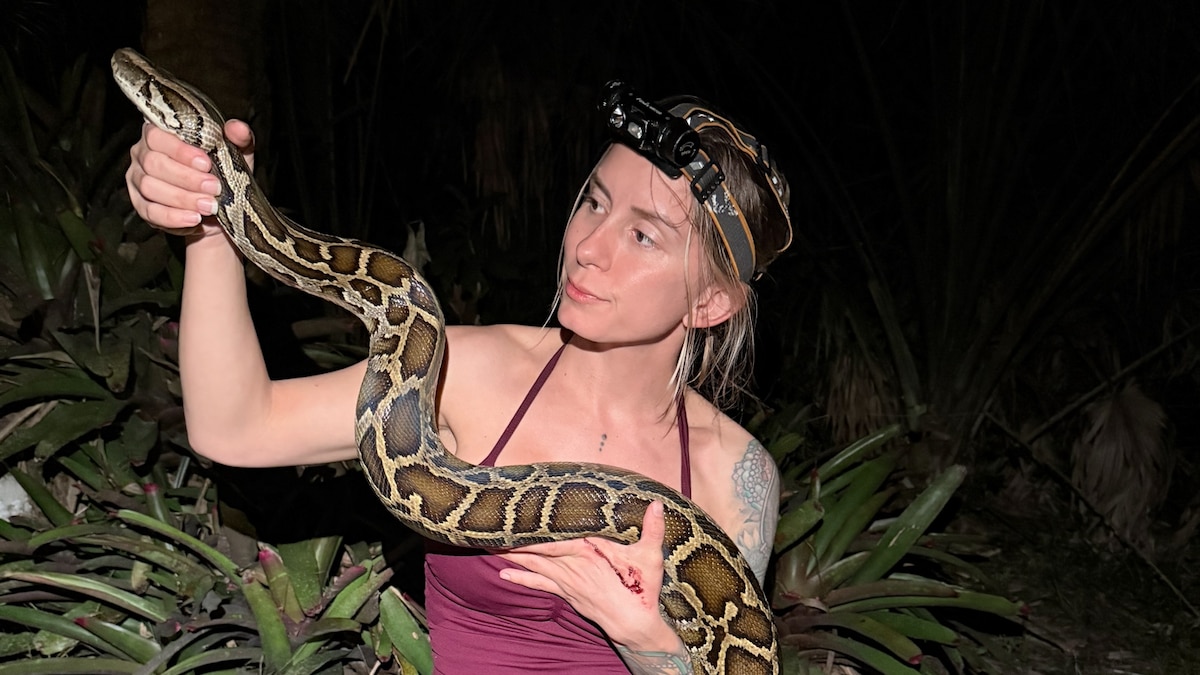
Before 2021, the challenge was typically held in the winter, but the FWC decided to move it to July to align with python hatchling season. Pythons mate in late winter and lay eggs in the spring. Females have been known to abandon their eggs if the nest is disturbed or there’s flooding, but they typically wait until a few crack open before slithering away for good. But moving the challenge’s dates also placed it in the middle of Florida’s rainy season, when daily torrential rainstorms and stifling humidity make the 90-plus-degree days and nights practically unbearable. The bugs don’t help, and neither does the Everglades’ unpredictable terrain.
Stanberry, however, was undeterred last year, kicking off her shoes to hunt barefoot, giving her more maneuverability in the cypress swamps. When she’s on any hunt, her adrenaline still spikes at the sight of the tip of a scaly tail in the bush.“Every catch really is different,” she says. “You just have to expect the unexpected.”
Some pythons are easy to collect, while others can coil around the hunter’s arms.“That’s when you get into some trouble,” she admits. Typically, when catching pythons, she does what most hunters do: grabs the back of their heads and mid-body. When extra-large serpents require more power, her husband, Rhett, steps in to help.
“I just grab them with my hands and put them in the pillowcase and … expect to be really smelly by the end of the night,” Stanberry says.
Python hunting is indeed a stinky business. The snakes have a nonvenomous bite, and they defecate on predators and musk them with an aroma that, according to Stanberry, resembles “dead fish.” It’s a defense mechanism that discharges a foul-smellingsubstance from their cloaca that either startles or disgusts a predator long enough that the python can slither away.