
TAMPA, Fla. — The world of horse racing has a rich history here in the Tampa Bay area, with the Tampa Bay Downs and a large horse training community.
But the history goes back even further than many may think.
This Juneteenth, we explore how the face of the horse jockey changed over the last 250 years and how that history is being preserved, and the efforts to popularize the sport in the Black community where it started.
From the American Revolution through the Civil War, horse racing was the country’s sport of choice, and some of the sport’s best horsemen were enslaved, according to experts. But the face and race of horse jockeys started to change over time, with very few Black jockeys in the sport to this day.
Pictured on the back of a horse after winning one race after another is how many people get to see jockey Rocco Bowen for the first time.
“You gotta like it, love it,” he said. “You gotta eat it every day.”
Bowen is living his childhood dream as a horse jockey. “As you know, the younger you are, the more fearless you are,” he said.
Rocco grew up in Barbados where he said there were more jockeys than horses and the remnants of the past aren’t as evident.
“In America, most people dream for kids are football. In Barbados, if you got a son you want him to be the next best jockey or be a jockey, you know,” he said.
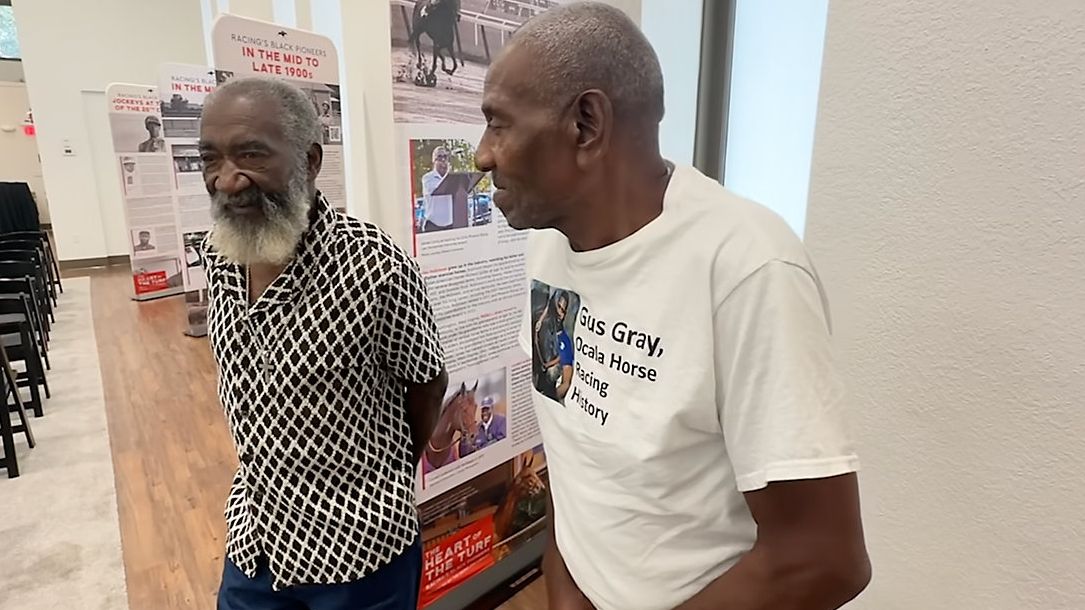
It’s the kind of dream that’s rooted in a history dating back to the American Revolution. And it’s detailed in part with this traveling exhibit, The Heart of the Turf: Racing’s Black Pioneers, recently on display at Tampa’s Black History Museum.
Lugusta Gray and Willie Lee Jones drove down from Ocala to see the exhibit that examines every era of horse jockeys in Kentucky.
“This means a lot to me, and it should mean a lot to everybody else that we have come this far, but we can go further. But we gotta get out of the history books and go to the OBS and start to buy your horse,” said Gray.
They also came to share some of their own experiences.
“I never worked on the racetrack,” Jones said. “I was always on the farm, we’d get the horse ready to go to the races.”
For decades, both men, now in their 80’s, worked on the horses in the races, but never as jockeys. Historians say that was by design.
“You have to remember Jim Crow racism was at its height in the early 1900’s and that’s when almost all the Black jockeys disappeared almost overnight,” historian Fred Hearns said.
With all of the books, pamphlets and exhibits over the last 250 years detailing the once thriving Black rider nearly erased, there’s an effort to move the needle forward.
“Nine of the first 12 Kentucky Derby’s were won by Black jockeys, and no one asks the questions, what happened to them, where did they go? What changed? What is the history between now and then, and how do we move that history forward as far as making sure everybody of every walk of life can be involved in the sport,” horse industry expert Tammy Gantt said.
It’s what Rocco says all the young people coming up behind him are counting on.
Gray and Jones said one way to have more black horse jockeys is to have more black thoroughbred horse owners who hire them to ride and compete. It’s an industry that has many layers and draws in billions. It’s an industry first made successful by Black riders.
To learn more about the exhibit, click here.