
As rising ocean temperatures bleach and kill coral reefs around the world, scientists at Woods Hole Oceanographic Institution are searching for a rare category of reef that might hold the key to their survival.
Researcher Anne Cohen has spent years tracking down what she calls “super reefs” – coral communities that resist or recover from extreme heat even as neighboring reefs turn ghostly white and die. Her research is focused on the Central Pacific, where she has been working in the Marshall Islands to identify, protect and eventually connect heat-tolerant reefs into a vast network that could help repopulate degraded reefs across the region.
Since 2023, record-breaking marine heat waves have swept through the tropics, fueling the most severe global coral bleaching event ever recorded. More than 80 percent of the world’s reefs have been impacted in at least 83 countries and territories. Scientists warn that without significant intervention; the majority of tropical reefs could disappear within a generation.
Cohen’s team uses a combination of ocean-current modeling, lab heat-tolerance testing and an unmanned robotic vessel called Yellowfin which is fitted with a GoPro camera, to survey vast stretches of reef quickly. The robot can capture up to 20,000 images while covering 40 miles of reef in a single day, far beyond what any dive team could achieve. Artificial intelligence is now being used to analyze those images automatically, flagging which coral colonies bleach under heat stress and which ones don’t.
The goal is not just to find resilient reefs, but to protect them and ultimately use them as nurseries, seeding heat-tolerant coral into restoration projects so that rebuilt reefs have a better chance of surviving future warming.
Cohen’s vision is even larger: a “super reef blue corridor” stretching across the Marshall Islands, Kiribati and Tuvalu, where ocean currents would connect protected super reef sites and allow heat-resistant coral offspring to spread naturally across the Pacific.
Miami’s urban reef, up close
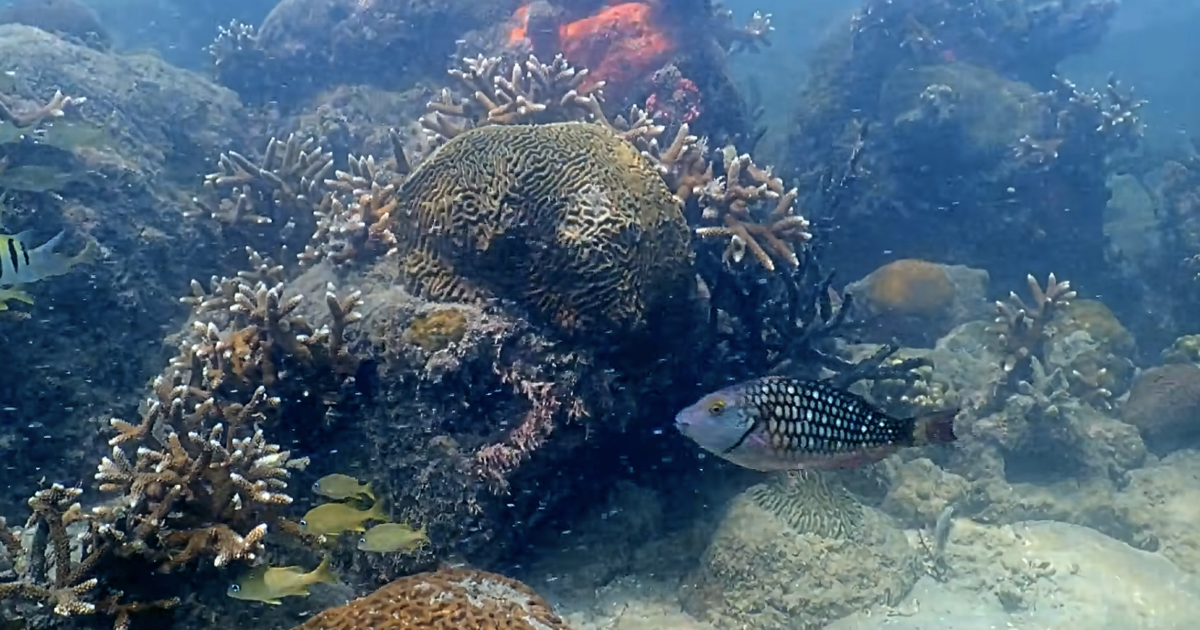
South Florida residents don’t have to travel to the Pacific to connect with coral. In Miami, a live underwater camera called the Coral City Camera streams the daily life of an urban reef sitting in about 10 feet of water near PortMiami.
The Coral City Camera is a public art and scientific research project by Coral Morphologic, produced with Bridge Initiative and Bas Fisher Invitational. The stream offers an unfiltered look at Miami’s living reef – fish, invertebrates, and coral – in real time, any time of day.
For Key Biscayne and greater Miami residents who care about the health of Biscayne Bay, the camera is a rare window into what lies just beneath the surface of Biscayne Bay and the surrounding coastal ecosystem. Viewers can watch at coralcitycamera.com, also streaming live on YouTube.
The stakes are high locally. South Florida’s reefs are part of the Florida Reef Tract, the only barrier reef in the continental United States and an important ecologically and economically important marine ecosystems. That reef system has suffered repeated bleaching events in recent years, with 2023 and 2024 bringing catastrophic high-water temperatures to the area.
Cohen’s research into what makes some corals survive while others don’t is the kind of science that researchers in Florida are watching closely. Scientists at the University of Miami’s Rosenstiel School of Marine, Atmospheric, and Earth Science are among those working on parallel coral restoration efforts, including experimental cross-breeding of heat-tolerant coral strains for outplanting in places like Dry Tortugas National Park.
The message from scientists is consistent: time is running out, but there is still reason for hope, especially if heat-resilient corals can be found, protected and used wisely.
Source: Inside Climate News / Teresa Tomassoni. Additional information from coralcitycamera.com.
As ocean temperatures rise, scientists hunt for corals tough enough to survive – and restore – our warming seas.