
Come July 4, Americans from all 50 states will gather to celebrate the 250th anniversary of our nation’s founding and our revolution against British rule and independence from the British crown. No matter that British blood ran deep in the settlements and cities that emerged after English settlers first arrived in Jamestown in 1607 and at Plymouth Rock in 1620.
But in Pensacola at the time? In St. Augustine?
No, Florida’s relation to our shared country is different from that of, say, Massachusetts, with its Pilgrim heritage, or Virginia, with its early British roots. Yes, Pensacola was ruled by the British in 1776, the year of revolution, but the city had only been under British control for 13 years at the time.
Pensacola’s history, and that of the state, was much more influenced by Spain than England.
“One of the problems with Florida being left out of things in the United States as it was forming is it was Spanish,” said Judith “Judy” Bense, historian, author, archaeologist and president emerita of the University of West Florida. “They were not British, they were not Anglo at all, they were Spanish and they were Catholic and that’s what was going on here.”
Check out June’s photo highlights of Pensacola’s news of the day
1 of 5
Maggot Sandwich frontman and founder Mike Graham and the band’s current drummer, Mike Kimberl, rehearse for an upcoming show on June 3, 2026.
(Tony Giberson/Pensacola News Journal)
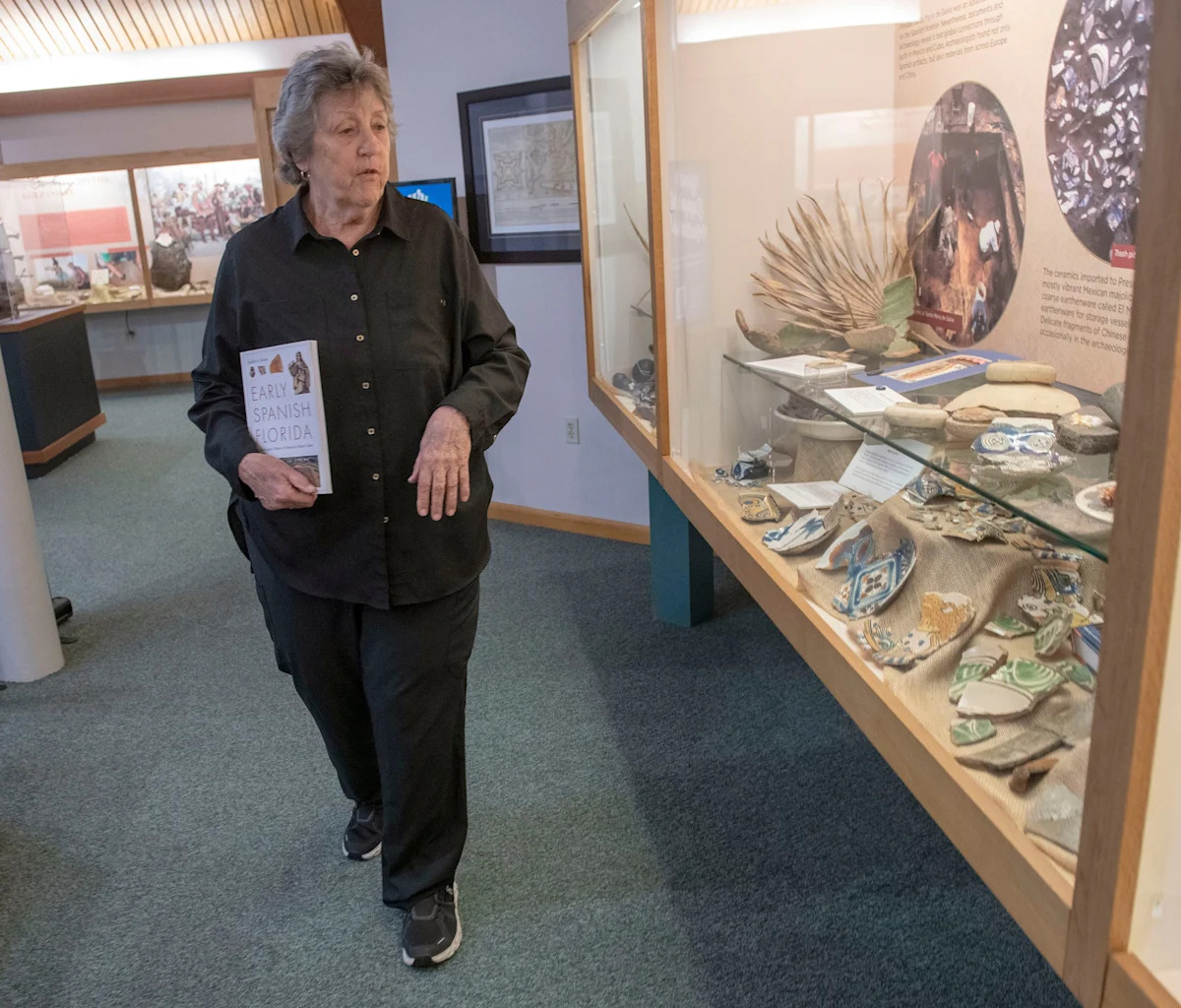
She’s not just talking about Pensacola. She is talking about Florida as a whole. Now Bense—used to writing in precise academic styles filled with, as she puts it, “five-syllable words, lots of charts and fine print”—has released a new book, “Early Spanish Florida − Unearthing the History of America’s Oldest Colony,” a book she said was written for all those interested in history, even casually, and not just academics.
“This is 250 years of Spanish control of Florida,” Bense said, referencing the time from Spanish explorer Ponce de Leon’s landing expedition of 1513, just 21 years after Columbus sailed “the ocean blue,” to the early 1760s, when the British first gained control of not just Pensacola, but Florida.
“Some people kind of forget how old Florida is. Everybody thinks of Jamestown and Plymouth Rock and all that, but when they landed in 1620 in Plymouth Rock, the third generation of Floridians was growing up in St. Augustine.”
Bense said her book, published by the University of Florida in association with Florida Humanities, will hopefully educate people about Florida’s very different connection to United States’ history.
“So, there’s an emphasis on how unusual this is,” Bense said. “Many people don’t know that the first capital of Florida was in South Carolina at Parris Island or that Florida extended all the way to the Mississippi. This is news to the general public. I think a lot of people are going to be surprised.”
The recently released book sells for $32 and is available at Barnes & Noble, Books-A-Million and Bodacious Bookstore, as well as on Amazon.com and other online sellers.
Whereas Bense’s previous academic books and publications have those charts and five-syllable words, her “Early Spanish Florida” is a user-friendly 227-page publication with more than 150 color images—including photos of startling archaeological finds, illustrations, old maps and paintings—that non-academics like me and most of you really prefer in our books.
More of Bense’s work: Setting the stage: Our Pensacola is fifth Spanish settlement on Pensacola Bay
There is plenty in Bense’s book on Pensacola, going back to Tristan de Luna and his ill-fated expedition to the area in 1559, and the establishment of the first European settlement in the New World on Pensacola Bay where East Pensacola Heights is located today. That settlement was Spanish, not British, and though the Pensacola settlement was doomed and abandoned within two years, it predated Jamestown and Plymouth Rock by decades. There is much on the area’s presidios (Spanish military posts or fortified settlements) and history related to Spain through the British occupation of 1763. Still, Bense knew the book had to be more than just an examination of Pensacola’s history but must include all of Florida as well.
“I knew that a book for the public on West Florida wouldn’t sell because it’s too small of an audience,” Bense said. “So I decided to expand it to all of Florida. I wanted to use ordinary language that people can understand, but I think it’s still pretty darn educational.” (Reporter’s note: It is.).
Bense thought writing a non-academic history book would be easier than the books written for academia and other experts in the fields of history, anthropology and archaeology.
“In academic writing, it’s very defensive,” she said. “You have to have your sources, you have to cite everything, you have to write it in a way that you could absolutely defend it because there are going to be critics and they’re going to pull it apart. But with this book, there’s no bibliography. I don’t cite a thing except in the text, but the public has trust in my expertise to tell them the truth.”
And she didn’t want to betray that trust, earned through decades of scholarship and leadership in her field.
“So when you get right down to it, I had to do as much research for this book (as for others),” she said. “It took me so much longer than I thought it would … I had to get details down so I could summarize it, just like you do.”
This article originally appeared on Pensacola News Journal: How Judy Bense makes Spanish Florida clear and why that matters