
By Anne Cosgrove
From the May/June 2026 Issue
Recognized for its population growth, tourism industry, and favorable tax environment, the state of Florida has evolved into a more diversified economy—one increasingly attracting headquarters operations, financial services firms, aerospace investment, logistics facilities, and advanced technology companies.
Under Governor Ron DeSantis, Florida economic development policy in 2026 is emphasizing tax relief, infrastructure investment, workforce development, and business recruitment as central pillars of the state’s strategy.
Gov. DeSantis’ proposed 2026-2027 “Floridians First” budget highlights continued investments in workforce programs, infrastructure, and business competitiveness while pursuing additional tax relief measures. One of the administration’s significant priorities has been eliminating or further reducing Florida’s business rent tax. The state has already reduced the tax in recent years, and Gov. DeSantis has noted additional reductions as essential to maintaining Florida’s competitive edge.
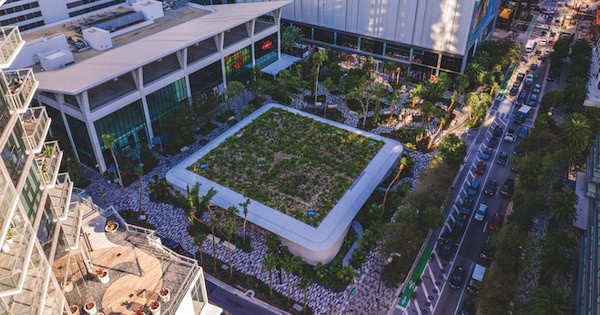 Miami Worldcenter is a 27-acre downtown district in Miami, Florida featuring residential, retail, hospitality, and public space. Opened in 2025, the district has achieved LEED for Neighborhood Development (LEED-ND) Silver Certification. (Photo: Miami Worldcenter)
At the same time, Florida’s leadership continues promoting the state as a destination for financial services, aerospace, technology, and headquarters operations. According to FloridaCommerce, the state worked with economic development partners in 2025 to secure 58 new economic development projects that generated more than $5.5 billion in capital investment and nearly 8,900 new jobs with average wages exceeding $100,000 annually.
Economic growth continues to benefit from strong population inflows and business migration trends. South Florida is seeing a continued influx of financial firms, investment groups, and technology companies relocating operations or establishing secondary headquarters in the region. Miami, West Palm Beach, and Tampa have emerged as increasingly important centers for finance, private equity, fintech, and corporate headquarters operations.
The state’s lack of a personal income tax remains an advantage in executive recruitment and corporate relocation decisions. Florida also benefits from strong consumer growth, international connectivity, and expanding infrastructure investment across ports, airports, and logistics corridors.
Exports & Global Reach
In April, FloridaCommerce and SelectFlorida shared that Florida businesses exported a total of $78.9 billion in 2025—increasing by $6.4 billion (8.9%) from 2024. Additionally, Florida’s manufactured products accounted for 92% of all Florida-grown and Florida-made exports in 2025, with manufacturers exporting approximately $72.2 billion—increasing by $6.3 billion (9.5%) over 2024 and $19.5 billion (37%) since 2018.
“Florida continues to break economic records by providing Florida businesses with the resources they need to expand their footprint, create jobs and support their local economies.,” said Florida Secretary of Commerce J. Alex Kelly. “Florida has been ranked the #1 economy in the nation for three consecutive years with the fastest growing manufacturing sector in the country. This record-breaking performance is a direct result of our strategic investments into the talent development and critical infrastructure needed to set the foundation for businesses to expand beyond our state borders and onto the world stage.”
“Through continued collaboration with Florida businesses, trade partners and logistics leaders, SelectFlorida is helping small and emerging business reach customers worldwide,” said SelectFlorida President Matt Swanson.
Bilateral trade through Florida’s seaports and airports in 2025 totaled $205 billion—increasing by $8.3 billion (4.2%) from 2024. The top export markets for Florida businesses included Brazil, Mexico, Canada, Germany and Colombia. The top categories of Florida-made exports are: civilian aircraft & parts; Telephones; pharmaceuticals, turbojets and gas turbines; and cars.
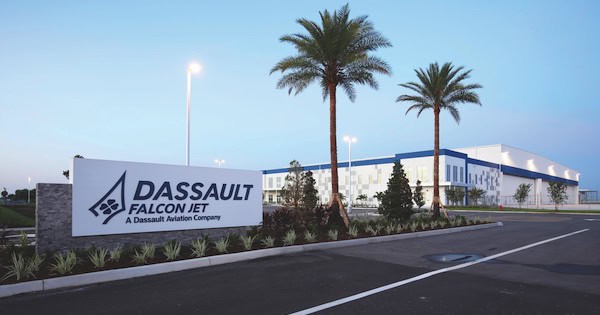 Dassault Falcon Jet opened its new maintenance, repair, and overhaul (MRO) facility at Melbourne Orlando International Airport, supporting the growth of the state’s aerospace sector. (Photo: Dassault)Aerospace & Defense Expands Its Foundation
Florida’s aerospace sector continues a rapid expansion. In Cape Canaveral, SpaceX announced plans for approximately $1.8 billion in investment to expand Starship launch and processing capabilities at Kennedy Space Center and Cape Canaveral Space Force Station. The project is expected to create 600 full-time jobs by 2030 tied to launch operations, engineering, and manufacturing activities. The expansion includes additional launch infrastructure and processing facilities.
In late 2025, Dassault Falcon Jet, a wholly-owned subsidiary of Dassault Aviation, has opened its new maintenance, repair, and overhaul (MRO) facility at Melbourne Orlando International Airport (KMLB) on Florida’s east coast. This facility represents a significant expansion of Dassault’s presence in the Americas, and it is one of the most recent additions to Dassault Aviation’s global MRO network.
“Our state-of-the-art Melbourne MRO is the latest expansion of our worldwide network of more than 40 service locations. It adds significant capacity in the Americas and puts more service capability closer to our Falcon customers. Dassault already has a large footprint in the United States which includes 2,500 employees, aircraft completions and sales,” said Eric Trappier, Chairman and CEO of Dassault Aviation.
Florida’s Space Coast has benefited from a broader ecosystem that includes NASA operations, defense contractors, launch providers, satellite companies, and advanced manufacturing suppliers.
In the northwest section of the state, Accelint, a defense technology company, has established a new unmanned surface vessel (USV) integration facility in Bay County, positioning the area as a growing hub for maritime autonomy. The company specializes in building autonomous vessels equipped with advanced payloads for defense operations, including surveillance and security missions.
Financial Services & AI: Emerging Growth Industries
Another significant development is the growth in financial services and artificial intelligence-related industries. Miami and West Palm Beach have attracted hedge funds, fintech companies, family offices, and technology startups at a pace that would have seemed unlikely a decade ago.
At the same time, Florida continues strengthening sectors such as cybersecurity, cloud computing, logistics, and defense technology.
One of the high-profile business moves in 2026 to date is Palantir Technologies’ decision to relocate its corporate headquarters to Aventura in Miami-Dade County. The data analytics and artificial intelligence company joined a growing list of firms shifting executive operations to Florida amid broader migration trends affecting the finance and technology sectors.
As migration and capital flows continue reshaping the national economic landscape, Florida appears positioned to remain one of the country’s most active and competitive environments for business expansion and relocation.