
From an outdoor stairwell of the Knight Oceanographic Research Center in St. Petersburg, the remains of the burnt Marine Science Laboratory next door can be seen below.
“What we’re looking at right now is kind of an aerial view of an 80,000 square foot two-story building. The fire consumed the roof … so the roof has been completely removed,” said Tom Frazer, dean of the USF College of Marine Science.
Workers in white hardhats and yellow vests are walking on a concrete slab where the roof used to be on one side.
On the other side the roof’s charred metal infrastructure is still intact – that’s because it was a later addition to the building so it doesn’t have the same concrete slab, and instead has a steep drop into the rooms beneath.
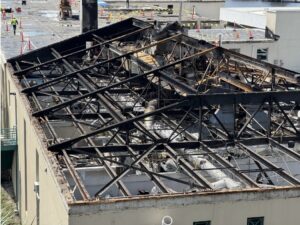
The remains of the USF Marine Science Laboratory in St. Petersburg after a roof fire in early May.
The sounds of construction bounce off the Bayboro Harbor in the distance.
Frazer works out of the Knight Research Center so he sees and hears the commotion from next door every day.
“[It’s a] constant reminder,” he said.
The scientists are rejoicing, although it’s unclear if some of the specimens are still viable after being exposed to smoke and water.
So, they’ll have to conduct experiments on their experiments. “Most of those samples are being processed right now, or a lot of them are,” said Frazer.
“We’ll know in short order what’s good and what’s not, but I feel fairly confident that most of the samples that we retrieve from the building are going to be viable and useful for their intended purpose.”
The lab contained a lot of local research, including servers holding lots of scientific data like how algae blooms move through water, and frozen specimen collected from Tampa Bay to test for contaminants.
Then there’s the dirt collected a lot further from home.
“A majority of our samples are from Antarctica,” said Amelia Shevenell, professor of geological oceanography.
She’s surrounded by towering stacks of boxes in the lobby of the Knight Research Center, where the recovered samples are landing.
Shevenell couldn’t shake hands because hers were soiled with presumed soot from the fire. “It wasn’t as if these samples were very clean before the fire because a lot of it is dirt, so I’m just dirty,” she said, chuckling.
Some of these samples were collected onboard a ship, and icebreakers which are no longer in service.
“We literally can never get these samples again, and so it’s been really wonderful to be able to get them out of the building,” said Shevenell.
“We end up with carbon dioxide gas that we’re actually able to date, which is super cool, and so that can go into climate models,” Kaiser said.
This can tell the story of when glaciers melted and help to predict sea level rise.
Kaiser said some of the first samples to come out of the scorched lab were in refrigerators, like the one storing some of her mud.
“Being able to see that fridge come out was really exciting for us, but we still have to see if we can even run these samples because they were without refrigeration for a little bit,” she said.
Fellow PhD student Alejandra Aguilar got her boxes of samples back from workers digging through debris.
“I look at the guys who’s like mostly Latino community doing this job, explain to them in Spanish how grateful I am. They’re like, ‘Why are you so excited about this?’ I’m like, ‘You guys, this is the job that I’ve been doing the past few years,’” Aguilar said.
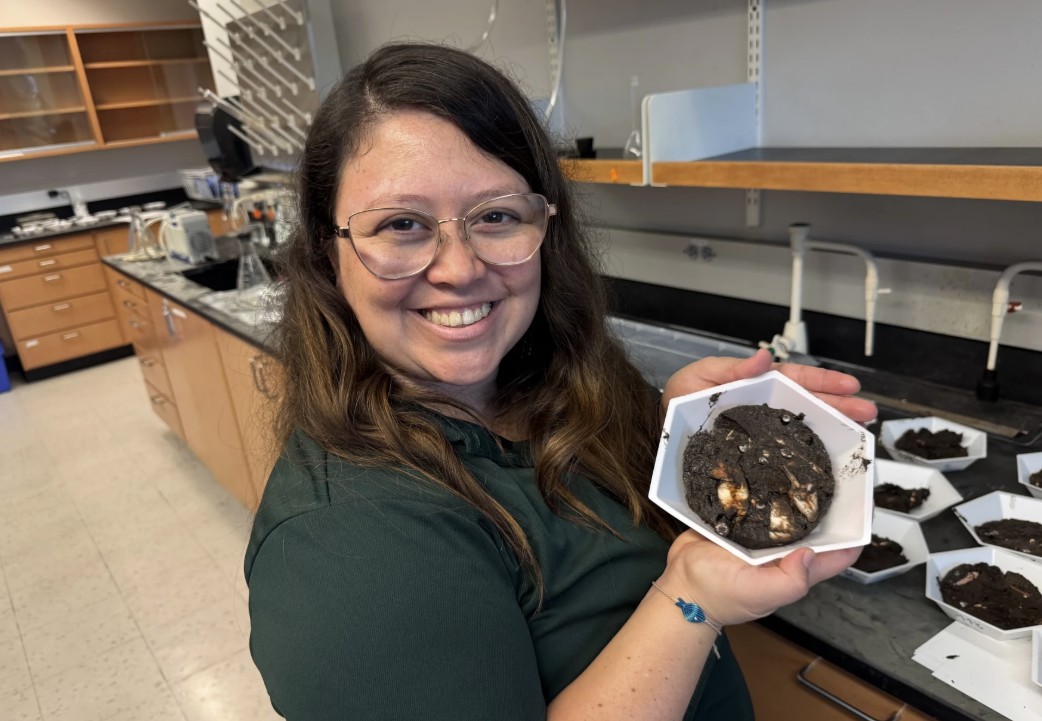
She’s been studying local mangrove soils to see how long it takes for these tree forests to store carbon after being relocated, among other things.
In fact, she plans to share her findings at an international conference in Okinawa, Japan next month, so the fire added a lot more pressure.
“I want to say I’m like 50% ready because most of my samples, I send them to University of Florida to process them because we used to be able to do it here, but not any more,” she said.
The instrumentation Aguilar needs for her final step of radiocarbon dating was inundated with water. Tens of thousands of dollars of custom glassware, like valves, which made up that instrument are in boxes.
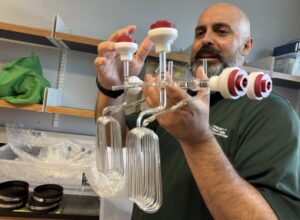
Brad Rosenheim, professor at the USF College of Marine Science, holding up an example of the intricate glass instruments which need to be checked for viability.
Aguilar’s advisor Brad Rosenheim said even if he had the space to start rebuilding the equipment today, it could still be six months to a year before they were able to tell if the glassware is up to their standards.
“And we just found out that the company that we bought them from to custom make them, they don’t even make them any more,” he said.
For now, they’re working out of a small makeshift lab upstairs in the Knight Research Center, trying to do everything previously done in multiple rooms.
“We’re used to challenges in this line of work, but … this challenge has been bigger than most because it doesn’t just affect current students, it affects the legacy of your work, the samples that you have to share with future students, your ability to recruit good students as well to a facility that is now kind of half the size as it was,” said Rosenheim.
But since the fire, he’s been impressed with his students’ resilience.
Aguilar, for example, set up a trip to collect backup mangrove soil samples, just in case the ones from the lab were unretrievable. She battled mosquitoes and stinky swamps.
“To see her just say, ‘Let’s do it … just keep moving forward,’ was really key,” Rosenheim said, choking up.
Aguilar said she often gets asked how she’s doing.
“And I’m like, I’m doing science, and I’m happy,” she said, although she is mourning the loss of her daily routine on campus.
“Seeing everybody … all the things that I did from parking to starting my work … this is not gonna happen in that way again,” she said.
Once the salvaging phase of the lab is over, insurance adjusters will have to quantify the loss of the building and its contents, which could take a few months.
“We still have a long road ahead of us,” said Rosenheim.
Jessica Meszaros is a reporter for WUSF, the bay area’s NPR affiliate.