
Quick Read
Covering $90,000 annually in Key West forces a 4.6% portfolio withdrawal rate, well above the safe 3.5% ceiling for early retirees.
Monroe County wind and flood insurance compounding at 8% annually turns a $12,000 premium into $120,000 per year by your nineties.
Sequencing Roth withdrawals first preserves low modified AGI, protecting up to $10,000 annually in ACA subsidies before Medicare starts at 65.
A recent study identified one single habit that doubled Americans’ retirement savings and moved retirement from dream, to reality. Read more here.
Someone in their late fifties with a $1.6 million portfolio looks at February temperatures and starts pricing one-way tickets to Key West. The math feels close enough to work. Here’s whether it actually does, and what specifically has to be true for this scenario to land as promised.
 Paul Briden / Shutterstock.com The Key West cost reality
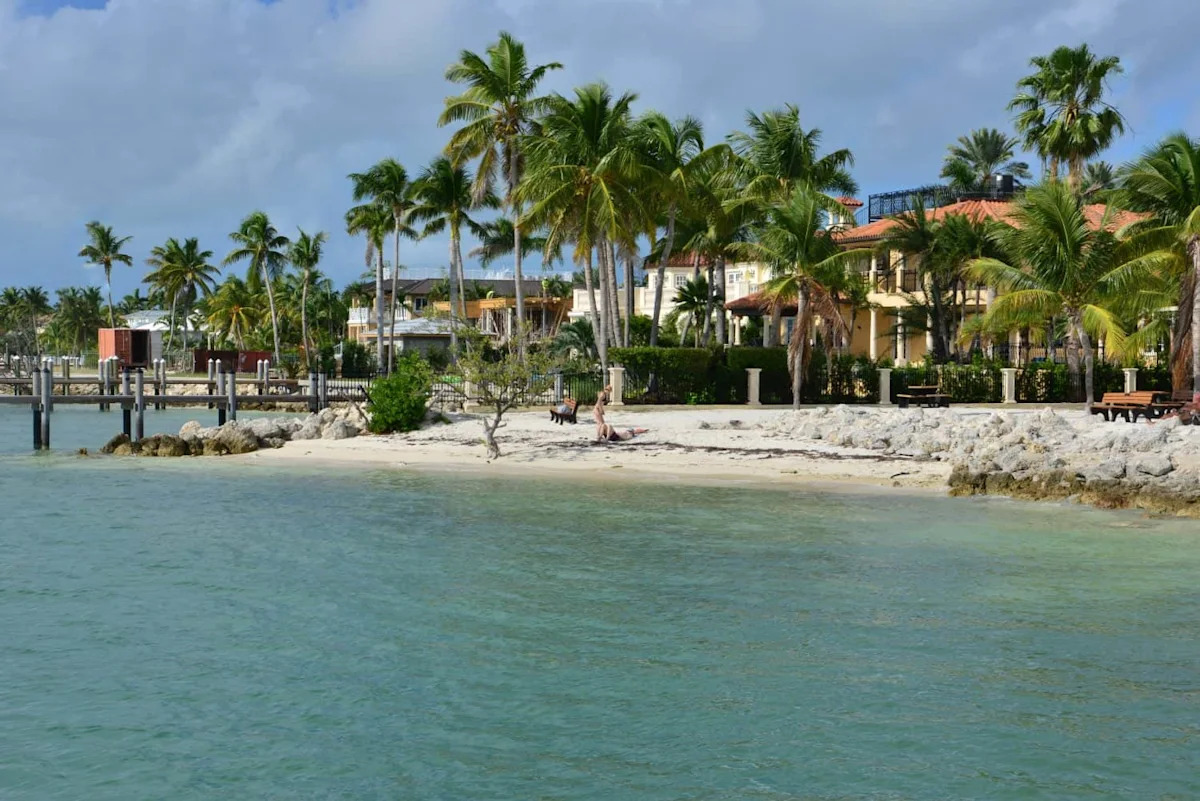
Florida overall runs about 3.4% above the national cost-of-living average, but that statewide number is useless for Key West. Monroe County is its own market. Single-family homes routinely clear seven figures, and modest two-bedroom condos in walkable neighborhoods sit in the $700,000 to $900,000 range. Buying with cash would consume roughly half your $1.6 million before you turn on the air conditioning.
Carrying costs are steep. Wind insurance through Citizens, a separate NFIP flood policy, and standard HO-3 coverage commonly run $8,000 to $15,000 annually on a modest island condo, with premiums climbing faster than the broader CPI, which itself sits at the 90th percentile of its historical range. Property taxes with homestead exemption add $5,000 to $7,000. Condo association fees regularly run $700 to $1,200 monthly because buildings fight saltwater constantly. Electricity for AC running ten months yearly is substantial.
The working budget
Renting makes the math work better than buying. A one-bedroom in a decent Key West building runs $3,500 to $4,500 monthly, roughly $48,000 annually. Add:
Read: Data Shows One Habit Doubles American’s Savings And Boosts Retirement
Most Americans drastically underestimate how much they need to retire and overestimate how prepared they are. But data shows that people with one habit have more than double the savings of those who don’t.
Utilities and internet: $6,000
Groceries: $7,500
Transportation: $5,000
Healthcare bridge to Medicare: $9,000 (achievable only with low modified AGI)
Contingencies (dental, travel, evacuations, tech): $10,000
Federal taxes on withdrawals: $5,000
Total: roughly $90,000 annually for a single person living in Key West.
Story Continues
The math
Social Security at 62 takes a 30% haircut from the full retirement age benefit for anyone born 1960 or later. The average retired worker benefit at full retirement age is around $1,950 monthly, so claiming at 62 lands closer to $1,400 monthly, or roughly $16,800 annually. The 2026 COLA of 2.8% will lift that modestly, but COLA only protects purchasing power.
The portfolio must cover roughly $73,000 annually. That’s a withdrawal rate of about 4.6% on $1.6 million. Too high for a 62-year-old planning a 30-plus-year horizon. The defensible rate for early retirement is closer to 3.5%, producing about $56,000 annually, leaving you $17,000 short.
Three realistic ways to close the gap:
Move slightly off-island to Big Pine or Stock Island, saving $12,000 to $15,000 annually on rent
Delay claiming Social Security to 67 or 70, bridging with heavier early withdrawals
Arrive with $1.9 to $2.0 million instead of $1.6 million
The insurance spiral
Generic retirement calculators miss this. Key West insurance premiums compound relentlessly. Wind and flood policies in Monroe County have risen in double digits annually for years, well ahead of the 2.8% Social Security COLA that adjusts income. Over a 30-year retirement, a $12,000 insurance bill compounding at 8% becomes north of $120,000 annually by your nineties, even as COLA-adjusted Social Security has barely doubled. This is the silent budget killer in every Florida coastal retirement, and the strongest argument for renting. When you rent, the landlord eats the insurance spiral. When you own, you face insurance volatility for life.
Florida has no state income tax, the headline reason retirees move here. But that advantage only matters if you keep portfolio withdrawals tax-efficient. To qualify for meaningful ACA subsidies between 62 and 65, you need low modified AGI, which means leaning on Roth or taxable-account basis during bridge years and deferring traditional IRA withdrawals. Get that sequence wrong and you lose $6,000 to $10,000 annually in subsidies, exactly the amount that breaks this scenario.
What it takes
To retire to Key West at 62 on $1.6 million, rent rather than buy, keep annual spend at or under $80,000 in a one-bedroom on-island or modest two-bedroom slightly off, hold a 3.5% to 3.75% withdrawal rate against a portfolio weighted toward index funds and a treasury ladder yielding around the current 10-year rate of 4.46%, claim Social Security at 62 only if you have a specific reason, and sequence withdrawals from Roth and basis first to preserve ACA subsidies through 64. Done that way, $1.6 million works, but barely. Arrive with $1.9 million and you stop worrying. The insurance spiral is the variable that decides whether year 25 feels like the brochure or like a trap.
Data Shows One Habit Doubles American’s Savings And Boosts Retirement
Most Americans drastically underestimate how much they need to retire and overestimate how prepared they are. But data shows that people with one habit have more than double the savings of those who don’t.
And no, it’s got nothing to do with increasing your income, savings, clipping coupons, or even cutting back on your lifestyle. It’s much more straightforward (and powerful) than any of that. Frankly, it’s shocking more people don’t adopt the habit given how easy it is.