
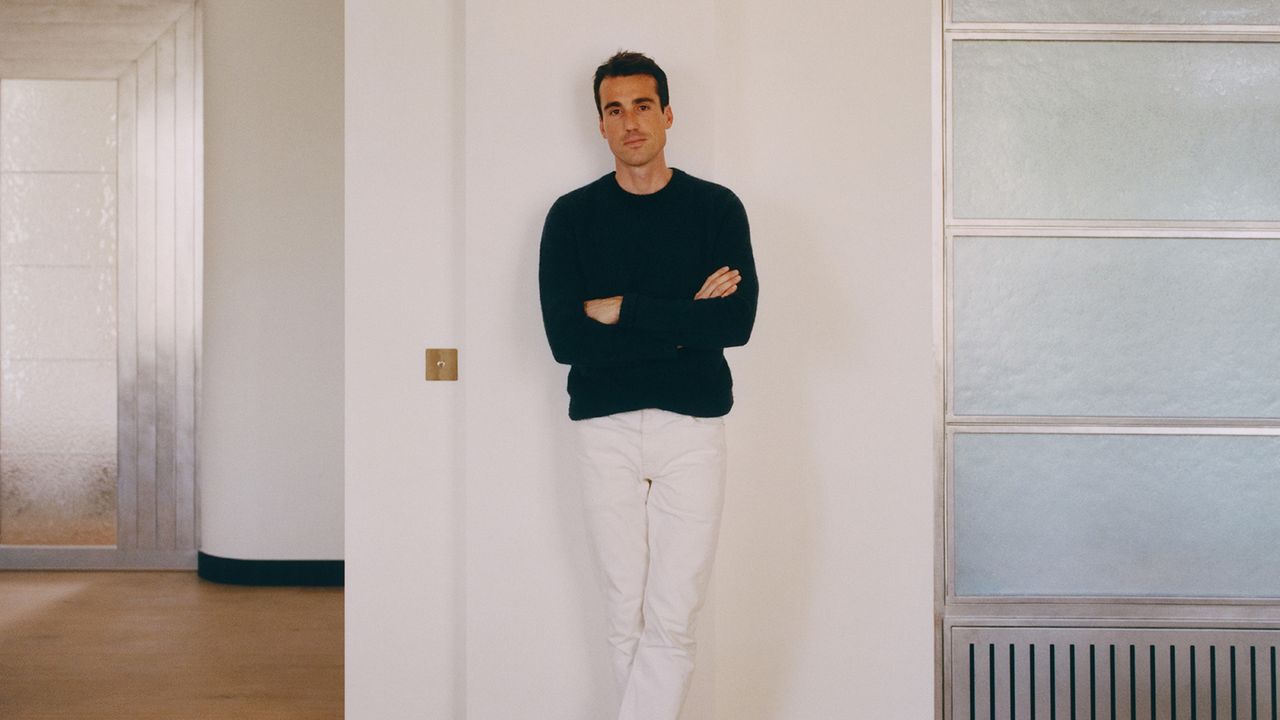
The living room is peppered with standout pieces of furniture like Petite Friture’s reissue of René Herbst’s tubular-steel chaise longue, and Philippe Starck’s aluminum Romantica chair. Two horizontally elongated, sandblasted Plexiglass fixtures with stainless-steel strips crown the ceiling with soft, golden light. “When designing it, I had Piero Portaluppi’s Villa Necchi Campiglio in Milan in mind,” Guénaire says. The design is reflected in the partially mirrored built-in shelving unit, in front of which stands a bean-shaped coffee table of Guénaire’s own design. The organic, gray-marble surface is framed with smoked pear wood. “In the 1920s, there was a trend to frame everything,” Guénaire says. He also designed a double-leaf door, made from striped ribbed glass and metal that resembles intricate marquetry. It leads from the living room to the bedroom, where the same door surprises once again. Seen from its other side, it’s made of burl wood, “which has been used for furniture at least since the 16th century,” notes Guénaire.
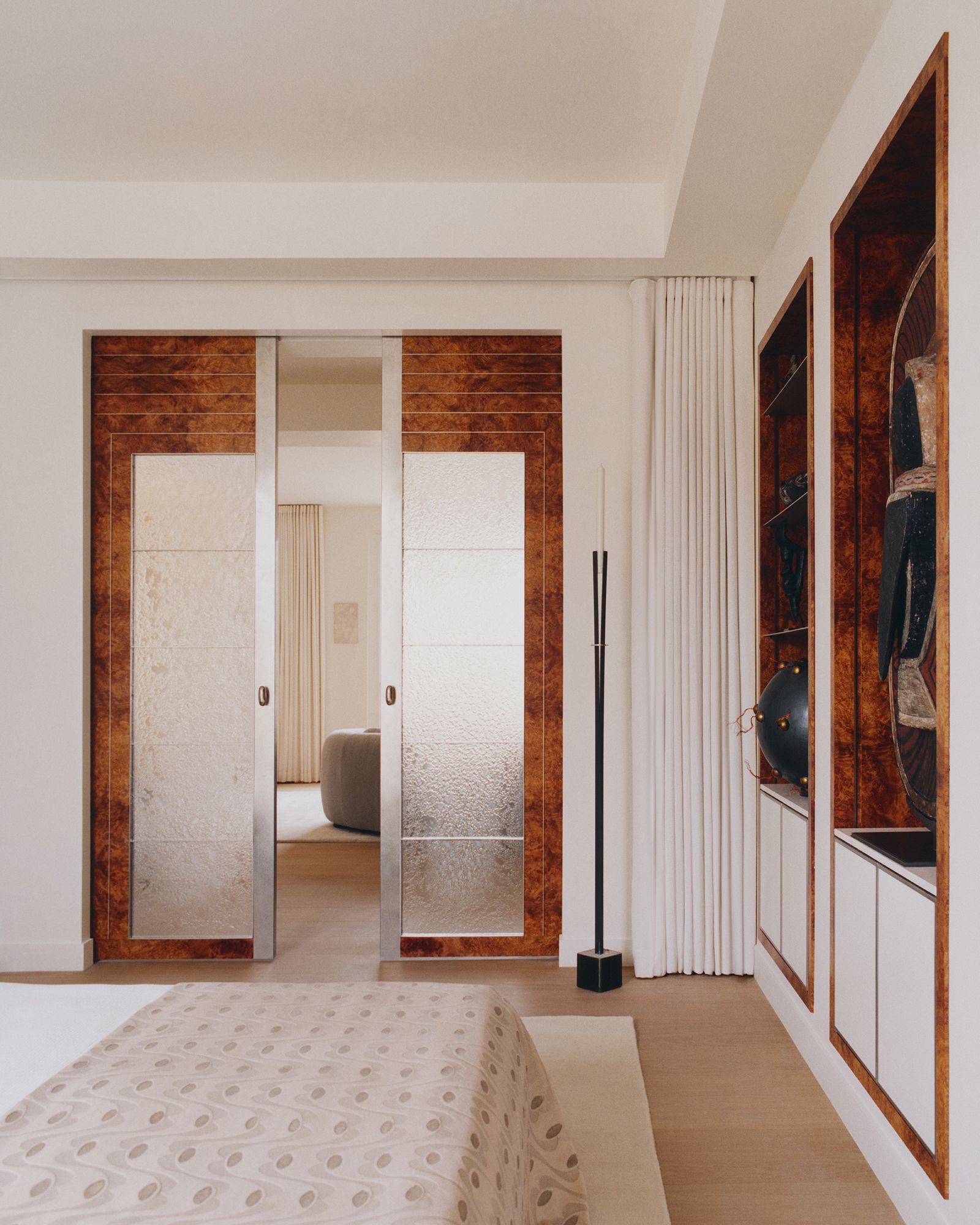
In the bedroom, the mix of materials and eras reaches a peak.
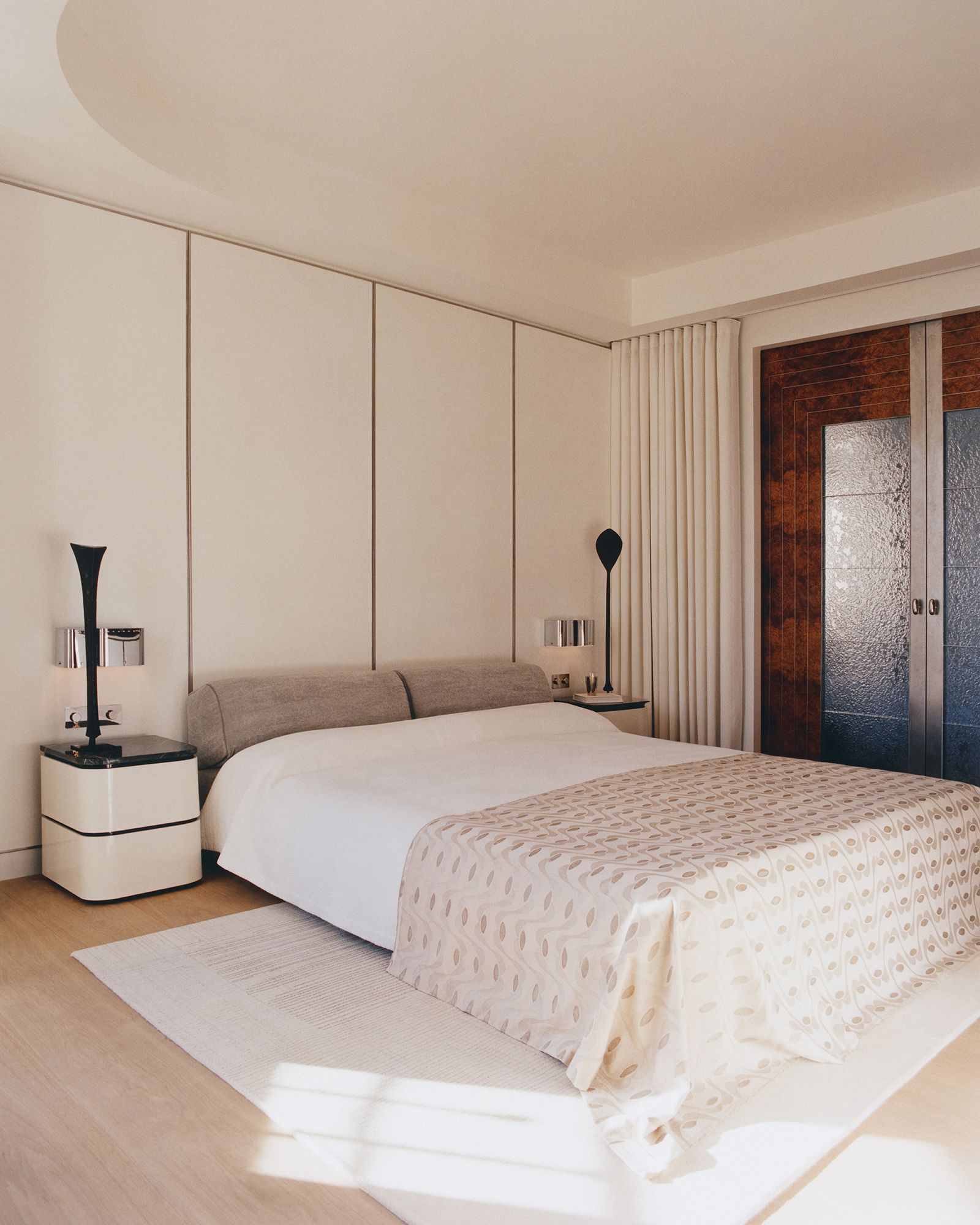
The rounded lacquered nightstands with push-to-open drawers and gleaming, curved, chrome accents were designed by Guénaire. The wall paneling is white suede and the bedspread is by Jules & Jim Paris.
Though the apartment now appears clean, sleek, and sensual, its final design wasn’t a foregone conclusion during the decision-making process. When Guénaire first proposed the material palette and an oak floor to the residents, they weren’t especially enthusiastic. But he managed to win them over: “My mother was a teacher; maybe that’s why I enjoy debating so much,” he says with a laugh. “Today, the couple loves the wood accents.” The bedroom’s built-in shelves are also made of burl wood, and are flanked by masks from Mexico, panels from Papua New Guinea, and African-inspired vases from the Parisian galleries Romain Morandi and Lucas Ratton. The latter gallery is also the source of the Polynesian ceremonial paddle from the late 19th century and a traditional wooden club from Tonga from the early 20th century.
Back in the living room, design accessories and art objects abound too: Both Jean Gabriel Chauvin’s Graine Ardente (Galerie Maison Rapin) and a 19th-century sculpture made of wood, pigments, and shells from the Solomon Islands are on display in the built-in shelf. Paris-based design studio Garnier & Linker designed both a wooden-and-metal vase, and the rectangular yellow-crystal piece on the coffee table by Guénaire. This butter-hued piece is just one way the designer incorporated a few pastel accents for his clients—but the pink and sky-blue onyx in the bathrooms are the definite standout. Here, the gem-like material becomes an innovative way to reinterpret the clients’ initial request for Art Deco, sun-bleached Miami Vice vibes.