
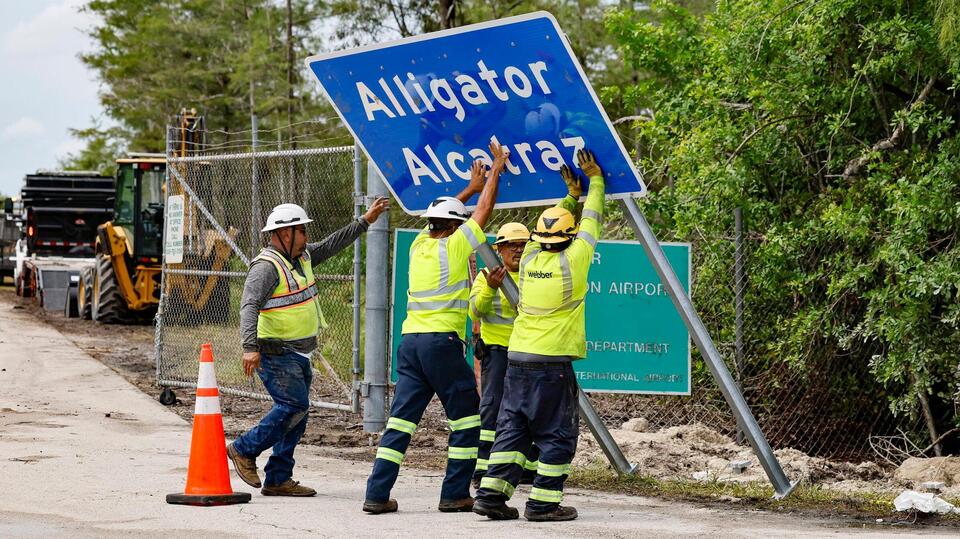
As Gov. Ron DeSantis prepares for a press conference Thursday to discuss the future of the now-shuttering Alligator Alcatraz facility in the Everglades, Miami-Dade Mayor Daniella Levine Cava is unveiling plans of her own for the county-owned site.
Levine Cava notified County Commissioners that her administration intends to pursue the transfer of all county-owned land at the Dade-Collier Training and Transition Airport — currently the site of the Alligator Alcatraz immigration detention facility — to the National Park Service or other Everglades restoration partners, once its operations wind down.
She argued in a memo that the remote site has limited remaining value as an aviation asset, citing high maintenance costs and restrictions on flight activity due to its location beside sensitive wetlands, adding that the land’s “highest and best long-term use” is conservation as part of the Central Everglades Restoration Plan.
“The eventual closure of and decommissioning of the Alligator Alcatraz facility would present a historic opportunity to permanently protect these lands and contribute meaningfully to one of the most ambitious environmental restoration efforts in the nation. The Administration believes that returning these lands to conservation and restoration purposes would represent a significant contribution to both regional ecological recovery and the long-term sustainability of Miami-Dade County,” Levine Cava wrote in the Thursday morning memo.
“The Administration’s objective is clear: to ensure these lands are permanently removed from future detention, industrial, or intensive commercial development and dedicated in perpetuity to ecological restoration, habitat preservation, and environmental protection. In addition to the environmental benefits, the transfer of these lands would reduce future County liabilities associated with maintaining and managing a remote aviation facility with limited strategic utility while creating opportunities to leverage federal restoration funding and strengthen partnerships with agencies responsible for Everglades restoration and management.”
Levine Cava noted that the county’s Director of the Department of Environmental Resources Management, Loren Parra, had attempted an on-site environmental inspection of the facility with staff on Wednesday, but that they were denied access due to what officials at the site described as an ongoing security sweep.
In the coming months, Levine Cava said, her administration will work with the County Attorney’s Office and state and federal partners to identify a legal transfer mechanism — conservation easements, deed restrictions, intergovernmental agreements, land exchanges or fee-simple conveyance — after which her Office will provide the Commission with formal recommendations.
Levine Cava’s memo closely followed DeSantis’ announcement Thursday of a planned press conference with border czar Tom Homan at the Alligator Alcatraz site, which sits on a roughly 17,000-acre span of wetlands within the Big Cypress National Preserve in the deep west end of the county abutting Collier County.
Last week, the U.S. Department of Homeland Security confirmed that all detainees at the facility had been transferred to federal sites for their “safety” ahead of hurricane season.
Alligator Alcatraz, as conceived and named by Florida’s appointed Attorney General James Uthmeier, DeSantis’ former Chief of Staff, has been praised by President Donald Trump.
But its conditions have been harshly criticized by lawyers, families and human rights groups, who have denounced the mistreatment of detainees since the center opened 11 months ago, during the Atlantic hurricane season.
The detention facility opened on July 3, 2025, one month after the start of that year’s hurricane season, which concluded without any storms making landfall in Florida. DeSantis had used emergency powers under a 2023 anti-illegal immigration declaration to take over the airstrip site and build the facility within days.
Detainees at the facility have talked about their difficulty accessing lawyers, and have described poor physical conditions, including worms in the food, toilets that don’t flush, flooding floors with fecal waste, and mosquitoes and other insects everywhere.
And it’s been exorbitantly expensive, with vendor contracts exceeding $824 million for operations and maintenance, not counting construction.
An analysis by The Atlantic this month found it would have been cheaper “to buy each of the 1,800 or so men detained at Alligator Alcatraz his own one-bedroom condo in Orlando and pay for a personal, full-time guard to keep an eye on him.”
Florida has been approved for $608 million in reimbursements for the facility, but has received just $58.2 million so far.
Levine Cava’s memo comes less than a year after she asked Uthmeier to give Miami-Dade monitoring authority over the detention center, citing the county’s ownership of the land as grounds for remote video access, weekly reports and scheduled site visits.
In a separate letter at the time to then-Homeland Security Secretary Kristi Noem, Levine Cava raised concerns about detainee safety, noting that detention centers like Krome and the Everglades facility are in isolated areas with poor access to hospitals and legal counsel. She cited 32 emergency calls reporting life-threatening conditions from a Miami detention center in June 2025 alone, compared with five in the same month a year earlier.
___
Material from The Associated Press was used in this report. Republished with permission.