
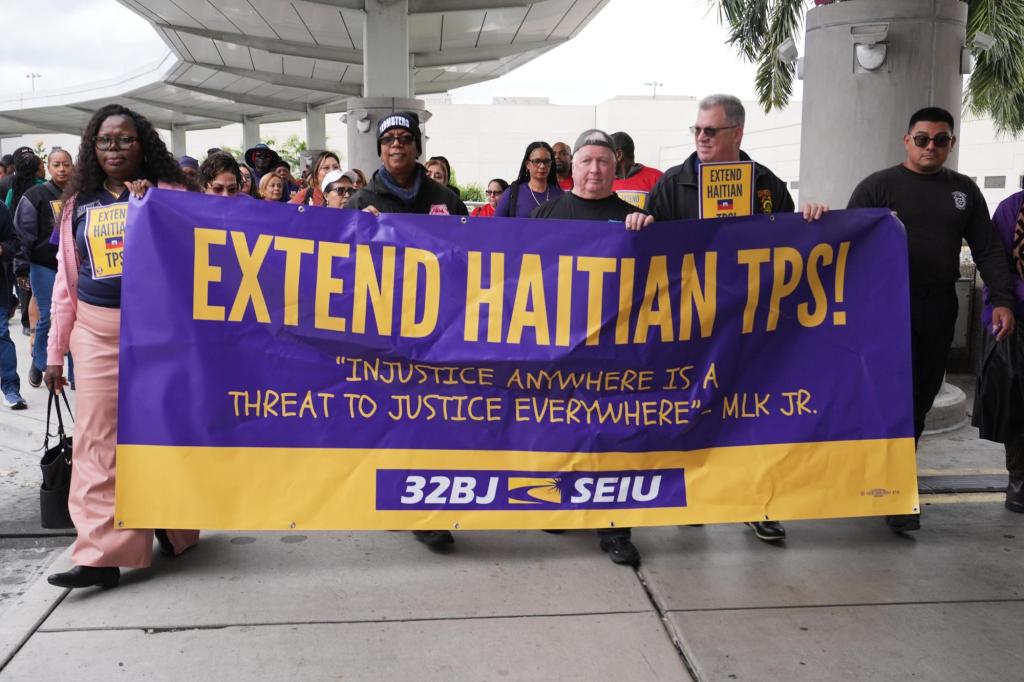
Advocates in the Haitian American community are warning that the Supreme Court decision approving the Trump administration’s efforts to end temporary protected status will inflict pain on people in South Florida.
Community and political leaders warned Friday that the impact would be felt beyond the Haitian community, including by older South Floridians who lose their caregivers and as the region loses a significant pool of workers.
“The decision to revoke temporary protected status for hundreds of thousands of Haitians is more than an immigration issue, it is a moral issue. And it forces us to ask a simple question: How do we treat people who are our co-workers, our caregivers, our taxpayers, and our friends?” said Denise Brown, CEO of LifeNet4Families.
“More than 350,000 Haitians who have lived and worked legally in the United States under temporary protected status face an uncertain future following the Supreme Court’s decision allowing the termination of TPS protections,” Brown said at a news conference. “This is especially significant here in South Florida, home to one of the largest Haitian communities in America.”
Widely known by the acronym TPS, the humanitarian program allows people from designated countries such as Haiti to live and work in the U.S. when conditions make it dangerous to return to their home countries.
The Supreme Court opinion also applies to TPS for Syrians, but it has implications for people from many other countries, including the large Venezuelan community in South Florida.
Florida has more Haitian TPS holders than any other state. Americans for Immigrant Justice estimated earlier this year some 158,000 live in the state. The majority are in South Florida.
Brown, whose organization provides emergency food, housing and rental assistance to families, spoke at a Broward news conference convened by U.S. Rep. Debbie Wasserman Schultz. After the Supreme Court handed down its opinion on Thursday she and other members of Congress went to the steps of the court to denounce it.
On Friday, Wasserman Schultz said the decision “is going to throw people’s lives in South Florida and across this country into absolute chaos. And the cruelty of that decision, the racism that it is based in, is truly shocking.”
Wasserman Schultz, the senior Democrat in the Florida delegation, said TPS recipients “have been targeted” by President Donald Trump, who she said has long harbored animus toward Haitians in the U.S.
“The court selectively ignored Trump’s open racism against Haitians to imply that race was not a factor in this case. They could have and should have recognized what was staring them right in the face, but we all know better. It is very clear that this despicable, revolting Supreme Court decision is the direct manifestation of what happens when you elect a naked racist as President of the United States,” Wasserman Schultz said. “This is a president that has been after Haitians from the first minute that he stepped into the Oval Office.”
He campaigned in South Florida’s Haitian American community in 2016, but during his first term he disparaged Haiti as a “s—hole country” during his first term. Campaigning for a second term in 2024, he repeated Haitians legally living in Springfield, Ohio, were in the U.S. illegally, and that they were eating neighborhood dogs and cats.
Wasserman Schultz said the Supreme Court opinion, which she termed “disgusting,” means “there are Haitian families that will be torn apart here in Broward.”
State Rep. Marie Woodson, D-Hollywood, was not at the news conference, but in a statement later dismissed the idea that Haitians in this country could safely be repatriated to Haiti. “The dire conditions in Haiti — marked by violence, instability, and economic despair — render it unfit for safe return.”
Wasserman Schultz cited a U.S. government advisory that tells Americans it is not safe to travel to Haiti.
Woodson, who is Haitian American, added, “We must not abandon those who have sought refuge and built lives here.”
Sandra Cherfrere, a detention attorney for Americans for Immigrant Justice, whose parents are Haitian immigrants, said people with TPS are fingerprinted and undergo background checks every time they reapply. “This whole idea that there’s a whole bunch of criminals walking around with temporary protected status is not true at all.”
Wasserman Schultz said when her mother entered hospice before dying of cancer, the people who cared for her in her home were Haitian. “Our elders, people that I represent … (are) cared for and taken care of and allowed to live the last stages of their lives in dignity because of the incredible kindness and skill and commitment of Haitians.”
Gov. Ron DeSantis, the state’s top Republican, praised the ruling. “Correct decision,” DeSantis wrote on social media, adding criticism of the justices who dissented. “But note that 3 liberal justices ruled that ‘temporary’ protective status is essentially ‘permanent’ status.”
Neither the office of U.S. Sen. Rick Scott, R-Fla., nor U.S. Sen. Ashley Moody, R-Fla., who was appointed to the Senate to fill a vacancy and faces an election in November, immediately responded to a request for comment about the Supreme Court’s TPS decision.
The Supreme Court decision was also condemned by the other Democrats who are running in the reconfigured 20th Congressional District in Broward, where Wasserman Schultz is running for reelection.
The 20th District includes most of the county’s African American and Caribbean American communities.
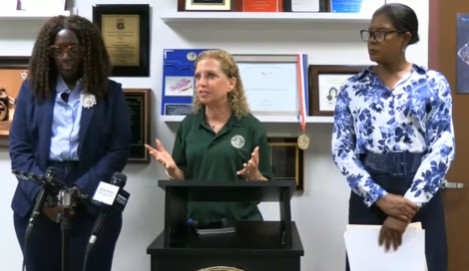 Sandra Cherfrere, left, U.S. Rep. Debbie Wasserman Schultz, center, and Denise Brown discuss the impact of a Supreme Court ruling on temporary protected status at a news conference in Sunrise on Friday, June 26, 2026. (Office of U.S. Rep. Debbie Wasserman Schultz livestream/courtesy)
Former U.S. Rep. Sheila Cherfilus-McCormick, said in a social media post that it “is not just a Haitian issue. It is an American economic issue.”
“Removing thousands of hardworking people from our workforce will disrupt industries, weaken small businesses, reduce tax revenue, and hurt local economies at a time when families are already struggling with rising costs. The economic harm is undeniable. Sending families back to a nation facing extraordinary violence and instability is not just unjust — it is bad for America,” she said.
Cherfilus-McCormick was the first Haitian American elected to Congress. She resigned in April as the Ethics Committee was about to consider recommending sanctions for 25 ethics violations. She is running in the 20th District to return to Congress.
Dale Holness, a former Broward County and former Lauderhill commissioner also running for the 20th District nomination, said in a statement that the Supreme Court’s ruling was “not just legally reckless, it’s morally bankrupt. The six justices in the majority have turned their backs on a people who are suffering unimaginably, and in doing so, they have dishonored the very history of this nation.”
Another candidate, community activist Elijah Manley, decried the Supreme Court for allowing the administration to deport “hardworking Haitians, people who pour billions into our economy every year, staffing hospitals, schools, and businesses,” which he said “sends them straight into gang massacre in Haiti.”
Anthony Man can be reached at aman@sunsentinel.com and can be found @browardpolitics on Bluesky, Threads, Facebook and Mastodon.