
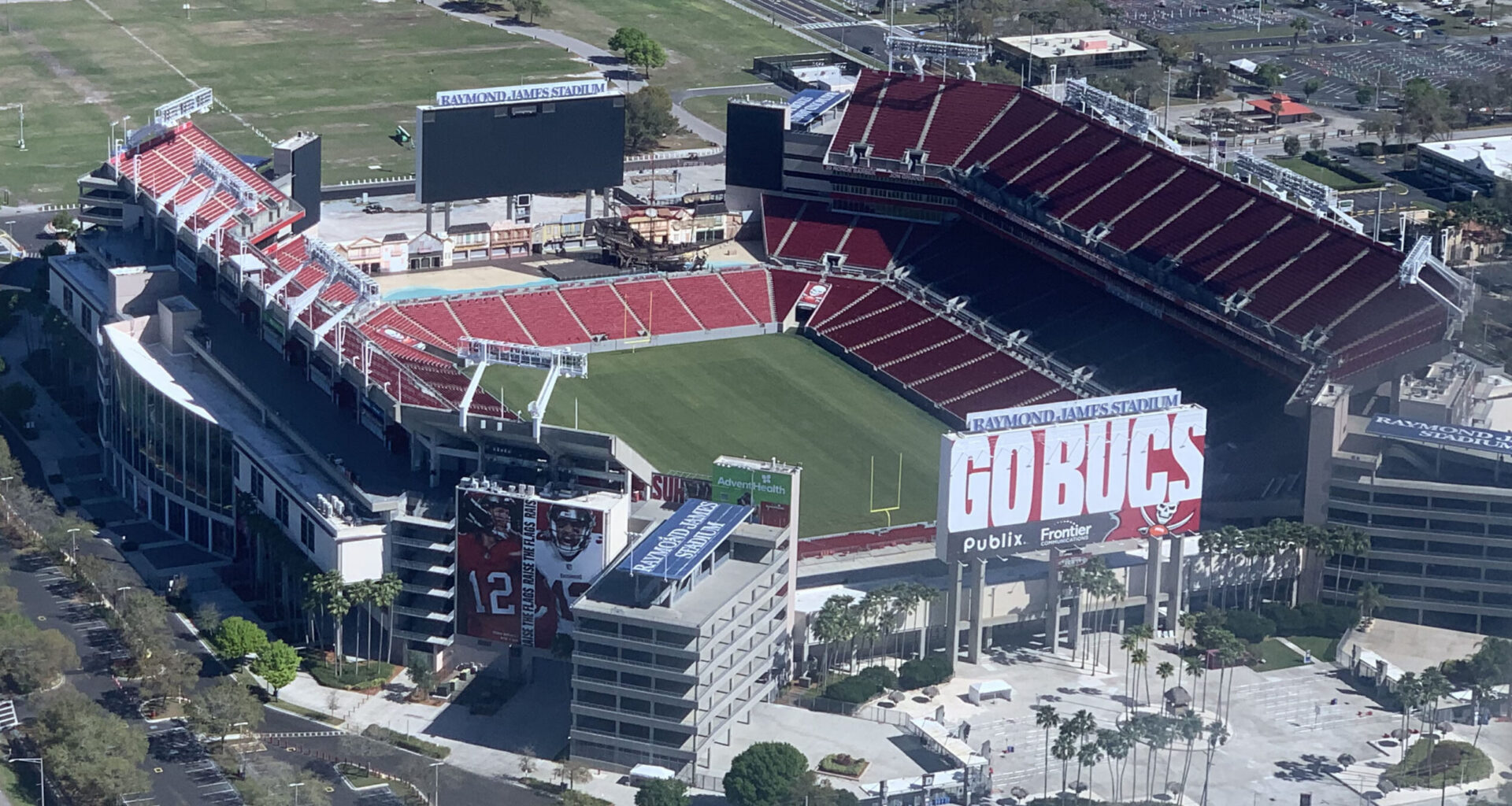
Nearly two weeks after Senator Rick Scott stood inside the Florida Holocaust Museum and called on the Tampa Sports Authority to cancel Ye’s concerts, the rapper formerly known as Kanye West remains scheduled to perform tonight and Sunday at Raymond James Stadium.
The concerts will move forward despite a coordinated effort by Scott, Sen. Ashley Moody, former Gov. Charlie Crist, Holocaust survivors and community leaders who argued that a publicly owned stadium should not host an artist who has repeatedly made antisemitic remarks.
The outcome leaves the Tampa Sports Authority where it has stood since the controversy began: condemning Ye’s rhetoric while maintaining that the First Amendment prevents the agency from canceling the performances based on his views.
“We condemn antisemitism from any source. However, we also respect free speech rights guaranteed under the U.S. Constitution, even when we disagree with that speech,” the authority previously stated. “In addition, no taxpayer money is being used for staging the Ye concerts. To suggest otherwise is false.”

Kanye West, who now goes by Ye, is scheduled to perform June 26 and 28 at Raymond James Stadium. Publicity photo.
The controversy began June 15, when Scott, Moody and an entourage of political and community leaders gathered at the Florida Holocaust Museum, flanked by a World War II-era railcar once used to transport Jews to concentration camps and Thor, a Danish fishing boat that helped smuggle Jewish refugees to safety during the Holocaust.
Scott argued that Raymond James Stadium’s public ownership gives taxpayers a voice in who performs there.
“Taxpayers should have a say in what happens,” Scott said. “Wherever that money goes, whatever we do with it, we as public officials are responsible, full stop.”
Scott contended that allowing Ye to perform amounts to giving the public’s “seal of approval” to an artist who has repeatedly made antisemitic remarks, including releasing the song “Heil Hitler” last year.
“If you have a public venue you don’t get to go, ‘Oh, I have to let everyone go.’ No, you do not,” Scott had said. “There’s no law that says you have to let people that hate Jews show up.”
Moody echoed that argument, saying publicly funded entities should be accountable for the events they choose to host.
“When you are a taxpayer-funded body, and you are prioritizing hate and antisemitism, you have a lot of explaining to do,” Moody had said.
The following day, however, First Amendment scholar Clay Calvert argued that while Scott’s position may carry moral force, the Constitution largely favors the Sports Authority’s decision.
“The stronger argument is with the Tampa Sports Authority,” said Calvert, a non-resident senior fellow at the American Enterprise Institute and former professor emeritus at the University of Florida Levin College of Law.
According to Calvert, once a government entity opens a public venue for expressive events, it generally cannot exclude performers because of their viewpoints.
“Were the Tampa Sports Authority to cancel Ye – and the pressure being applied is by two senators and Charlie Crist, who don’t want him to perform because of his antisemitism – that is considered viewpoint-based discrimination,” Calvert said.
Scott and Moody repeatedly argued that because Raymond James Stadium was built with taxpayer dollars, government officials have greater authority to decide who performs there.
Calvert said the opposite is true: “It makes it much harder to exclude them,” he said. “The fact that the stadium was built by taxpayer dollars actually triggers the First Amendment.”
Had the concerts been scheduled at a privately owned venue, Calvert said, the legal analysis would be different because private operators generally have broader discretion over who they host.
The distinction, he said, is between condemning speech and censoring it.
“The United States generally protects hate speech under the First Amendment,” Calvert said, noting that Ye’s music falls far outside the narrow exceptions, such as direct “fighting words” intended to provoke an immediate confrontation.
Scott argued taxpayers helped finance Raymond James Stadium and therefore deserve a say in who performs there. The Sports Authority countered that while it condemns antisemitism, the Constitution limits its ability to deny access to a performer based on viewpoint.
Despite the political pressure, no legal action or alterations materialized, so the concerts remain on schedule.
The Tampa Sports Authority declined to comment further beyond its previous statement supporting First Amendment protections. Crist, who joined Scott and Moody at the Holocaust Museum press conference, also did not provide additional comment when contacted by the Catalyst.