
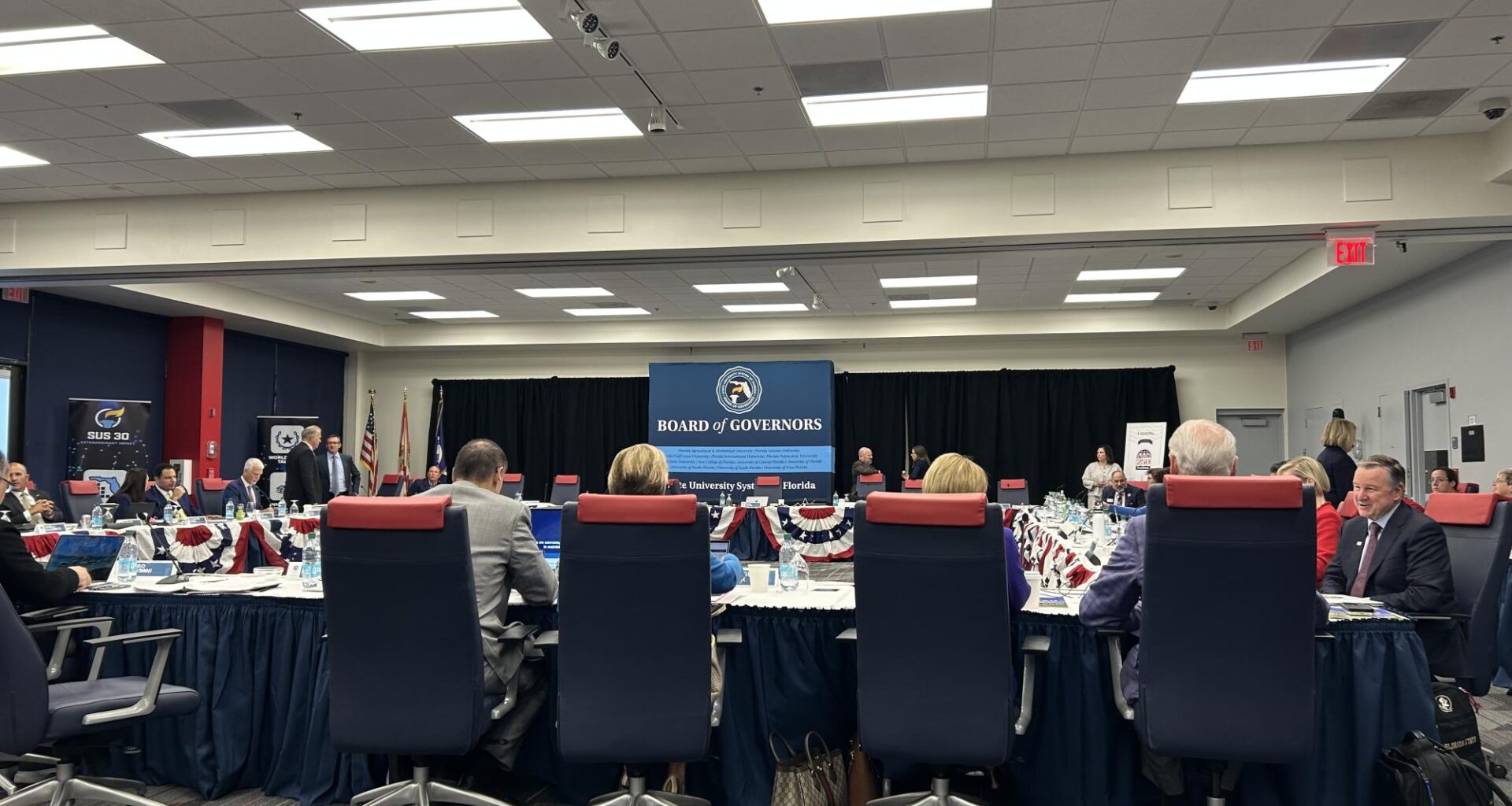
The Florida Board of Governors, which oversees the State University System’s 12 public universities, met at Florida Atlantic University on Wednesday and Thursday to discuss university initiatives and statewide higher education policies.
During the two-day meeting, board members approved FAU’s new five-year strategic plan, which outlines the university’s priorities through 2031. The Board also debated and approved revised language in an admissions regulation concerning applicants who are “unlawfully present” in the United States.
FAU’s Five-Year Strategic Plan
FAU’s President Adam Hasner presented to the BOG a five-year plan that serves as a roadmap for the university’s priorities through 2031, outlining goals for student success, research expansion, financial planning, and strengthening FAU’s national reputation.
Hasner stated that the plan is in response to an emerging question: “Will higher education be relevant five years from now? And equally as important, what will be the value of a college degree?”
The plan is organized around four major priorities: Deliver, Discover, Power, and Elevate.
Under the “Deliver” goal, FAU aims to ensure that students graduate with clear career pathways, hands-on experience, and the skills needed for employment or further education. The university plans to track progress through measures such as job placement rates, graduation outcomes, student engagement with career services, and time-to-degree completion. By doing so, the university can create metrics and begin predicting outcomes.
The “Discover” portion focuses on expanding FAU’s research presence in areas including neuroscience and healthy aging, quantum computing, environmental and ocean research, and national defense and autonomous systems.
FAU is classified as an R1 research institution by the Carnegie Classification of Institutions of Higher Education, placing it among the highest research universities. The university plans to increase research funding, expand industry partnerships, and grow programs in emerging fields such as quantum computing and neuroscience.
The “Power” section focuses on strengthening the university’s operations, financial position, and resources. As part of this effort, FAU is developing a new budget model designed to better align financial decisions with the university’s strategic goals, student success efforts, and performance outcomes.
Hasner acknowledged that “FAU is located in the second most expensive college town,” acknowledging the financial challenges created by Boca Raton’s high cost of living.
The final priority, “Elevate,” focuses on increasing FAU’s reputation and visibility while expanding community partnerships, athletics, arts, culture, and academic programs. The plan specifically highlights the university’s goal of growing opportunities in the arts, humanities, architecture, and cultural heritage through partnerships with creative industries and increased access to performances, exhibitions, and cultural programming.
“We can’t predict what will happen in five years, but our plan is our response,” Hasner stated to the Board of Governors.
General admissions regulation: citizenship status
During its meeting, the BOG considered changes to a regulation that establishes admissions requirements for institutions within the State University System. During the discussion of the regulation, a motion to amend Section (10) was made, and the Board approved the proposed change.
The amendment changed the wording from “a person who is not lawfully present in the United States” to “a person who is present in the United States unlawfully.” The board believed the language caused confusion and suggested it would prevent others outside the United States from receiving a diploma online.
The revised language addresses eligibility for initial enrollment beginning this 2027–28 academic year and states that a person who is present in the United States unlawfully would not be eligible for initial enrollment at a state university.
During public comment, FAU Junior political science major Alexander Lambridis, and vice president of the Florida College Democrats, said, “To expect the public to stand up and speak after the bonus [bill] already passed isn’t democracy. It’s political theater.”
Lambridis, who is running for a congressional seat to represent District 91 in the Florida House. continued saying, “Instead of standing up for the 8,000 plus undocumented students who graduate from Florida high schools every single year … Leadership on this board has chosen to yield to political pressure.”
Following the Board’s vote, the amended regulation will enter a 14-day public comment period before returning to the Board of Governors for final consideration. If approved, the revised admissions regulation will take effect for the 2027–28 academic year and apply across Florida’s 12 public universities.
The Guardian Program
At Wednesday’s meeting, the BOG outlined the first steps toward implementing a new state law to strengthen campus safety at Florida’s public universities. During the Campus Safety and Student Success Committee meeting, Vice Chancellor for Academic and Student Affairs Emily Sikes presented an overview of Florida House Bill 757, a measure signed by Gov. Ron DeSantis on May 15 that expands school safety requirements.
The Guardian Program would authorize public colleges and universities in Florida to allow faculty and employees to carry weapons on campus to serve as armed guards in the event of an active shooter, including mandatory mental health training for faculty and staff.
Sikes said university officials have already begun laying the groundwork for implementation. Initial planning started during the spring semester, with a systemwide workgroup meeting throughout the summer to develop recommendations. The state has allocated $1.8 million to support implementation of the new requirements.
Educational Plant Survey
The BOG also approved FAU’s 2026 Educational Plant Survey during Wednesday’s meeting, a state-required assessment conducted every five years to evaluate existing campus facilities and projected space needs. The survey projects enrollment to reach 49,123 full-time equivalent students over the next five years and identifies a need for additional academic space. The survey recommends three new construction projects totaling 145,916 net assignable square feet, along with various remodeling and renovation projects to support the university’s projected growth through 2031.
The survey recommends construction of a Health Professions Training and Resource Facility, Engineering expansions, and an Admissions Welcome Center on the Boca Raton campus. It also calls for renovations to the College of Education, Physical Science, Science, Social Science, and S.E. Wimberly Library buildings, as well as remodeling within the library to reconfigure existing study and office space.
Please email Hilton at [email protected] and Ives at [email protected] for more information on this or other stories.