
They say one man’s trash is another man’s treasure … well, if disposed of properly, anyway.
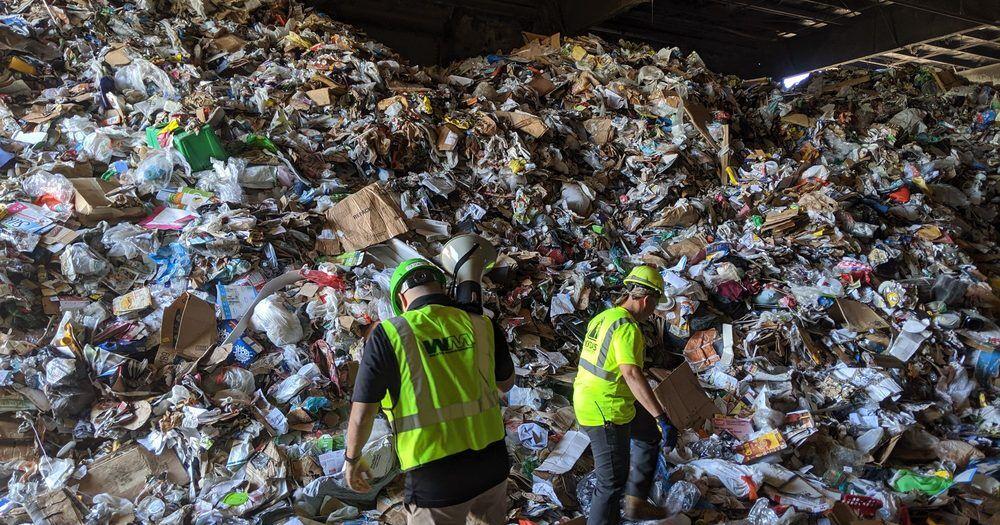
Helena Iturralde, the award-winning director of the sustainability nonprofit, A Zero Waste Culture, talked a little trash at a recent Rotary Club of Key Biscayne breakfast gathering, telling the audience that her group’s visit to the new $90 million Waste Management recycling facility in west Pembroke Pines was a real eye opener.
“It’s an amazing facility, with AI technology,” she said.
She said her visit, accompanied by a small group of community, business and condominium leaders, including former Councilmember Brett Moss, “reminds us that recycling is not enough. Making more conscious choices and that sustainability starts with everyday habits and community participation.”
One thing she noticed: “Even the best recycling systems cannot work efficiently” if contaminated materials, such as oily pizza scraps, are tossed in with recyclables, or even things like cinder blocks, which can be destructive to the valuable machinery.
The recycling plant, which opened in February, is designed to recycle 275,000 tons of material each year at a rate of 60 tons per hour. The facility services Miami-Dade, Broward, Monroe and Collier counties.
Restaurant owners and condo dwellers play an important role in recycling the correct products, too.
Christian Tribie, who was showing a series of slides from the visit to the recycling plant, said he’s seen “all kinds of things go into the blue (recycling) bin, chairs, even a helium tank. … That is not supposed to be in there.”
Iturralde learned that the recycling is going to be AI generated, like a “trash police.”
“They can see what’s inside your bin and can leave it there (if improper recycling materials are in there,” she said.
The recycling machine also uses AI sensors, with an air gust to separate paper and cardboard.
“Basically, they are making a lot of effort, so the trash is not to be (all) simply burned or headed to the landfill,” she said.
On Key Biscayne, and in many other surrounding communities, residences have a regular trash can and a blue recycling can.
“We need to educate ourselves on what goes into that (blue) bin,” Iturralde said. “Let’s hope Key Biscayne can make it better.”
The obvious choice would be to put out different colored cans, similar to the one Rotary Club President Pat Romano saw in the San Francisco airport, with distinct labels on each one for aluminum, plastic, paper, etc.
That could be done at certain locations in the community, maybe even at the new library when it is built.
“It’s better to fill your trash can with (regular trash) than to fill a recycle bin with stuff that you wish can be recycled,” Iturralde said.
Right now, she said, when Great Waste, the Village’s recycling hauler, picks up the plastic cans, either blue or green, “We don’t know where it goes.”
Education is the key.
At The Square shopping center, for example, property management leader Michele Estevez said that cameras needed to be installed to check who was filling the recyclable bin with contaminated items, and that those who were caught were charged with the $450 that Waste Management usually collects from business violators.
Iturralde said, “If we truly want a cleaner and more sustainable island, we must move beyond convenience and become more intentional about what we throw away, and what we choose to recover; Key Biscayne has to be an example for Florida.”
