
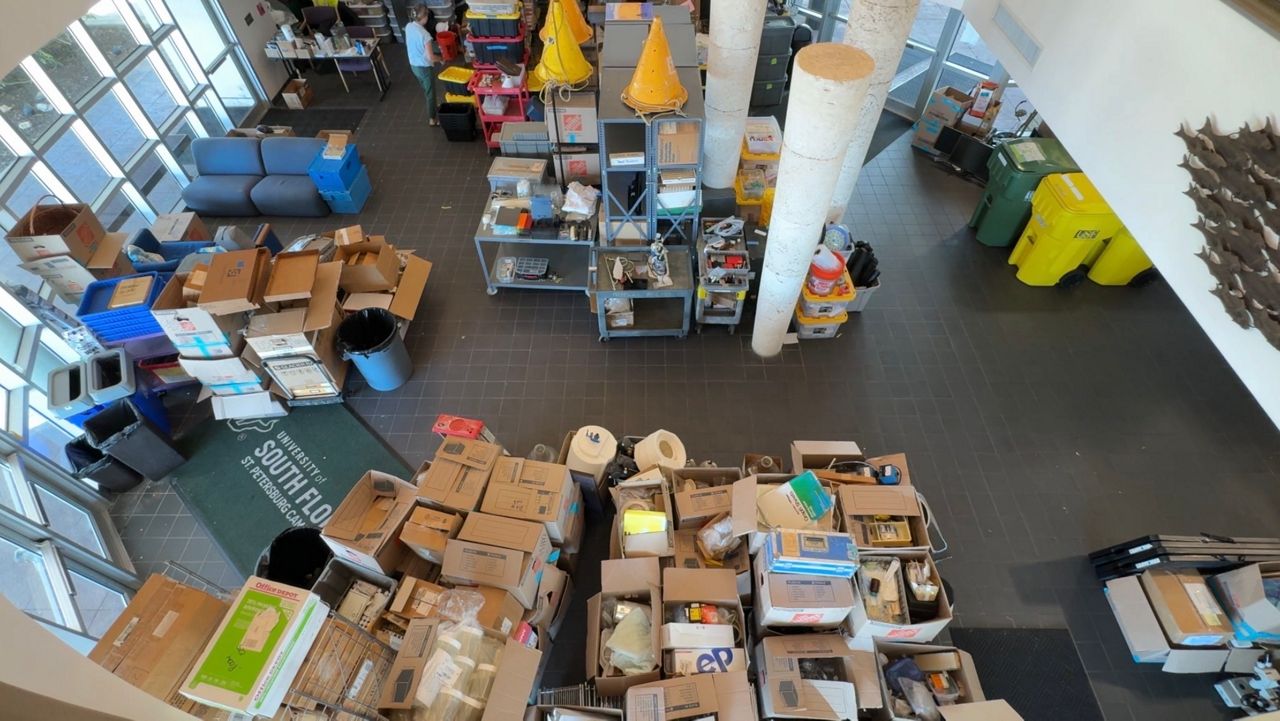
ST. PETERSBURG, Fla. — Nearly two months after a fire damaged dozens of labs at the USF College of Marine Science in St. Petersburg, the college is taking a major step in its recovery by speeding up the process of purchasing lab equipment.
The fire was believed to have been sparked by a lightning strike.
Since then, students and faculty have been working to recover research samples and keep projects moving forward.
The College of Marine Science says about 95% of the samples survived the fire.
Many are now being housed in the lobby of a building next door.
For students such as Emily Kaiser, a Ph.D. candidate in the College of Marine Science, those samples are essential to continuing research.
“So we’re looking for a concretion that came out of one of our sediment cores,” Kaiser said while searching through recovered materials.
Some of the samples date back as far as 60 million years. Kaiser said one sample she had been looking for turned up during the salvage effort, then got misplaced again.
“I found it when we were salvaging stuff. I was like, ‘Wait, Amelia, I found this sample we were looking for,’ and then it got lost in the shuffle,” Kaiser said.
Kaiser’s research focuses on Antarctic paleo-oceanography, using sediment to study past ice sheets and ocean conditions.
“I’m working on sediment from the last Ice Age to the present. So looking back like 30,000 years ago, trying to figure out what the ice sheets looked like and what the ocean looked like and how that influenced ice sheets through time,” Kaiser said.
Since the fire, Kaiser has been helping recover samples for herself and her classmates so they can continue research and stay on track to graduate.
Professor Amelia Shevenell said the fire could affect students depending on how quickly new lab equipment arrives or whether researchers need to travel to other labs to analyze samples.
“We don’t know yet, but I would say probably no more than a semester at the most,” said Shevenell, a professor of geological oceanography at the USF College of Marine Science.
Tom Fraser, dean of the College of Marine Science, said an advancement in the college’s insurance claim is helping speed up the process of buying replacement lab equipment.
“Our number one goal at the university is to make sure that the students are progressing and graduating on time,” Fraser said. “We want to make sure we give them every opportunity to do that. But our researchers as well — they have contracts and grants with deliverables and deadlines. We need to get operational as soon as possible.”
Kaiser and others at USF are continuing to sort through samples and recover what students need for their work.
After graduation, Kaiser said she hopes to become a postdoctoral researcher with the U.S. Antarctic Program, where she can continue retrieving and studying samples.