
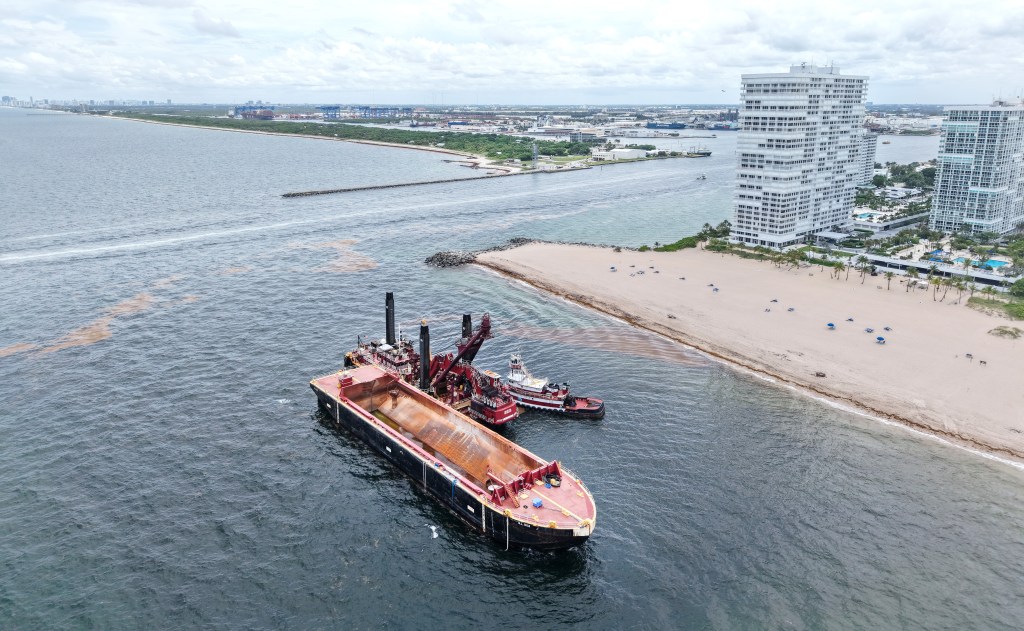
A sand-relocation project in the waters off Port Everglades has been underway for over a half-year, making crane and excavator barges a common sight in the area.
The initiative has sparked neighbors’ concerns about noise and light pollution, and environmentalists’ concerns about the work’s impact on marine life.
The construction effort, known as the Broward County Sand Bypass Project, will create a 10-acre pit along the beach just north of Port Everglades. Over time, it will fill with sand, which will be used to replenish beaches to the south, in areas such as Dania Beach.
Residents at the nearby Points of America condo building recall how their ocean views included manta rays, dolphins and unobscured sun rises over the Atlantic. They say their views these days instead are dominated by what amounts to a floating construction site. Meanwhile, environmental groups have been pushing to protect staghorn coral and queen conch nearby.
County officials say they’ve been putting the $110 million Sand Bypass project together for 30 years, and have gone through a 10-year permitting process. The county has relocated vulnerable coral and conch, and said they have a program in place to monitor sediment pollution. Prior to the project launch, the county said that if plumes drift outside of the legally allowed mixing zone, they can pause operations. They say the project is both necessary to save beaches to the south of the inlet, and is environmentally sustainable.
The county hopes to save on sand costs with the bypass and offer a sustainable beach-compatible sand source for shorelines south of the inlet. “Since there are no cost-effective sand sources remaining in southeast Florida, it’s critical for us to maintain access to this important resource by constructing this project,” Broward County beach program manager Stephanie Roche said during a public webinar last year before the project began.
The new sand will buttress beaches to the south, which will “enhance storm protection for critical infrastructure and valuable property, including the U.S. Coast Guard Station, port facilities and over $345 million in property.”
The sand also will keep Dr. Von D. Mizell-Eula Johnson State Park intact and preserve habitat and nesting areas for various species of sea turtles and shorebirds, the county says.
“Beach projects themselves are very costly,” said Broward County chief resiliency officer Jennifer Jurado told WPLG-Ch. 10 last November. “And so anything we can do to be more efficient in the way that we manage our local source of sand, which is so limited and valuable, is going to have environmental and economic benefits.”
She said, “We’ll capture that sand in this trap, and it provides a sustainable source for supporting preservation of our beaches.”
Providing a sand source
Beach shifting occurs naturally as sand migrates.
On Florida’s east coast, it migrates south, but can be blocked by development or structures such as the jetties at Port Everglades. The result is that beaches to the south of the inlet deteriorate.
The Sand Bypass Project, funded by Tourist Development Tax dollars and Florida Department of Environmental Protection grants, will allow the county to move the sand south manually.
The dredge is conducted by crane and excavator barges that dig sand up and deposit it in another barge.
A tug boat moves them around and keeps them in place.
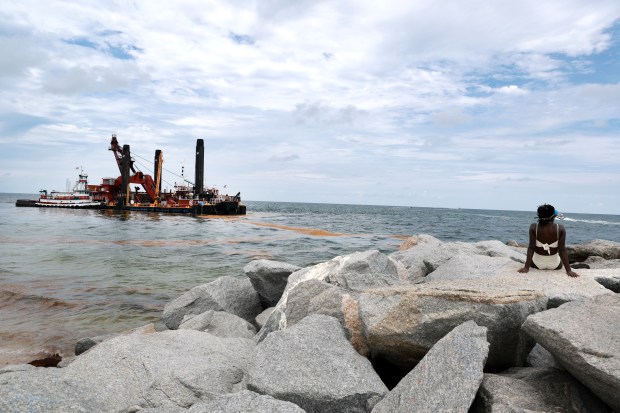 A vessel is docked near the inlet off Port Everglades in Fort Lauderdale in early June. Underway is a project to relocate sand. (Carline Jean/South Florida Sun Sentinel)
After years of permitting, construction began in October 2025 and dredging is slated to be done by early 2027.
After that, the sand pit will be redredged every two to four years to transfer the captured sand to beaches to the south. Sand harvesting should take 45 to 90 days, says the county.
The project will also add north jetty improvements, conduct artificial reef mitigation and rubble clearing.
Neighbors’ outcry
The dredge was carefully planned, and will, according to the county, save the county money on sand costs. But local residents say they’re bearing an inordinate quality-of-life cost.
“It’s on the beach. When it’s there it’s quite noisy and the banging echoes,” said Beth Bower, property manager at Mayan Beach, a condo building. “We do get quite a bit of dust coming from it.”
Kevin Hyland is a unit owner and board association treasurer at Points of America, a 600-unit complex that sits on the beach on the north side of Port Everglades inlet.
“There has been excess noise, excess light,” he said. “They can work 24 hours a day, 7 days a week. They’re shining these bright lights, which go into our residents’ homes.
“I understand the scientific reason they want to do this,” Hyland said. “The replenishment of the sand south of the port — that makes a lot of sense for Hollywood and Dania. … But it’s an inconvenience for the residents of our building big time.”
Hyland said he’s been startled by how close the construction barges come to shore.
“Well, it certainly appears a lot closer to the land than they described initially because it’s quite close.”
Photos from another resident at Points of America, Lenny Abrams, show the barges and tugboats within approximately 50 yards of shore.
Abrams owns a condo on the 27th floor. “I’ve got a full view of what’s going on,” he said. “We are concerned about quality of life. I have to have my balcony cleaned about every 10 days from the soot.”
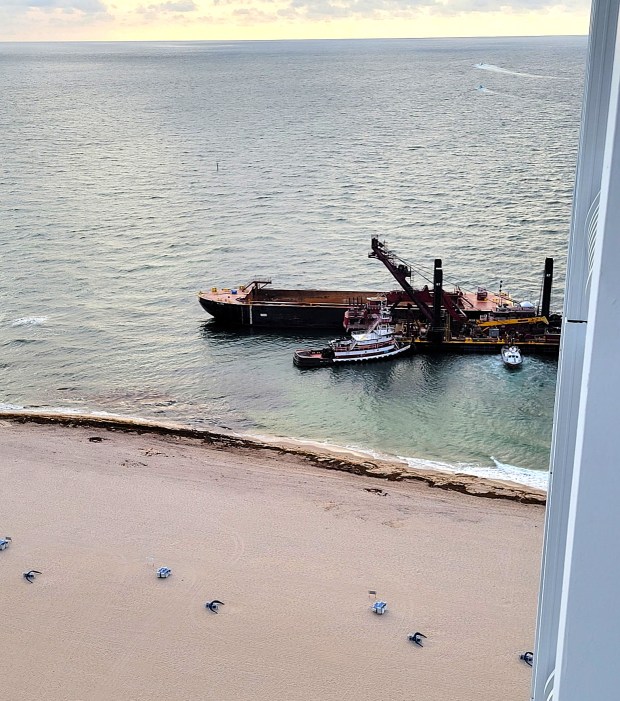 This photos, taken by condo owner Lenny Abrams, shows the Sand Bypass barge and tugboat close to the beach in front of the Points of America condo building near Port Everglades. (Lenny Abrams)
“The noise is horrible,” Abrams said. “They can be dredging at 1 in the morning. The only time you have down time is where they’re moving the barge.”
Sediment in the water is an issue that is riling up both residents and environmentalists.
“It is certainly murky,” Hyland said. “The specifications call for quite an amount of turbidity that’s allowable. We see that all the time. Sometimes it’s a lot worse than other times.”
The water can turn from clear aquamarine to a milky green, said Abrams. It can also stretch for miles up the beach, according to the National Marine Fisheries Service.
Permitting from the U.S. Army Corps of Engineers and Florida Department of Environmental Protection calls for a “mixing zone” that extends about a half-mile north up the beach and a half-mile out to sea, according to a file from the Florida DEP.
Satellite images show plumes extending beyond the mixing zone, according to the National Marine Fisheries Service. They have since asked the Army Corps to reconsider the permits for the project.
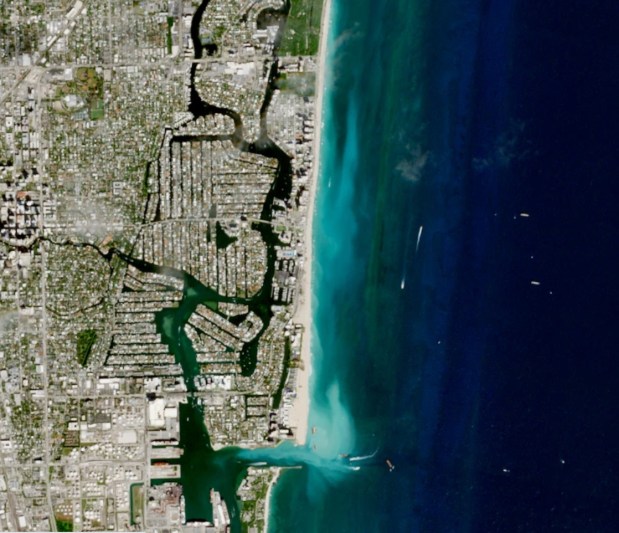 This satellite image from Jan. 9, 2026, shows sediment plumes from the Sand Bypass project drifting north along the beach. The National Marine Fisheries Service used the image in a letter urging the U.S. Army Corps of Engineers to reassess permits for the project. (Courtesy, Copernicus Data Space Ecosystem)
The South Florida Sun Sentinel reached out to the county for comment about the plume size, turbidity and distance travel. County officials referred the newspaper to the county webpage about the project.
The webpage says that the project has an allowable mixing zone defined by permits, inside of which “cloudiness” is expected.
The county did not clarify if the mixing zone had been exceeded.
Prior to the project launch, county officials ensured locals that they could respond in a timely manner if the plumes were too large.
During last year’s public webinar, beach program manager Roche said, “We have very stringent water quality monitoring that’s required by permit, so we will be continuously monitoring water quality and turbidity throughout the project and during those dredging activities.
“If we ever encounter a situation where turbidity is higher than our permits require, we have the ability to completely shut down dredging or ask them to move the dredge — whatever will create better conditions in the environment. … We’ll be keeping an eye on that very closely.”
It’s unclear what the turbidity standards are for water outside the mixing zone.
“The bigger problem is you can’t use our beach,” said Abrams. “And people live here because they want to use the beach.”
An east wind sets up a particularly unpleasant scenario, said Abrams.
As the dredge digs and sends out clouds of sediment, the east wind pushed both sediment and naturally occurring seaweed toward the beach. The ocean becomes a creamy expanse splotched with brown mats of decomposing algae, according to photos shared by Abrams.
Not only is the water less aesthetically pleasing, but Abrams is wary of it. “You don’t know what’s in there. You can’t see, so you don’t know what kind of large fish are there. You can’t use the beach,” said Abrams. “It’s very uncomfortable.”
“The biggest issue I have is the lack of cooperation with the information from the county,” said Abrams. “They come, they made a presentation, I asked questions. There is no communication other than, ‘We’ll look into it, we’ll look into it.’”
The initial dig should cease in early 2027, says the county webpage, but Hyland is concerned about the eventual sand harvest. “When they come to harvest the sand … you know, we’re going to have a dredger out there for a couple of months. That’s going to have an impact,” he said.
Next month, residents will get a temporary reprieve, as dredging will pause for coral spawning (approximately from July to October).
The Sun Sentinel reached out to the city and county commissioners whose district the project falls in for comment. A representative of County Commissioner Lamar Fisher said he was out of town attending a conference, and unable to comment. City Commissioner Ben Sorensen couldn’t be reached for comment.
Sediment concerns
Sediment from dredging is a concern for environmentalists as well.
According to environmental nonprofit Miami Waterkeepers, threatened staghorn coral and queen conch inhabit an area near the Sand Bypass that is vulnerable to sediment plumes set off by the dredge. The sediment can settle on coral and weaken or kill it, as happened during the 2013 PortMiami Deep Dredge Project.
The county’s webpage says it conducted coral and conch relocation before the dredge began.
Staghorn coral are in peril and were declared functionally extinct in Florida in 2025 by National Oceanic and Atmospheric Administration’s Coral Reef Watch.
Already listed as threatened under the Endangered Species Act, in 2023 the species suffered widespread mortality in Florida waters following a heat wave.
The area around Port Everglades, including the Sand Bypass, is home to some of the last survivors, according to NOAA.
Environmentalists think those corals could be crucial to the recovery of the species.
Several environmental groups, including Miami Waterkeeper, The Center for Biodiversity and Earthjustice, have filed a notice of intent to sue the U.S. Army Corps of Engineers.
They claim the Corps is legally obligated to reexamine the permits for the project, given new information about the size and density of plumes and the risk they pose to the threatened species.
Environmentalists’ concerns center on whether plumes are flowing beyond the legal mixing zone and whether the sediment is harming threatened staghorn coral. The National Marine Fisheries Service, a federal agency, also sent the Corps a letter in April indicating that they need to reassess the permits and possibly stop the project.
The letter stated, “New information reveals effects of the action that may affect listed species or critical habitat in a manner or to an extent not previously considered. … Further the action appears to have been modified in a manner that causes effects to the listed species or critical habitat that was not considered in the previous Opinions. … We recommend the (U.S. Army Corps of Engineers) evaluate the need to reinitiate consultation.”
The Corps has until mid-August to respond, said Rachel Silverstein, director of Miami Waterkeepers.
When asked about the situation by the Sun Sentinel, a Corps representative wrote in an email, “The Sand Bypass Project at Port Everglades is a Broward County project. The U.S. Army Corps of Engineers (USACE) Jacksonville District issued a DA (Department of the Army) permit to the county for the project.
“The Miami Waterkeeper has provided USACE with a Notice of Intent to Sue. Unfortunately, with the possibility of pending litigation we are unable to comment further.”
Broward County did not respond to questions about the plumes, but referred to its webpage, which says, “The County engaged with scientists from State and Federal agencies during the multi-decadal permitting process for the project to ensure that the best protections for the environment would be employed during the project.”
Bill Kearney covers the environment, the outdoors and tropical weather. He can be reached at bkearney@sunsentinel.com. Follow him on Instagram @billkearney or on X @billkearney6.