
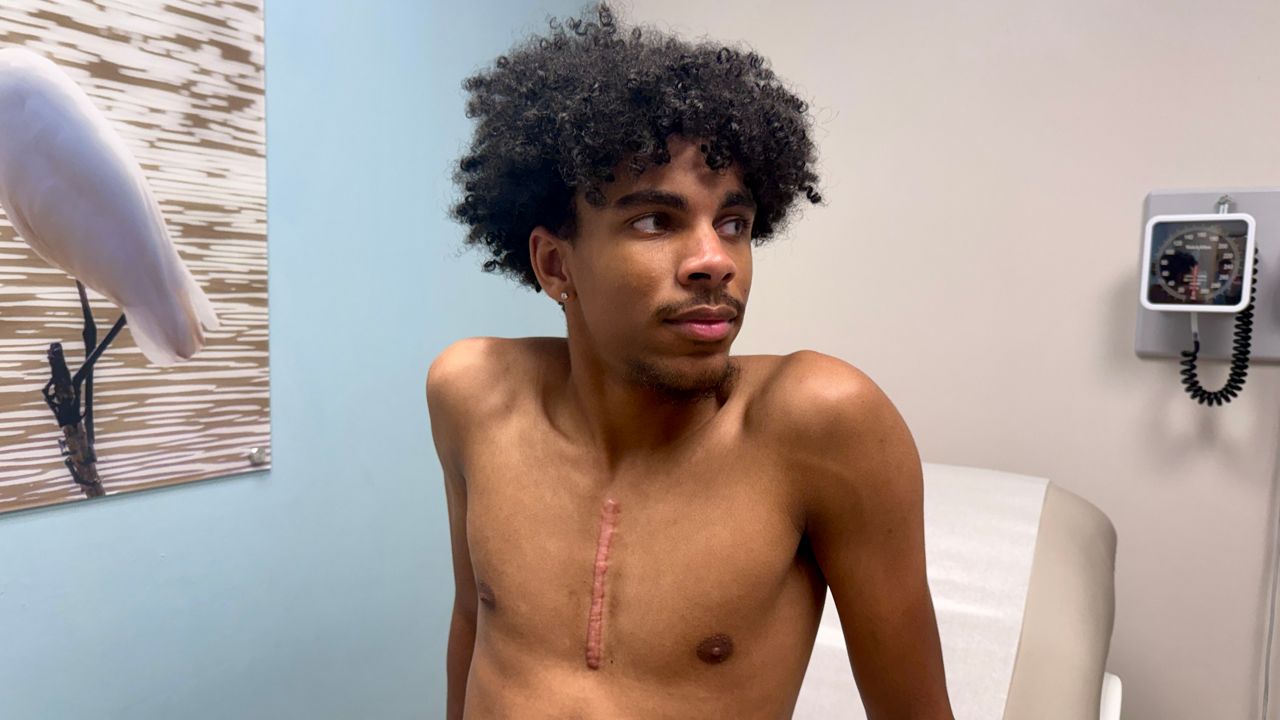
TAMPA, Fla. — This summer thousands of kids will run onto a sports field, baseball diamond, pitch or court — ready to give their all. The rhythm of the game matching the tempo of their heartbeats at times. A heart that could be about to fail.
For Jeremiyah Shepeard, that was his reality last year.
He grew up loving the game of basketball. He started playing competitively at the age of seven.
“He used to watch, like, Blake Griffin commercials. And he would run with his Fisher-Price basketball, dunking every time he saw the commercial,” said Shyree and Fred Shepeard, his parents, thinking back.
Jeremiyah’s love for hoops grew for a decade. He played in rec leagues, school leagues and travel leagues.
By May 2025, his AU travel team was playing in a tournament in Tennessee. At the start of one game, Jeremiyah remembered feeling off.
Fred, his father, was in the stands. He remembers Jeremiyah giving him a look while out on the court.
“He is like, ‘Dad, I don’t feel well.’ I am like, ‘Okay, sub out,’” said Fred.
But he didn’t sub out, and when the other team scored, Jeremiyah was in-bounded the ball.
“He just — the ball hit him, and he didn’t respond,” said Fred, remembering the odd moment.
The ball hit Jeremiyah in the face, and he then stumbled, collapsing on the court. His coach, dad, and other adults immediately ran to him and stopped play.
“It was scary, but the only thing that mattered was getting to him,” remembers Fred.
Jeremiyah was lucky that day. He was taken to a hospital and was treated in an ER. The doctors told him when he returned to Tampa he needed to see a pediatric cardiologist.
“I just thought it was dehydration,” said Jeremiyah.
That was not the case.
“This is what we call an anomalous right coronary artery from the left,” said Dr. Anjlee Patel, Pediatric Cardiologist at AdventHealth, pointing to a CAT scan image inside AdventHealth Tampa.
After an electrocardiogram (ECG) and a CAT scan, Patel found a structural issue with Jeremiyah’s heart.
She said it was a potentially deadly diagnosis.
“He was born with this defect. It’s considered a congenital defect and is actually the second leading cause of sudden cardiac arrest in athletes,” said Patel.
The only way to fix the issue was open-heart surgery.
“She came in with the heart mold, that kind of like crushed me a little bit,” said Jeremiyah, thinking back. “I felt like, dang, I’ve been playing basketball this whole time and like, why haven’t I felt anything until now?”
Jeremiyah had a choice: get the major surgery or risk living a life where his heart could give out at any moment. The choice was simple for his parents.
“I (couldn’t) care less if you played again,” said Fred. “She did say he could live without having a surgery, but it will always be there, like in the back of your mind. And so, I leaned on Shyree because I said, ‘What is your motherly instincts telling you?’ And she was like, ‘He needs a surgery.’”
“I thought about my love for the game and then Dr. Patel also said something about how if I was 35 or something and I was playing with my kids, I would still be at risk for something happening when I get older,” said Jeremiyah.
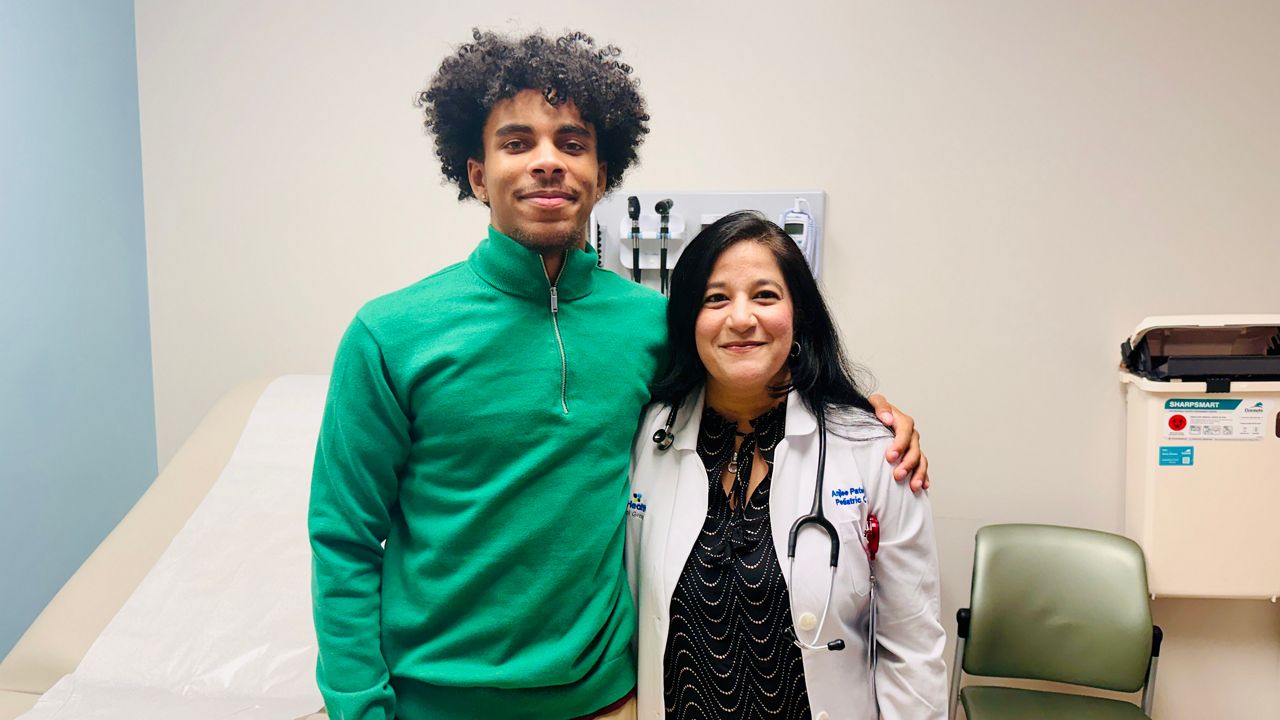
Jeremiyah Shepeard (left) and Dr. Anjlee Patel, a pediatric cardiologist at AdventHealth (right). (Spectrum News/Erin Murray)
It was enough to push him to go through with the procedure. A choice he didn’t take lightly, but a choice he at least had the chance to make.
A choice many Florida athletes did not get to make.
Antonio Hicks was a Citrus High School football player. His mom, Lakesha Harrison, visits his grave weekly in Citrus County and often wonders, “What he would be doing? How many kids he would have?”
Life events that will never come to pass for Antonio. Like Jeremiyah, Antonio loved sports.
“From wrestling, basketball, wrestling again… Pop Warner, everything, I mean soccer,” said Lakesha, pointing at different jerseys stitched into a blanket.
If it involved a ball, Antonio played it. Football was his favorite, and at practice on Sept. 28, 2021, that big defensive lineman went down.
“Coach Frank had called me and was like, ‘I just did CPR on Antonio,’” said Harrison. “And his voice, just his voice. I just took off out the door screaming.”
Antonio died on the field. His autopsy showed he had hypertrophic cardiomyopathy.
An ECG would have shown his condition.
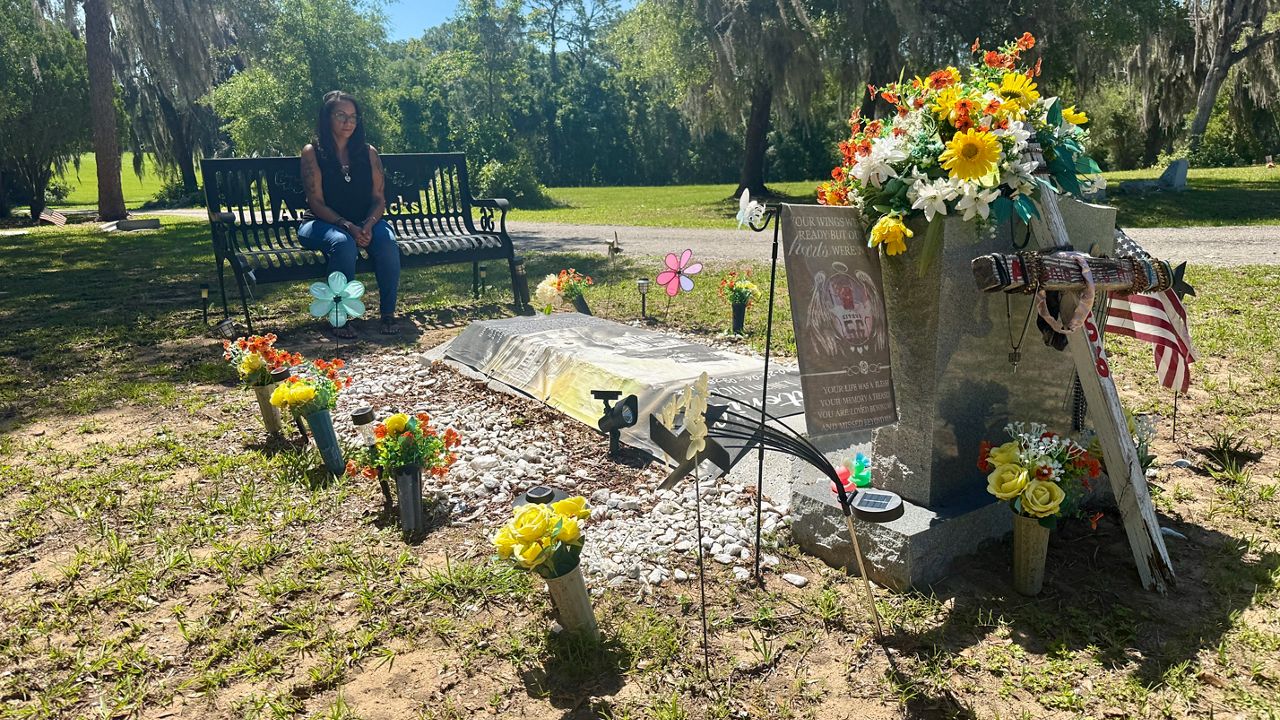
Lakesha Harrison, the mother of Antonio Hicks, sits at his gravesite. Antonio died from a heart issue in Citrus County a few years ago. (Spectrum News/Erin Murray)
Starting July 1, every Florida high school student athlete will have to undergo an ECG screening to play sports.
“It’s a test that looks at the electricity of the heart, but it also gives us information about the structure of the heart in the sense of thickening to the heart muscle, chamber enlargement, arrhythmias and things. So it really does give us a quite a bit of information at our fingertips,” said Patel.
Patel firmly believes these tests will save lives.
“I am so glad that this law was passed, and it will keep kids safer,” said Patel.
While it won’t bring back Antonio, Lakesha’s faith firmly assures her that her son’s life story will save others.
“There was a purpose. God has — had a plan. And he brought him home by his purpose, opened other eyes,” said Harrison.
Opened the eyes of lawmakers, school leaders, parents and coaches, the countless leaders who pushed to pass the Second Chance Act in 2025.
“His coach said to me something that I’ll never forget,” said Shyree, Jeremiyah’s mom. “He said, ‘This seems to happen a lot to kids.’ And I remember that at his school two years prior, there was an athlete, a football player that passed.”
Jeremiyah and his family help kids today sign up for ECG screenings now being held in every Florida county. They assist the organization Who We Play For.
Jeremiyah does this because he is thankful to be alive.
“I’m thankful for Dr. Patel. I’m thankful for even that game. I’m thankful for that. Like everything happened the way it did,” said Jeremiyah.
It has been just over a year since he collapsed and had open-heart surgery. Today he has been fully cleared to play basketball again.
AdventHealth said the cost of an ECG is $15 at their facilities. Who We Play For is hosting several events this summer for kids to get the screenings done.