
New laws passed this year in the Florida legislature address topics like A.I. data centers, foreign influence, pet sales and increasing penalties for sex offenders.
FLORIDA, USA — More than 100 laws passed in the 2026 Florida legislative session go into effect in Florida on July 1.
Lawmakers came together to pass legislation spanning several areas of focus, including criminal statutes, child welfare, the emergence of data centers and the renaming of several state roads.
Below are just some of the laws and their impacts.
Florida utility customers shouldn’t have to bear any additional costs brought by new large-scale AI data centers under SB 484.
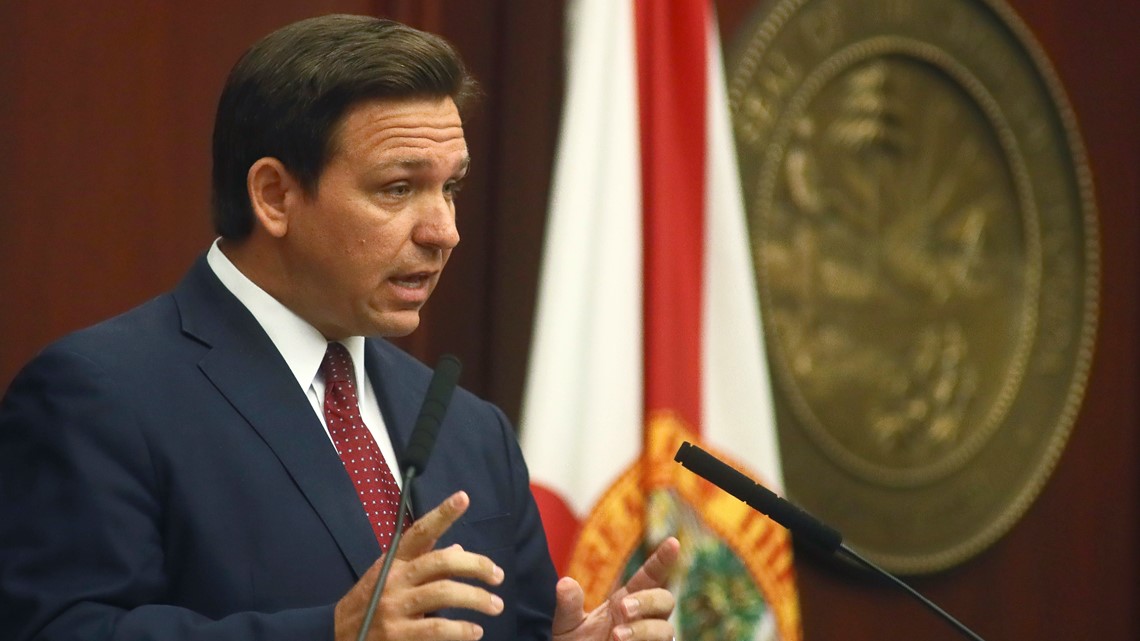
While it was not as strong on data centers as he hoped, Governor DeSantis called the law a “pretty strong first step.”
The data center bill requires the Florida Public Service Commission, which regulates electric utilities, to develop requirements to “reasonably ensure that each large load customer bears its own full cost of service and that such cost is not shifted to the general body of ratepayers.”
The measure also reinforces the right of local governments to refuse to allow the construction of data centers in their jurisdictions, something many have shown interest in. Several counties in Florida, including Clay and Nassau counties, approved one-year moratoriums on data center permitting, with some leaders expressing interest in an eventual ban.
Major concerns include their potential impacts on local power grids and water supplies due to increased demand and consumption.
However, the bill also allows city and county governments to enter into non-disclosure agreements with companies for up to 12 months, which would temporarily hide data center proposals from the public.
SB 52: Security Services at Places of Worship
This new law will allow volunteer security guards to carry guns inside places of worship, such as churches, synagogues and mosques. They will be exempted from Florida’s private security licensing requirements.
HB 919: Commercial Service Airports
The state will now have the ultimate authority to rename Florida’s major commercial service airports, preempting local governments.
HB 919 renames Palm Beach International Airport to “President Donald J. Trump International Airport,” subject to approval by the Federal Aviation Administration and the execution of an agreement between Palm Beach County and the trademark holder authorizing the commercial use of the name.
SB 628: Transportation Facility Designations
SB 628 allows for the honorary renaming of several roadways and signs to match.
Notably, one honors the sitting president. The entirety of State Road 80, running through Palm Beach County, Hendry County and Lee County, will be designated “President Donald J. Trump Highway.”
In Northeast Florida, the northbound off-ramp from U.S. 1 Alternate/Martin Luther King, Jr., Parkway to E. 21st Street in Duval County will be known as “Terry L. Fields Memorial Access” after the late Florida lawmaker, Jacksonville City Council member and educator.
A portion of U.S. 90 in Baker County between N. 3rd Street and the Nassau County line will also be designated as “State Representative/Circuit Judge Hon. John J. Crews, Jr., Memorial Highway.”
HB 445: Dangerous Crimes (Missy’s Law)
This new law expands Florida’s definition of a dangerous crime by adding violations of computer pornography and child exploitation to the state’s statutory definition.
The legislation will also require courts to immediately take a person into custody if they plead guilty or nolo contendere, or are found guilty of a dangerous crime. It further requires such individuals to remain in custody pending sentencing without the possibility of being released on bond.
Missy’s Law is named after Missy Mogle, a Florida girl who Governor Ron DeSantis said had a stepfather, Daniel Spencer, who had been convicted in a case involving an attempted sex crime against a 15-year-old, but was allowed to remain out on bail before sentencing in Leon County.
Between the time Spencer was on bail and the time he was sentenced, the governor said he murdered Missy.
HB 1159 expands criminal offenses related to child sexual abuse material and increases penalties for using a child or animal in a sexual performance and possessing or distributing abusive material.
The bill places mandatory minimum prison sentences for certain offenses committed by adults and creates a life felony for the aggravated exploitation of a child under the age of 12.
It also addresses emerging forms of exploitation involving generated content, like images made with A.I., showing fictitious people “who a reasonable person would regard as being a real person younger than 18 years of age, engaged in sexual conduct.” Generating or transmitting those images knowingly would be considered a felony.
SB 212: Sexual Offenders and Sexual Predators
This law revises residency restrictions for persons convicted of certain sexual offenses against children after July 1, adding that they may not live within 1000 feet of a public swimming pool.
Law enforcement officers are also authorized to conduct arrests of convicted sex offenders without a warrant if they have probable cause to believe the offender knowingly communicated with a minor at a prohibited location, such as a park, or knowingly visited an operating pre-k or K-12 school with students on the property.
SB 590: Statute of Limitations Period for Violations Involving Required Reports Concerning Children
SB 590 revises the statute of limitations for violations regarding required reports concerning children.
Under Florida law, a person must report any known instances of child abuse, abandonment and neglect, child sexual abuse and child death to the state’s central abuse hotline. Failure to do so is a third-degree felony in Florida and punishable by up to five years in prison.
This law provides that the statute of limitations timer for these violations only begins once law enforcement is made aware of the violation.
SB 418: Law Enforcement Officer Interactions with Individuals with Autism Spectrum Disorder
This bill requires the Department of Highway Safety and Motor Vehicles and the Criminal Justice Standards and Training Commission within the Department of Law Enforcement to establish programs to strengthen communication between law enforcement officers and people with autism spectrum disorder.
By January 1, 2027, the department will be required to offer a blue envelope and blue card program. The envelopes are intended to hold the person’s driver license, registration, proof of insurance and emergency contact information, as well as a blue card. The envelope and card can be provided to law enforcement to identify them as a person with autism and include communication guidelines to help with the interaction.
SB 428: Drowning Prevention
The age limit for free swimming lesson vouchers through the state program is rising from four to seven. According to state officials, the goal of the current program is to “increase water safety” by giving the vouchers to low-income families who make no more than 200 percent of the federal poverty level.
Hospitals, birth centers and home birth providers will be required to provide the families or caregivers of newborn babies with new educational materials on drowning prevention, developed by the Department of Health.
SB 1004: Domestic Animals
Under SB 1004, businesses that sell pets will be required to be more transparent with customers about the animal’s medical history and financing terms, with violations reportable under Florida’s Deceptive and Unfair Trade Practices Act.
All pet dealers will be required to provide veterinary records showing past examinations and treatments, and disclose the terms of any financing agreements before finalizing a sale.
If a pet is later found to have been sick or unfit for purchase at the time of sale, consumers will have more time to seek remedies, including reimbursement for certain necessary medical expenses.
The law also directs the state to establish a set of operational and animal care “best management practices” for dog breeders, which will be published online. While following the practices will be recommended, it will not be legally required.
RELATED: New Florida laws increase animal cruelty penalties, regulate pet sales
HB 89: Veterinary Prescription Disclosure
Before providing a prescription medication, a veterinarian or an authorized member of the veterinary staff must inform clients of the their right to receive a written prescription for the medication that can be filled at the pharmacy of the client’s choice, or, if the veterinarian clinic is able, the option to have the prescription filled there.
HB 277: Domestic Violence and Protective Injunctions
Enacts several changes to the penalty codes for perpetrators of domestic violence and extends protections to domestic violence victims. There are a number of key provisions in the law:
Repeat-offender penalty enhancement. If a person commits a domestic violence offense and already has a domestic violence conviction on their record, the new offense gets bumped up one degree on the penalty code. For example, a first-degree misdemeanor becomes a third-degree felony, a third-degree felony becomes second-degree, and so on. This also includes a first-degree felony becoming a life felony. This provision also expands the definition of “conviction” to include withheld adjudications or no-contest pleas.
Lower threshold for felony injunction violations. Instead of two prior domestic violence convictions turning a new domestic violence violation against the same victim into a third-degree felony, now it takes one prior conviction. This effectively makes a single violation of a protective injunction into a third-degree felony.
Military protective orders. Creates military protective orders which a commanding officer of a military unit can issue against one of their servicemembers. This provision lets judges weigh the existence of a MPO when deciding a civilian injunction.
Statewide verification system. FDLE now must enter dating and sexual violence injunctions into the statewide injunction verification database used by law enforcement to verify court orders and protective orders.
Relocation assistance. The one-time relocation payment for domestic violence victims rises from $1,500 to $2,500, and the lifetime cap from $3,000 to $5,000.
SB 436: Felony Battery
This bill adds felony battery on a law enforcement officer to the list of serious violent felonies covered under the prison releasee reoffender (PRR) statute. Under this statute, anyone who commits certain serious, violent felonies within three years of release from prison are, if convicted, stripped of sentencing guidelines and instead serve flat mandatory prison terms without the possibility of early release:
Life for a life felony30 years for a first-degree felony 15 years for a second-degree felonyfive years for a third-degree felony
In total, there are 19 crimes covered on the PRR list, including treason, murder, sexual battery, armed robbery, arson and kidnapping.
It also increases penalties for repeat violent offenders by allowing a second battery offense to be elevated to a felony if the offender has a prior conviction for resisting an officer with violence.
HB 35: Habitual Traffic Offender Designation (Isaiah’s Law)
This new law will add driving without a valid driver’s license to the list of offenses that can trigger habitual traffic offender status.
A person can be designated a habitual traffic offender if they are convicted three or more times within a five-year period for certain traffic offenses committed in separate incidents.
Before this law, qualifying offenses included:
Driving a vehicle while license is suspended or revoked.Driving under the influence (DUI).Leaving the scene of a crash involving injury or death.Driving a commercial vehicle while disqualified.
SB 984: Firefighter Cancer Benefits
This law requires that the families or beneficiaries of firefighters who die of cancer receive certain benefits from the firefighter’s employer up to one year after their employment ends.
SB 178: Athletics in Public K-12 Schools
This new law allows high school head coaches in Florida to use their own money to help student-athletes with certain basic needs such as food, transportation and recovery services, without violating Florida High School Athletic Association (FHSAA) rules.
Before a coach can provide assistance to a student-athlete, the student’s parent or guardian must provide written consent.
The law further limits the assistance to one head coach per athletic team, caps spending at $15,000 per team each year and requires coaches to report any use of personal funds to the FHSAA.
This new education law makes several changes across public and private schooling, including:
Public school students in grades 3–5 must receive cursive writing instruction (letter formation, spacing and alignment, writing complete sentences), and must demonstrate proficiency by the end of 5th grade.Subject to legislative appropriation, each public school must display portraits of George Washington and Abraham Lincoln in a conspicuous place. The Department of Education will select and distribute the portraits.Students not being dismissed from charter schools based on academic performance while the school is under a school improvement or corrective action planWhen a student’s scholarship account is closed (due to fraud, two years of inactivity, or a student being unenrolled for 30+ days), any remaining funds now revert to the scholarship organization rather than the state. Those funds must be used for new scholarships in the same fiscal year, with any leftovers carried forward and fully spent the following year.Private schools enrolling 150 or fewer students are now a permitted use in commercial and mixed-use zoning districts, without rezoning or obtaining a special exception or land use. They may also operate in existing assembly, day care, mercantile, or business occupancies as long as they meet applicable fire safety standards
The new law also establishes “The School Teacher Training and Mentoring Program” within the Department of Education. School districts and charter schools may place retired or current teachers as mentors in “D” or “F” graded schools. Mentors must have at least three years of teaching experience in K-12, earned a highly effective rating on their most recent performance evaluation and maintain the relationship with the mentee for one grading period. Mentors can earn a stipend of up to $3,000.
HB 1471: Systems of Law and Terrorist Organizations
This law authorizes the Department of State to dissolve corporations designated as terrorist organizations and creates criminal penalties for receiving terrorist training, providing material support to terrorist organizations, or knowingly participating in a domestic terrorist organization.
The law allows the Chief of Domestic Security to designate domestic and foreign terrorist organizations, subject to approval by the governor and their cabinet, and requires publication of approved designations.
Through the law, students who promote domestic or foreign terrorist organizations will be limited from receiving certain public education funds.
HB 905: Foreign Influence
This law establishes definitions for “designated foreign terrorist organization” and “foreign country of concern,” and imposes penalties on individuals who receive or seek anything of value from representatives of those organizations or countries.
The law also directs the Commission on Ethics to adopt implementing rules by a certain deadline and permits tax collectors to revoke or refuse to renew business tax receipts for individuals, businesses, or entities found in violation of the law.
In accordance with the law, the Florida-China Institute is removed from the state’s list of linkage institutes and the governor is granted authority, under specified conditions, to suspend certain laws or rules involving Cuba temporarily.
SB 340: Human Trafficking Education for Nurse Licensure
This law revises the requirements for registered nurses or practical nurses to gain their licenses to include a 2-hour course on human trafficking, allowing them to identify signs that their patients may be victims and in need of intervention. The requirement will take effect for licensure applicants on July 1, 2027.
SB 168: Public Nuisances
This law eliminates the cap on fines that may be imposed on establishments designated as public nuisances and updates the procedures for assessing and collecting those fines.
The law also expands the definition to include gambling houses among the types of properties that may be declared a public nuisance.
See all the bills and new laws
All bills, whether they passed or failed in the 2026 legislative session, can be viewed in their entirety online at flsenate.gov.
RELATED: Florida’s new student-athlete heart screening law takes effect July 1