
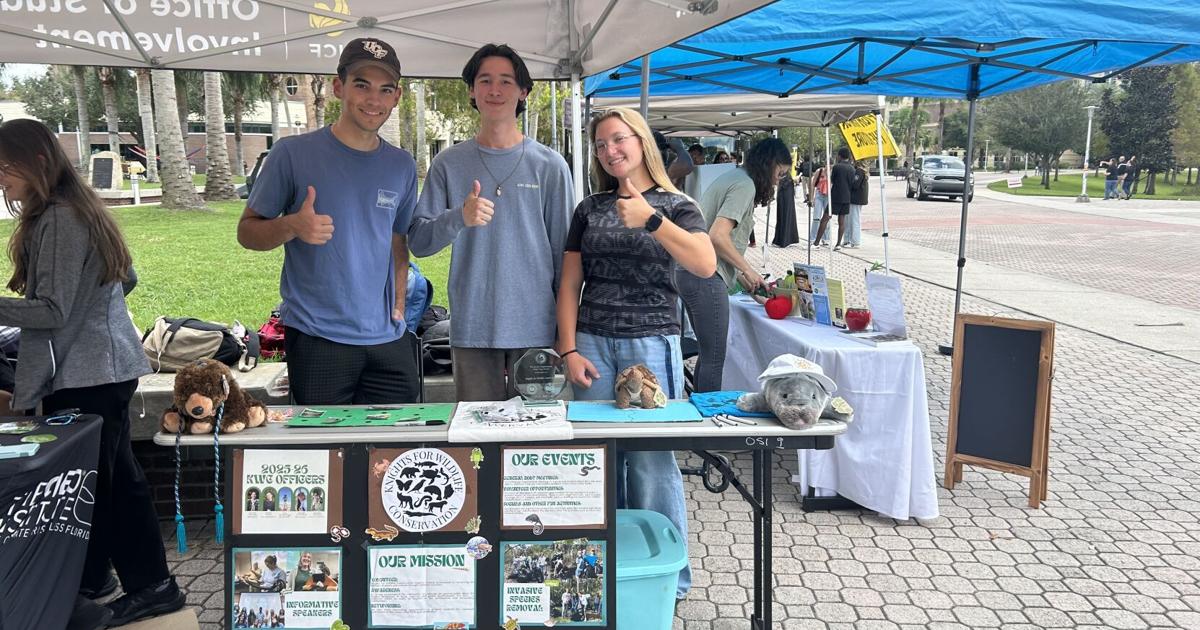

Brandon Marchese, junior biology major; Jackson Talmadge, junior biomedical science major and Kellen Mathis, senior biology major, explain native and invasive species in Florida while tabling with UCF Knights for Wildlife Conservation at Memory Mall on Tuesday.
McKenna Fiorino
An assortment of student clubs on campus gathered on Tuesday for a sustainability fair hosted by the Student Government beside Memory Mall, teaching students passing by about wildlife, from venomous snakes to foraging bees.
Ava Hendricks, Student Government sustainability, innovation, and wellness coordinator, organized what she called the “rebranded sustainability fair” named “Keep UCF Wild.”
“I think putting the ‘why’ in sustainability was the main goal with this,” Hendricks said. “Kind of like understanding what there is to lose and what we have to protect.”
The mascot for this semester’s sustainability fair was a raccoon. Tote bags and stickers were given out for free by the Student Government, which had the raccoon front and center. Hendricks said the tote bags ran out within the first hour of the event.
Some of the registered student organizations there, like Knights for Wildlife Conservation and the Herpetological Society, had their own mascots as well. KWC had stuffed animals of a bear, a manatee and a turtle on their table. The Herpetological Society had native venomous species listed on their table.
“We go to tabling events like this to try and teach people how to identify venomous snakes,” said Ava Dennison, president of the Herpetological Society. “That’s one of the big things that we focus on.”
Bees join members of UCF Arboretum Beekeepers while tabling at Memory Mall during Keep UCF Wild on Tuesday.
McKenna Fiorino
In order to educate students on beekeeping, another RSO, the UCF Arboretum Beekeepers, brought various tools with them, one of them being frames and a hive box. Some foraging bees smelled the box and were attracted to it, interrupting members while they were tabling.
Brianna McCaughey, senior environmental leadership major, moved the box behind the table, and the bees followed suit. The beekeepers were then able to keep tabling without any more interruptions.
“We’re letting people know that bees are chill and not harmful,” McCaughey said. “It’s just a live demonstration.”
The RSOs also came to inform people about various native wildlife and events they host.
UCF’s Botanical Society came to inform people about native plant life. The Arboretum’s Natural Resources team encouraged attendees to see native plant life on the campus walking trails, which are located by Lake Claire and across from Garage C.
“A lot of people we talk to just don’t know we have like 20 miles of trails on campus,” said Olivia Mehring, senior intern on the Natural Resources team.
The Entomological Society, Knighthawk and Marine Biology, Education and Awareness club weren’t able to attend Keep UCF Wild. Instead, Coalition for Steam Outreach, a marketing hub, represented them.
“My goal with tabling today is just to get people to join these clubs, scan the QR code, maybe learn something new, or find a club that maybe they didn’t know about,” said Landry Goodwin, member of the coalition and junior environmental major.
Many of the tables had various ways to keep people engaged. The Herpetological Society held a game where students could guess whether a snake was venomous or non-venomous. KWC made a game where students could fill in the blank Florida food web, and another where students could guess different native or invasive species.
“We try to showcase in any way that we can,” Dennison said. “Whether that be through our merch or through a little game.”
Even though the RSOs tabling were there to have fun and meet with students, the overall goal of “Keep UCF Wild” is education about wildlife, organizers said, changing the way people view wildlife on campus.
“Because we’re in such an urbanized environment, it gets really easy to forget that the raccoons in the breezeway, and the raccoons in the Cypress Dome, are not pests,” Hendricks said. “They are an important and integral part of this ecosystem.”