
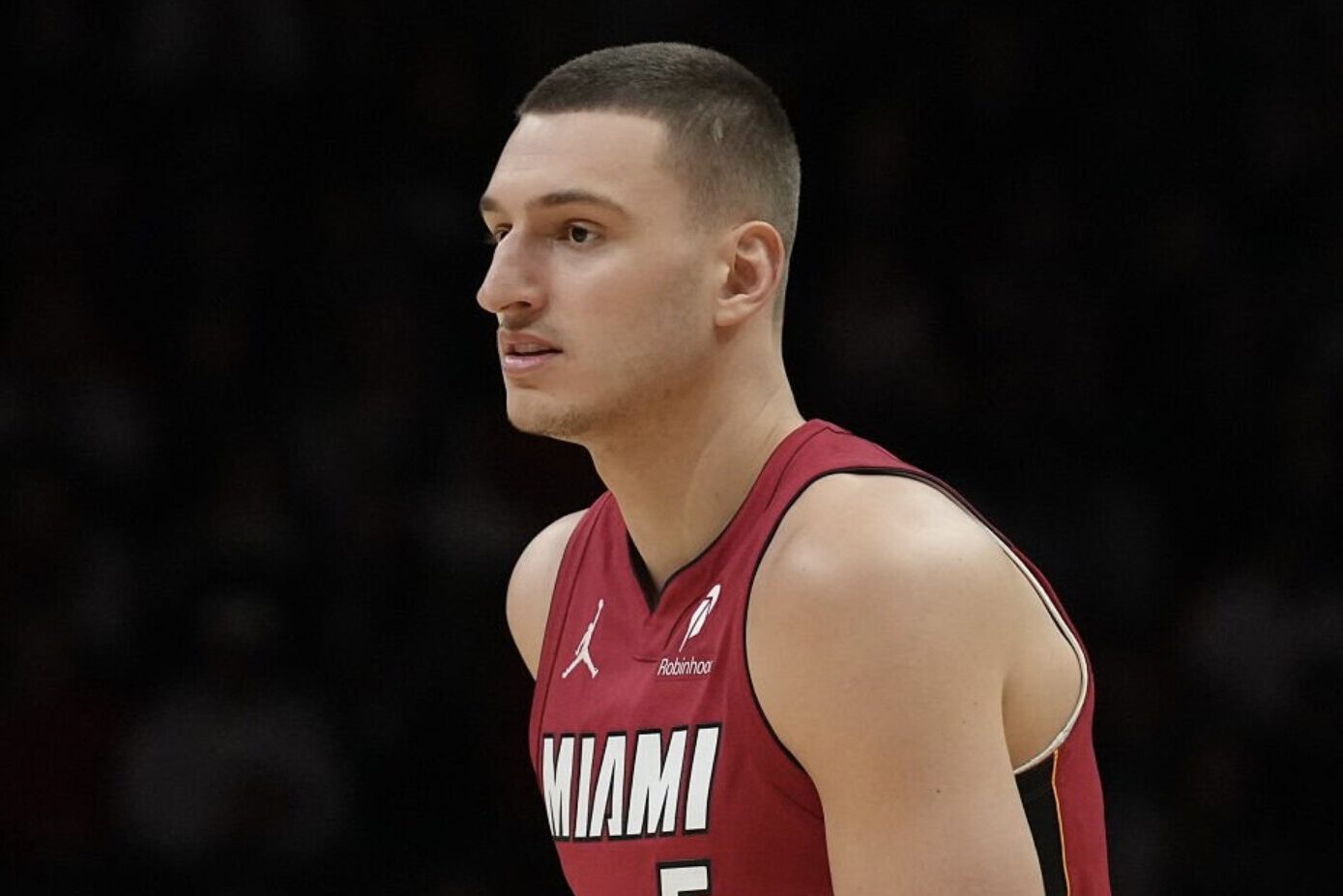
 (Mandatory Credit: Eric Espada/NBAE via Getty Images)
The Miami Heat’s first big roster move after acquiring Giannis Antetokounmpo came on Monday.
Hours before the option deadline, Andrew Wiggins exercised his $30.2 million player option, though he also tacked on two additional years for $34 million combined, with cap hits for $16.5M and $17.5M, respectively.
As it currently stands, the Heat have nine players rostered — excluding rookie Ryan Conwell, who’s expected to receive a standard contract in the coming days (or weeks) — and are $20.5 million below the first apron, where they are hard-capped. Thus, they are not privy to their full $15.0 mid-level exception, nor are they able to re-sign Norman Powell (unless he takes a massive pay cut), barring any other roster moves.
But one player could help create more flexibility.
How Nikola Jovic helps Heat create more flexibility:
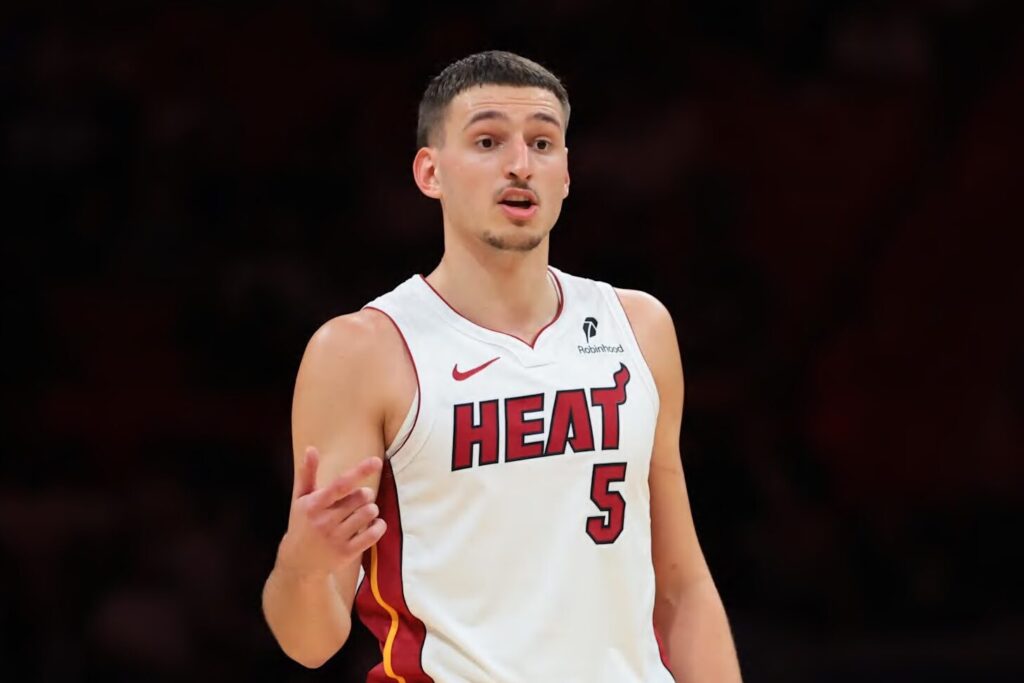 (Mandatory Credit: Sam Navarro-Imagn Images)
There’s no denying that Nikola Jovic had a disappointing season last year. Coming off his most impactful season as a pro in 2024-25, Jovic regressed, averaging 7.3 points and 3.3 rebounds on 36.6 percent shooting and 48.0 percent true shooting.
Jovic signed a four-year, $62 million extension last summer. He will be on the hook for $16.2 million this season, followed by $14.9, $15.1 and $16.2 million the next three seasons, respectively. He won’t exceed 9.8 percent of the salary cap in each of those four seasons, which, on the surface, is very reasonable for the recently turned 23-year-old.
However, Miami will need to either 1.) Offload Jovic or 2.) Find a new home for Bobby Portis, adding further complications to the Giannis Antetokounmpo trade, to re-sign Norman Powell or gain full access to the non-taxpayer mid-level exception. They could also hope that they acquire something of value in return in a Norman Powell sign-and-trade, assuming he signs with a team without cap space for more than the MLE.
The difficulty of trading Nikola Jovic right now:
How the Heat allocate their funds this summer is quite important.
On the surface, Norman Powell is quite replaceable — more than Wiggins. But the Heat also desperately needs shooting and shot creation. Powell, when healthy, is about as good an option as any realistic target on the open market.
There are pros and cons to every move. That same can be said about moving Jovic.
The pro is extra flexibility under the first apron. However, Miami essentially has nothing to attach to Jovic; they’re bereft of draft capital, owning just one second in 2027 (least favorable of MIA/OKC/SAS/HOU/IND) and own just one conditional first-round pick (2029) over the next seven years.
We aren’t privy to conversations in other front offices. But who is willingly taking on Jovic plus one second-round swap? And why wouldn’t said team try to take advantage of the Heat’s desperation to move off Jovic by potentially demanding, say, Myron Gardner or another low-cost player who would be useful in a different context?
Miami has an incredibly thin margin for error entering free agency. If the Heat decide to move off Jovic, my guess is that it will come when the dust settles around the NBA as free agents find new homes. But that will be much easier said than done with a limited amount of assets to attach to Jovic.
***
To check out our other content, click here.
Follow Hot Hot Hoops on Twitter/X here!
Follow Hot Hot Hoops on Instagram here!
Check out Hot Hot Hoops on Facebook here!
Subscribe to our YouTube channel here!