
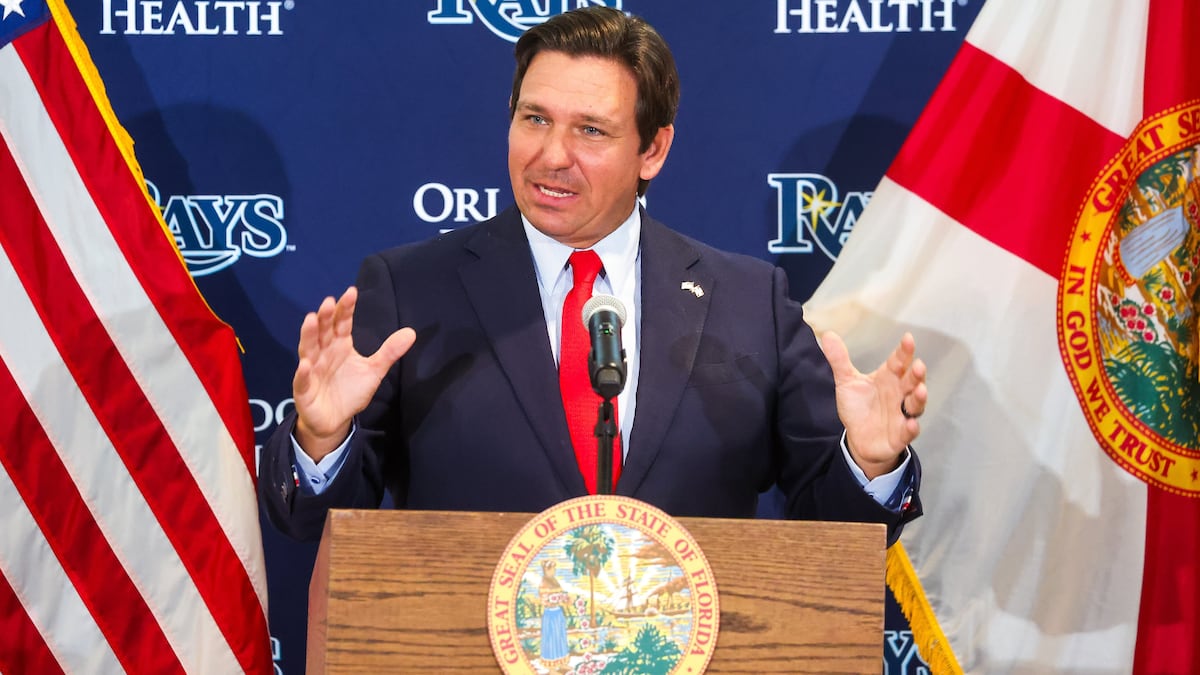
When Gov. Ron DeSantis signed the $117.6 billion state budget Monday in Tampa, he praised a spending plan that has shrunk every year of his second term — thanks, in part, to roughly $800million in line-item vetoes.
The cuts are not as significant as in previous years, DeSantis said, adding, “I’m not trying to set a veto record.” Still, they add up to hundreds of millions in local projects axed across the state.
The budget, which takes effect July 1, is the last DeSantis will sign as governor before he leaves office due to term limits in January. It comes after a year of heightened scrutiny on state and local government spending from DeSantis’ state Department of Governmental Efficiency task force.
So, how did Tampa Bay’s funding requests fare?
Cuts to water, education programs in Hillsborough
DeSantis’ veto pen cut millions in Hillsborough County requests — though less than in previous years.
Several water-related projects top the vetolist in Hillsborough, including a $2 million request to modernize county water meters. The upgrades would have improved billing accuracy, reduced meter-reading costs and enhanced outage detection capabilities, according to a funding request document.
The governor also cut $1.5 million slated for Tampa’s South Howard Avenue flood relief project, a city effort to alleviate flooding in parts of South Tampa that has long divided neighbors, business owners and city leaders.
A city of Tampa project to redesign intersections near a water treatment facility and Tampa Electric’s operational hub also lost $500,000 in state funding.
Some education programs took a hit, too.
The governor nixed a request for Hillsborough County’s school system to get $878,900 for a pilot program to track students’ grades, test scores, coursework and more. The program would have served more than 800 people, targeting at-risk youth, grade school and high school students, according to a funding request document.
Hillsborough College also lost out on$250,000 to expand its associate program in artificial intelligence. The money would have gone toward training, classroom resources and technology.
That veto came as DeSantis approved $50 million — what he called a “big chunk of money” — for the redevelopment of the college’s Dale Mabry campus, the site of the proposed Tampa Bay Rays baseball stadium.
The Children’s Network of Hillsborough was denied $800,000 to launch a program for children who have experienced commercial sexual exploitation. The program, called CHANCE, would have provided therapy, mentoring and other services for up to20 kids annually.
The governor denied a $675,000 request to establish a memorial for Hillsborough County firefighters who have died in the line of duty. He also cut a $320,000 request to update exhibits at the Tampa Firefighters Museum. And he axed a $260,000 request from Hillsborough County Fire Rescue for drainage improvements.
Still, DeSantis approved a range of big-ticket projects in the county,including a $10 million training center for the Sheriff’s Office. He also OK’d more than $4.8 million for the county’s African American Arts and Cultural Center and approved money for a number of arts organizations that faced cuts in years past.
Pinellas County arts funding spared
As in Hillsborough, DeSantis was kinder to the arts, museums and cultural programs in Pinellas County this year.
The Florida Orchestra, primarily housed inside the Mahaffey Theater, is getting $500,000 from the state to plan for a permanent home. The St. Petersburg Arts Alliance is getting $90,000, and the Museum of Fine Arts of St. Petersburg is getting $150,000.
The revival of the Pinellas Science Center, taking shape after the St. Pete City Council urged Mayor Ken Welch to reconsider the project four years in the making, gets $350,000.
DeSantis approved $2 million for storm damage improvements along Denver Street in the Shore Acres neighborhood, considered ground zero for devastating flooding from Hurricane Helene in 2024. Projects include installing a new pump system and expanding capacity to reduce the risk of surface water flooding.
But he vetoed $500,000 for storm drainage improvements in the Childs Park neighborhood. That funding would have gone toward upgrading the system that strains sediment and debris out of stormwater runoff.
The governor cut a $750,000 line item for a shoreline protection and water quality program from Tampa Bay Watch, as well as a $350,000 request for a new K-9 training facility for the St. Petersburg Police Department.
DeSantis also vetoed $2 million to harden the Lealman ExchangeCommunity Center with a backup generator and independent water and sewer capability. The facility seeks to serve as a backup for schools serving as storm shelters.
He also turned down $1 million to elevate a stretch of South Bayshore Boulevard and theadjacent bike and pedestrian trail from Gulf to Bay in Clearwater to Safety Harbor to keep it safe from flooding. Largo lost out on $600,000 to reduce flood risk to homes by replacing concrete pipes with larger ones.
Pasco County gets millions for transportation
DeSantis vetoed $1 million for a science, technology, engineering and mathematics career pathways program for at-risk children in Pasco County Schools and $800,000 for building 2.6 miles of sidewalks along Shady Hills Road.
He also vetoed $910,000 to install high service pumps and reduce water loss from storage tanks in New Port Richey. Other than that, DeSantis appears to have spared many funding requests approved for Pasco County.
The county will receive millions for transportation projects, Saint Leo University and Pasco-Hernando State College.