
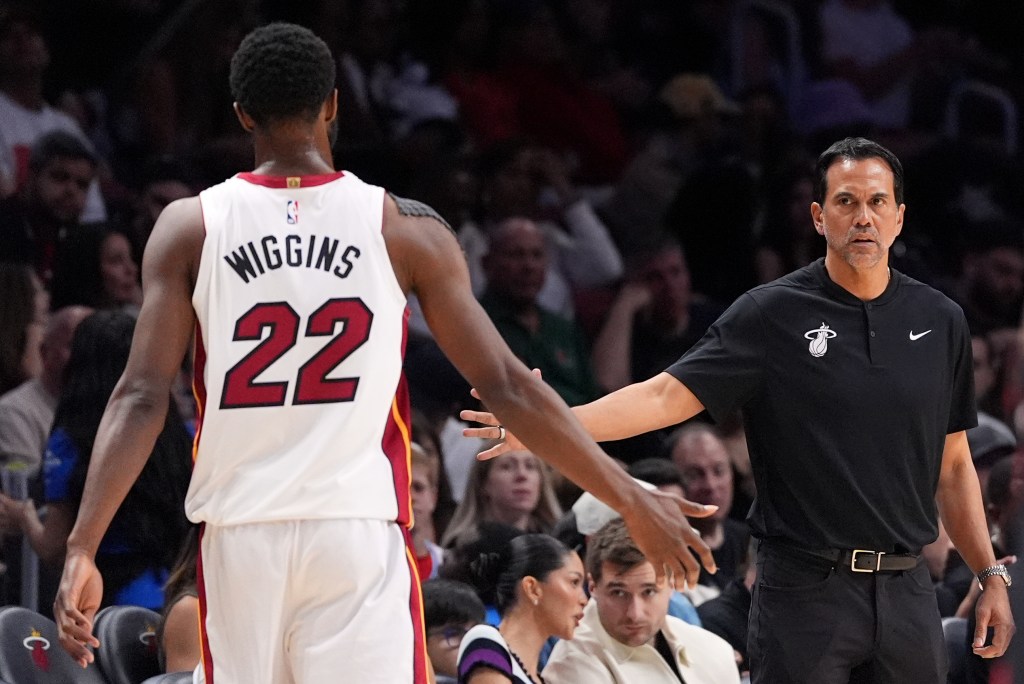
MIAMI — The initial reaction to Andrew Wiggins’ opt-in-and-extend decision with the Miami Heat was confusion about both sides of the equation.
Why such a limited overall package for Wiggins, with the three-year, $64 million agreement?
Why no immediate cap/tax/apron relief for the Heat for this coming season?
But stepping back, the reasoning by both sides comes into view.
The difference between this three-year $64 million package that starts with Wiggins’ $30.2 million 2026-27 option year and a three-year, $64 million package that would have started at a Heat-favorable $19.8 million is an extra $5 million for Wiggins over the package’s first two seasons. Beyond those two seasons, Wiggins then can opt out of the third year, almost assuredly still to be able to earn more than the $17.5 million on the third year of this new deal.
That’s why for Wiggins.
More money now.
And potentially even more money down the road than with the lower starting salary.
For the Heat, yes, an extra $10 million in 2026-27 cap space before their hard cap at the first luxury-tax apron certainly could have come in handy at Tuesday night’s start of NBA free agency.
But also consider that with the trade for Giannis Antetokounmpo, the Heat unavoidably will be in the luxury tax this coming season. That would have been the case regardless of Wiggins’ approach with his contract.
But now, with Wiggins taking his salary down to $16.5 million in 2027-28 and then to $17.5 in 2028-29 (if he does not opt out), there becomes wiggle room going forward beyond the extremely constraining limitations of the NBA’s highly punitive repeater tax.
In that regard, the Heat’s creativity with the extension element with Wiggins eases several factors a year from now.
Davion Mitchell: Mitchell’s team-friendly two-year $24 million contract expires after this coming season. That means a potentially higher starting point to a new deal during the 2027 offseason.
Even a move up to mid-level territory would mean a raise for Mitchell in his next contract.
Pelle Larsson: With several options going forward with the emerging 2024 second-round pick, the Heat opted for the cheapest current alternative in picking up Larsson’s $2.3 million team option for the coming season.
All the while, Larson remains eligible for a $92.8 million extension that would kick in starting in 2027-28, or he can enter free agency next summer. Either approach would lead to an exponential increase in salary.
Mid-level exception: While limited to the degree they could utilize their mid-level exception for the coming season, the Heat should be positioned a year from now to utilize the entire such exception.
Such a contract would also lead to a sizable jump in the overall payroll.
First-round pick: While the worst of all worlds in Antetokounmpo’s first season would be to wind up with a first-round pick next June, the reality is the Heat likely will be adding a first-round salary in one of the next two drafts, something that was not the case this year.
The Heat’s 2027 first-round pick goes to the Charlotte Hornets if it is not among the first 14 selections. It otherwise goes to the Hornets unprotected in 2028.
While the Heat have been willing to pay into the tax when necessary, such as their $4.2 million payment in 2024-25 and their $15.3 payment in 2023-24, the rules of the repeater tax also require a degree of fiscal gymnastics.
With the Antetokounmpo deal coming together so close to the 2026-27 cap calendar, certain constraints could not be avoided — at least at the moment of truth, when the trade was agreed to in principle — including the 2026-27 hard cap and an inability without a follow-up move to utilize the full mid-level exception.
But with the design of the Wiggins’ reworked contract, it provides a key contributor with the salary that already was in place for 2026-27, while giving the Heat far greater latitude for cap maneuvering next summer.
There now not only is a plan in place to sate Wiggins this coming season, but at least a two-year plan to follow that includes the ability to grow with Antetokounmpo as a cornerstone.
Number switch
Mitchell has changed his number from No. 45 to No. 2 next season in honor of a friend whom he grew up with in southeast Georgia.
“I changed to No. 2 in honor of my young bull, Spud, who passed away,” Mitchell said. “We both came from the 912, and he will always be a part of who I am. Wearing this number is my way of keeping his memory close and carrying a piece of him with me every time I step on the court.”