
Explosives don’t discriminate between produce and fingers.
At a fireworks safety demonstration ahead of the nation’s 250th birthday, Fort Lauderdale first responders added a fake gel-molded hand to the mix of cantaloupes and watermelons they detonated to show how an accident could affect a real body.
“Our goal today is simple,” Fort Lauderdale Fire Rescue Battalion Chief Christopher Davis-Partridge said at a news conference on Tuesday. “We want to prevent injuries before they happen and make sure everybody gets home safely after celebrating our nation’s birthday.”
Nearly 15,000 people were treated in emergency departments for firework-related injuries last year in the U.S., a 52% increase from the previous year. Hand and finger wounds accounted for 36%, and 15 people died.
Fort Lauderdale Fire Rescue logged only one firework-related incident last year, which was a small roof fire sparked by a stray firework landing on a home.
“Fortunately, nobody was injured, but that’s just a demonstration of how it only takes one firework landing in the wrong place to create an emergency or catastrophe for somebody,” Davis-Partridge said.
Broward Health, however, wasn’t as lucky — its doctors describe the Fourth of July as one of the busiest times of year in the ER.
“We typically see an increase in visits due to firework injuries, sparkler injuries, dehydration and heat-related injuries,” said Jose Lozada, a Broward Health trauma surgeon, who attended Tuesday’s safety demonstration with Fort Lauderdale Fire Rescue and Fort Lauderdale Police Department.
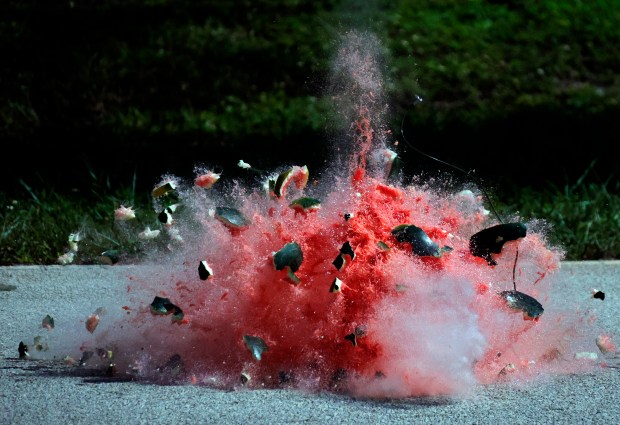 A watermelon is blown apart during a Fort Lauderdale Fire Rescue fireworks safety demonstration on Tuesday at the Fort Lauderdale Executive Airport Fire Station. (Joe Cavaretta/South Florida Sun Sentinel)
Lozada said the most common firework-related injuries Broward Health sees across its four hospitals are burns to the hands, the face, the ears and the eyes. Other injuries include hearing damage from loud explosions and amputations. Above all though, mangled hands are the hospital’s most common injury on Independence Day, he told the South Florida Sun Sentinel.
A common misconception is that sparklers are safer than fireworks.
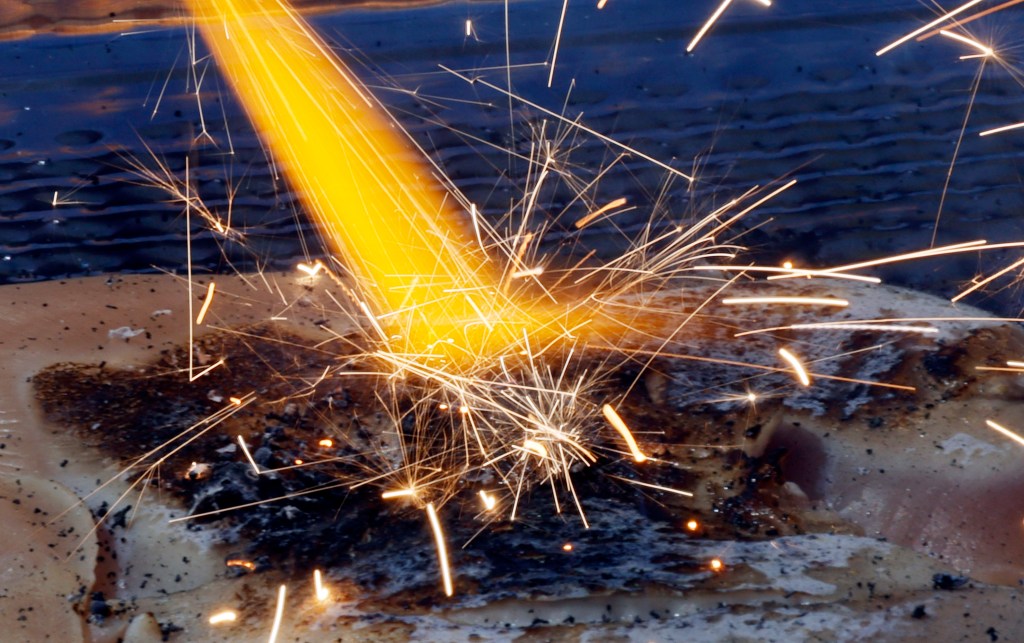
“Many people view them [sparklers] as harmless, but sparklers can burn at temperatures approaching 2,000 degrees Fahrenheit,” Davis-Partridge said.
The Fort Lauderdale Police Department Bomb Squad showed just how quickly sparklers can cause serious burns using a chicken breast — which like human skin, has muscle, tendon and a layer of skin — to simulate the damage.
“The smallest fireworks can cause severe burns,” said Lozada, adding that last year, of the people who sought emergency care due to firework-related injuries, 38% were burns.
In the case of a minor burn, he recommends cooling the area under cold running water immediately after the incident for at least 20 minutes, then placing a clean and dry cloth on it. But if the burn is around the eyes, nose, ears, toes or fingers, regardless of the size, he urges families to seek medical care.
If someone loses a finger or another extremity, Lozada advised covering the area with clean, moist gauze and placing the missing part in a sterile, ice-packed plastic bag until an ambulance arrives.
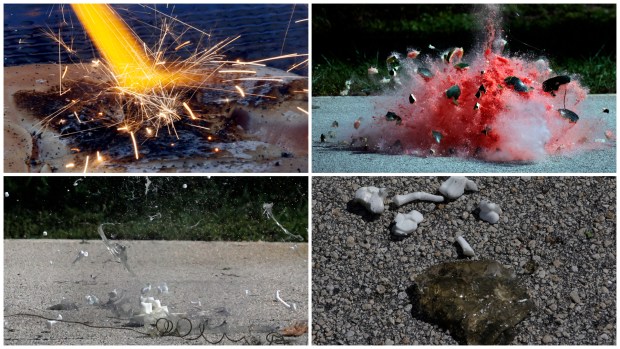 This combination of photos shows a chicken breast used to demonstrate how sparklers can burn skin, top left; a watermelon blown apart during a fireworks safety demonstration, top right; a model of a human hand blown apart, bottom left; and the remains of the model hand, bottom right, during a Fort Lauderdale Fire Rescue presentation Tuesday at the Fort Lauderdale Executive Airport Fire Station. (Joe Cavaretta/South Florida Sun Sentinel)
It’s not just fireworks first responders are worried about. Police Sgt. Pat O’Brien stressed another point: Don’t fire guns.
“Every year across the country, some people choose to celebrate the holiday by firing guns into the air,” he said. “This is not only illegal, but it’s extremely dangerous. You must always remember what goes up, must come down.”
He said every bullet fired into the air eventually returns to the ground with enough force to seriously injure — even kill — someone.
“Those bullets don’t disappear, they can strike children playing outside, families gathered at cookouts, neighbors watching fireworks or someone simply walking to their car,” he added.
Violators, he warned, risk arrest and prosecution.
This year’s celebrations could be especially intense. With the Fourth of July marking the nation’s 250th birthday and the World Cup playoffs, Lozada expects more people celebrating, and with that, the potential for more injuries.
“It’s just a mixture of a lot of reasons to be celebrating, and that’s great… but at the same time there can be some bad decisions that are made in the brief moment that have long-term or lifelong consequences,” he said.
Ultimately, according to Davis-Partridge, the safest way to enjoy fireworks is to attend a professional display.