
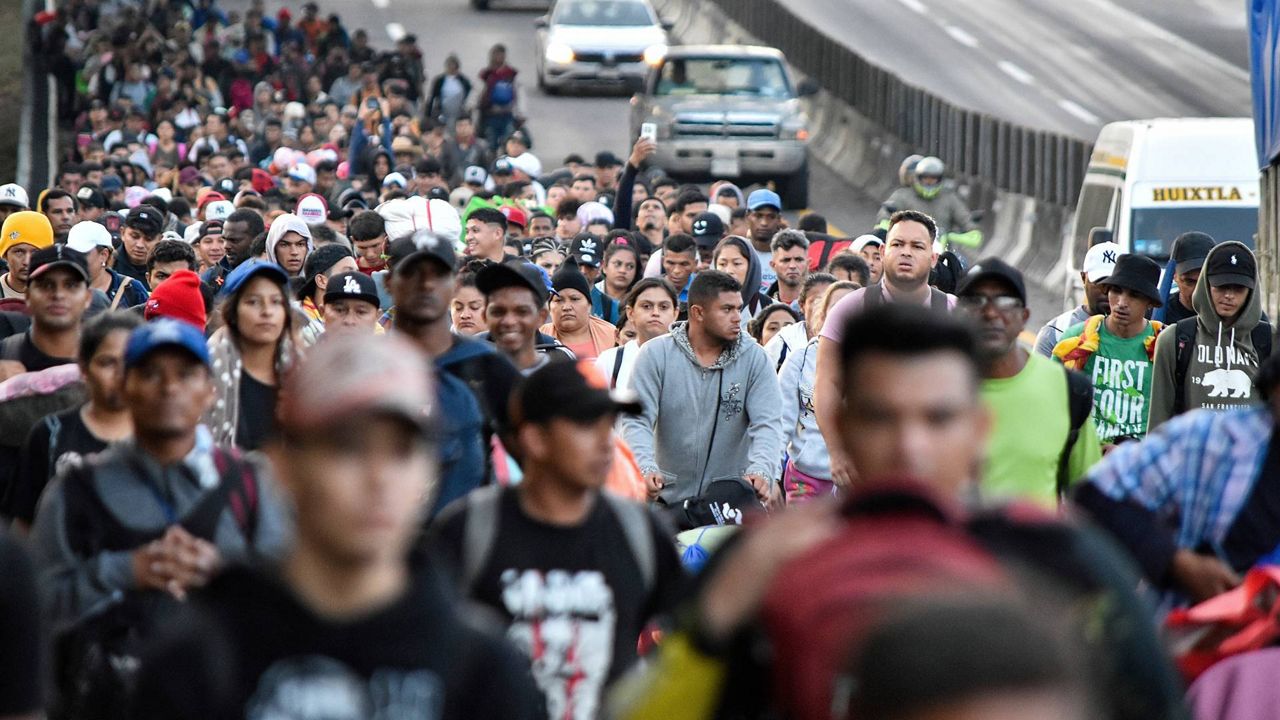
The Florida State Board of Education adopted a new rule that bans undocumented immigrants from attending state public colleges, and the U.S. Supreme Court makes a ruling on birthright citizenship.

Florida bans undocumented immigrants from public colleges
Soon, Florida will no longer allow undocumented students to attend public colleges.
The State Board of Education adopted the new rule Tuesday, among others, as part of Gov. Ron DeSantis’ broader illegal immigration crackdown.
As with any immigration debate, there are two very different views on this change.
Supporters say these publicly funded institutions should prioritize Floridians first, plus those here lawfully.
Meanwhile, critics say this rule could very well backfire and drive talent away from Florida.
Under this new rule, Florida’s 28 public colleges must verify an incoming student’s U.S. citizenship or otherwise ensure they’re lawfully present prior to admission.
“You know, if you’re here illegally, you know, you go to go to a state university, it doesn’t make sense. I would rather have that spot go to a Florida resident,” DeSantis said.
In addition, the same now applies to most general education programs, like second language classes or a course for GED prep. The changes are among the most notable since Florida eliminated in-state tuition for undocumented immigrants.
“They’re getting less than what like a U.S. citizen in Georgia is getting, someone that lives in south Georgia. It just doesn’t make sense at all,” DeSantis said.
According to the American Immigration Council, Florida is home to roughly 49,000 undocumented students in all of higher education
State Rep. Anna Eskamani is among the new rule’s biggest critics.
“These are some of our best and brightest kiddos that contribute to our public school system. They’re academically strong. They are engaged with our extracurricular activities, and they just want to be a kid,” she said.
This rule change currently applies only to Florida public colleges. Similar rules are under consideration that would apply to public universities.
More than two months after hearing oral arguments, the Supreme Court ruled Tuesday that President Donald Trump’s executive order restricting birthright citizenship is unconstitutional.
In a 6-3 opinion, the court ruled Trump’s order to deny automatic citizenship for the children of undocumented immigrants and temporary foreign visitors born on U.S. soil violates the 14th Amendment. The president signed the directive on his Inauguration Day in 2025.
“Citizenship, then and now, was the right to have rights — to freely participate in our political community,” Chief Justice John Roberts wrote for the court. “The Framers of the Fourteenth Amendment extended that promise to ‘every free-born person in this land. We keep that promise today.”
Roberts was joined by conservative Justices Amy Coney Barrett and Brett Kavanaugh as well as liberal Justices Ketanji Brown Jackson, Elena Kagan and Sonia Sotomayor in rejecting Trump’s executive order, although Kavanaugh said his decision was based on federal law, not the Constitution.
Roberts cited the 1898 landmark decision in United States v. Wong Kim Ark, which recognized the amendment granted citizenship to the children of foreign nationals.
“Not surprisingly, then, in the 128 years since, we have repeatedly understood the rule of Wong Kim Ark to guarantee citizenship to all children born in the United States and subject to its power,” Roberts said. “We see no reason to depart from that view today.”
Conservative Justices Samuel Alito, Neil Gorsuch and Clarence Thomas dissented.
Thomas wrote in his dissenting opinion that the citizenship clause was never intended for the children of foreign temporary visitors.
The “Court adds to the sad history of the Fourteenth Amendment, which was designed and understood to secure equal rights for the freed blacks but has instead been repurposed for political projects that the Reconstruction Congress did not support,” Thomas wrote.
Trump responded on social media by calling on Congress to pass legislation.
“The Supreme Court upheld Birthright Citizenship, which is too bad for our Country, but we can easily make it up in Congress through Legislation, with the support of the President, that has now been determined during this process,” he wrote on Truth Social. “No long and unwieldy Constitutional Amendment is necessary! Congress should start TODAY to work on ending expensive and unfair to our Country, Birthright Citizenship.”